

Table of Content
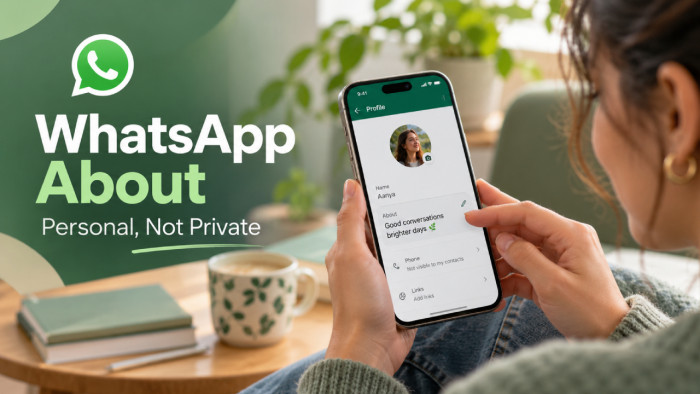
I've scrolled past hundreds of these without ever stopping to think about them, and I'd guess you have too. Your WhatsApp About is one short line sitting quietly under your name. Your best friend sees it. So does the plumber you saved last week. Most people either leave the default untouched or drop a passing mood into it and forget it's even there.
That's a quiet waste. Done well, this line tells people something true about you without handing over anything you'd rather keep to yourself. The whole skill comes down to one distinction: sounding personal and actually exposing yourself are not the same thing. Once you can see the gap between them, writing a good About gets a lot easier.
The One Line Everyone Ignores
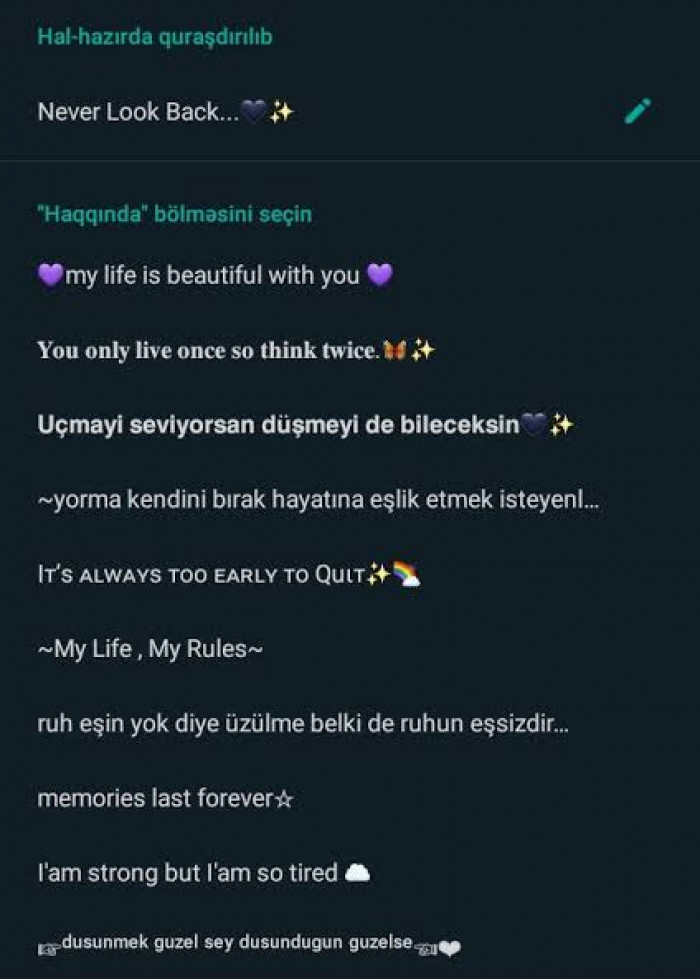
Scroll through your own contact list and read the Abouts properly for once. Almost all of them fall into two camps: the factory default ("Hey there! I am using WhatsApp"), or a raw feeling someone typed on a rough day and never came back to fix. Neither tells you anything real about the person behind the name.
That's a strange thing to waste, because this is free real estate. It's a line tied to your name that stays visible until you decide to change it. It isn't buried in some profile nobody opens; it sits right there every time a person opens your chat or taps to check your details. The space is small, but it gets seen far more often than you'd think, which is exactly why it's worth a few minutes of real thought.
Personal Is Not the Same as Private
This is the idea the entire article rests on, so it's worth slowing down for. Personal means the line feels specifically like you: your taste, your sense of humour, a stance you genuinely hold. Private means it reveals something tender or situational, the kind of thing you'd normally share only with people you trust.
People confuse the two constantly. They assume "be personal" has to mean "share something vulnerable," so they either overshare or, nervous about doing that, write nothing at all and fall back on the default. The truth is you can score high on personal and close to zero on private in the very same line. That combination is the whole target, and nearly every technique below is just another way of hitting it.
Personal, not private: Still think filter coffee beats everything. Private, not really personal: Trying to hold it together this month. |
Who's Actually Reading It
Here's the constraint that quietly shapes every choice you make. The same line is read by the people closest to you and the people who barely know you. Your partner reads it. So does your accountant, your child's teacher, and the delivery rider you saved just once. You don't get to show a warm version to friends and a guarded one to everybody else. It's a single line for all of them at the same time.
So the real test for anything you write isn't "would my close friends understand this?" It's "am I comfortable with a near-stranger reading this?" If a line only makes sense, or only feels safe, inside your inner circle, it doesn't belong in a field the whole list can see. Write for the widest set of eyes on your contacts, not the warmest few, and you'll almost never get it wrong.
Why “Permanent” Changes Everything
WhatsApp gives you two separate places to say something, and people mix them up all the time. A Status disappears on its own after 24 hours, making it more suitable for temporary updates, changing moods, and everyday moments. Planning WhatsApp Status updates separately from your About helps keep those passing thoughts out of a more lasting profile description. Your About stays as written until you replace it yourself, so the distinction should guide what goes where.
A feeling belongs in a Status, because feelings pass. Put one in your About and you freeze a passing moment into a permanent public label. "Exhausted" or "heartbroken" stops being how you felt on a Tuesday and becomes the thing strangers read about you for months afterward. A simple rule of thumb: if a line is tied to a specific day, mood, or event, it's a Status, not an About.
Moods are weather. Your About is architecture.
Where Personal Tips Into Oversharing
The boundary between personal and oversharing is easier to feel than to define, so here are the clearest warning signs that a line has slipped over it. Treat any single one of them as reason enough to rewrite. A line is oversharing when:
• It names a feeling that's still in motion. Pain, anger, or longing you're currently sitting in reads very differently from something you've already processed and moved past. The first is raw; the second is just honest.
• It needs backstory to make sense. If a reader is left wondering "wait, what happened?", you've posted a cliffhanger about your private life, and that almost always reads as quietly fishing for concern.
• It sounds aimed at one specific person. A line that's clearly a message to someone in particular turns everyone else on your list into an audience for a conversation they were never part of.
• It would prompt a “you okay?” text. If the honest reaction from a half-stranger is worry rather than interest, the line is doing emotional work it has no business doing in a field this public.
Clear all four and you're almost certainly on the safe side of the line, no matter how personal or specific the line feels.
The Three Registers
Strong Abouts almost always sit in one of three modes. Knowing which one you're writing in keeps the line focused and stops it turning into a muddle of all three at once.
| Register | What it does | Example line |
| Functional | States what you do or what you're around for | Designer. Fastest replies before noon. |
| Expressive | Puts a value, taste, or worldview into a few words | Happiest where the coffee is strong. |
| Playful | Dry wit or a light, disarming line | Professional overthinker, amateur everything else. |
As a rough guide: functional fits a list that's heavy on work and clients, playful suits a list that's mostly friends, and expressive works for almost everyone in between. The common mistake is reaching for all three at once, trying to be useful, deep, and funny in a single breath. Pick the register that matches your list and commit to it. One note played clearly will always beat three played over each other.
Ingredients That Travel Well
Some kinds of content stay personal without ever exposing you. They tell people who you are while giving away nothing you'd later regret. When you're stuck for what to write, reach for these first:
• A value you quietly hold. A small principle you actually live by says a great deal about your character and nothing at all about your circumstances, which is exactly the trade you want.
• A specific taste. A food, a place, a kind of music, a daily habit. Concrete, harmless, and far more "you" than any sweeping adjective could ever manage.
• Light self-aware humour. A line that gently pokes fun at yourself reads as warm and quietly confident, and, crucially, it can't be used against you by anyone reading it.
• One small, telling detail. A craft you practise, a city you love, a thing you're always doing. It gives people some texture to hold onto without ever becoming a confession.
Ingredients to Keep Out
The opposite list matters just as much, because these are the lines that feel personal in the moment but quietly cost you later. They either expose you, age badly, or manage both at once.
• Feelings in flux. Anything about how you happen to be coping right now is a Status at best. On a permanent public field, it mostly just works as a worry magnet.
• Relationship signals. Hints about a breakup, a new crush, or trouble at home quietly turn your About into a running soap opera for your entire contact list.
• Health and hardship. Real and important, but not something for a line that every saved number can read. Share it with the people you choose to tell, not with everyone by default.
• Location or routine. "Gym at 6, office by 9" quietly hands strangers a map of where you are and when. Keep your daily movements off a line anyone can see.
• Cryptic subtweets. A vague, loaded line aimed at one person reads as pure drama to everyone else, and as something petty to the one person who actually understands it.
Saying More With Less
The field is tight on space, and that limit is a gift rather than a restriction. Following practical bio writing rules can help keep the wording clear, personal, and appropriate for the platform. A short character limit forces you to cut unnecessary words and keep only those that genuinely earn their place. Three habits do most of the heavy lifting.
Choose specifics over sentiment. "I love adventure" says nothing, because everyone says it. "Happiest on a train with no fixed stop" carries the same idea but sounds like a real person wrote it. As a rule, a concrete noun will beat a warm adjective almost every time.
Imply instead of announce. You rarely need to state the feeling outright, because the right detail carries it for you. A reader fills in the warmth on their own, and does it more willingly than if you'd spelled it out.
Lead with your most interesting word. People read these lines in about half a second while scanning a chat, so a flat opening gets skipped entirely. Put the vivid, specific word near the front, where it actually registers before attention moves on.
Matching the Line to the Room
The rules themselves never change, but your safe zone does, and it depends entirely on who's actually sitting in your contacts. A freelancer whose list is mostly clients is really writing a tiny professional tagline, so a functional or lightly expressive line serves them best and keeps things credible.
Someone whose list is mostly friends has far more room to be playful, odd, or pointedly specific. Before you write a single word, picture the three or four types of people who'll read the line most often. Then write the version that works for every one of them, rather than the one that only really lands with your favourites. A good line is safe for the whole room and still unmistakably yours.
Before and After
Most weak Abouts aren't beyond saving. They just need the exposing part swapped out for a telling one, while the personality stays fully intact. Here's that exact move, shown in practice:
| Weak or oversharing | Reworked | What changed |
| Hey there! I am using WhatsApp | Always mid-book, usually behind on replies | Default swapped for a real, light detail |
| Done with people fr | Low on patience, high on chai | Drama turned into dry humour |
| Missing someone today | Collector of long walks and old songs | A passing mood traded for lasting texture |
| Living my best life ✨ | Chasing good coffee and bad weather | A cliché made specific and personal |
| Available 24/7 for work | Designer. Replies fastest before noon. | Needy availability turned into a clear signal |
The pattern underneath every fix is the same: keep the personality, remove the exposure. Not one of the reworked lines tells you anything you could use against the person, and yet every single one of them sounds like a real human being wrote it.
When to Change It
An About isn't a set-and-forget field, even though most people treat it like one. It goes stale quietly, and a stale line can end up saying more about you than you ever intended. It's time for a rewrite when the line points at something that's now over, when you cringe a little on reading it back, or when it has sat untouched so long that it describes a version of you from years ago.
The fix is to treat it as a small, seasonal habit. Glance at it every few months and ask one question: does this still fit who I am right now? A line that felt perfect last year can read as oddly out of step today, and you're almost always the last person to notice the gap.
The Final Read-Through
Before you hit save, run the line past four quick questions. If it clears all four, it's ready to go up:
• Does it need backstory? If a stranger would be left asking "what happened?", rewrite it until it stands on its own.
• Would I mind a near-stranger seeing it? If the thought of a client or acquaintance reading it makes you wince, it's too private for this particular field.
• Is it a mood or a signal? A mood belongs in a Status; only a signal about who you are belongs here.
• Does it actually sound like me? If the line could belong to just about anyone, push it until it could only belong to you.
The Verdict
After reading enough of these, you start to notice how rare a genuinely good one is, and how quickly you warm to a person when their line is specific and a little bit human. That's really the whole payoff. A good WhatsApp About does one quiet job: it lets people feel like they know you a little, without you having told them anything you'd want back.
So keep it concrete, keep it current, and write it for everyone on your list rather than the handful closest to you. Personal is the texture: your taste, your humour, your small specifics. Private is the exposure, and that stays off a line the whole world can read. Get the balance right, and one short sentence will do more for how people see you than a hundred disappearing statuses ever could.