
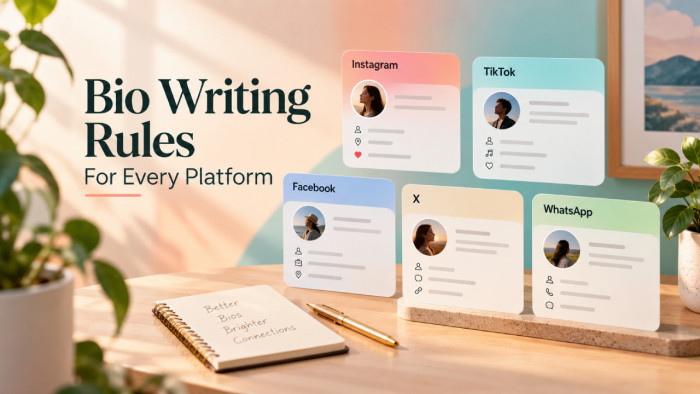

Table of Content
- The smallest hard problem in writing
- The physics of the field
- The first line is 80% of the bio
- The three jobs every bio is trying to do
- Instagram : 150 chars
- TikTok : 80 chars
- X / Twitter : 160 chars
- Facebook : 101 chars
- WhatsApp : ~139 chars
- The link problem
- Voice compression: saying more with less
- Signals and noise
- Write once, fit five
- Final Perspective
The smallest hard problem in writing
Open any profile and the bio is the first thing that has to earn a second of someone's attention. It's also the smallest thing most people ever write, and one of the few places where a single clumsy word is impossible to hide. A good bio does the job of a whole landing page in the space of a text message: who you are, why you're worth following, and what to do next.
The complication is that the space keeps moving. Instagram hands you a tidy 150 characters, X gives 160, WhatsApp around 139, Facebook a cramped 101, and TikTok a genuinely brutal 80. Same person, five different rooms, five different sets of physics.
Writing one bio and pasting it everywhere is the mistake almost everyone makes. What follows is how to write for each room on purpose, without wasting a single character.
The physics of the field
Before voice or cleverness, there's the wall. Each platform caps your bio at a fixed length, and the gap between the biggest and smallest is almost double. That difference alone decides how much of your idea survives.
Bio field limits as of 2026. Platforms change these quietly, so count before you commit.
| Platform | Bio field | Clickable link in bio? |
| X (Twitter) | 160 | Separate website field; links in text cost 23 each |
| 150 | One link (or a link-in-bio tool) | |
| WhatsApp (About) | ~139 | No link surface it's a status line |
| Facebook (bio) | 101 | Links show, but the field is tiny |
| TikTok | 80 | Business / eligible accounts only |
Two rules quietly shrink that budget further, and most people never notice them:
● Every line break you add to stack your bio neatly counts as a character, so a four-line Instagram bio has already spent a few of its 150 before you've typed a word.
● Emoji usually cost one character each, sometimes two, which means the five little icons decorating your profile have eaten the space of a short phrase that could have said something real.
None of this is a reason to write short for the sake of it. It's a reason to treat the limit as the brief, not the obstacle.
The first line is 80% of the bio
People don't read bios so much as glance at them. On a phone, the opening fragment is what shows before anything collapses behind a more link, it's the part that gets screenshotted, and it's the part a stranger scans in the half-second before deciding to follow or scroll on.
So front-load the thing that orients them. If someone had to leave after reading only the first few words, those words should still tell them what they've found. "NYC wedding photographer" survives a cut-off. "Hi! So glad you're here, a little about me…" does not it spends your best real estate clearing its throat.
Treat the opening like a headline and the rest like the fine print. The order you'd naturally write in warm-up, context, then the point is usually the exact reverse of the order that works.
The three jobs every bio is trying to do
Underneath the character counts, every bio is quietly juggling three jobs. Naming them makes it obvious what to cut when the field is small.
● Identity : the orientation. Who you are and what world you operate in, stated plainly enough that a stranger places you in two seconds. This is the job you can never skip.
● Value : the reason to stay. A promise, a specialty, a proof point. It answers the silent question "why should I care?" without actually asking it out loud.
● Action : the one next step. A link to tap, a thing to search, a reason to message you. Not a menu of options one door.
The trick is that a cramped field won't let you do all three well. An 80-character TikTok bio often has room for identity and a sliver of action, and nothing else. A 160-character X bio can carry identity and value and let a pinned post handle the action. Deciding which job a given platform is best at is most of the work.
Instagram : 150 chars
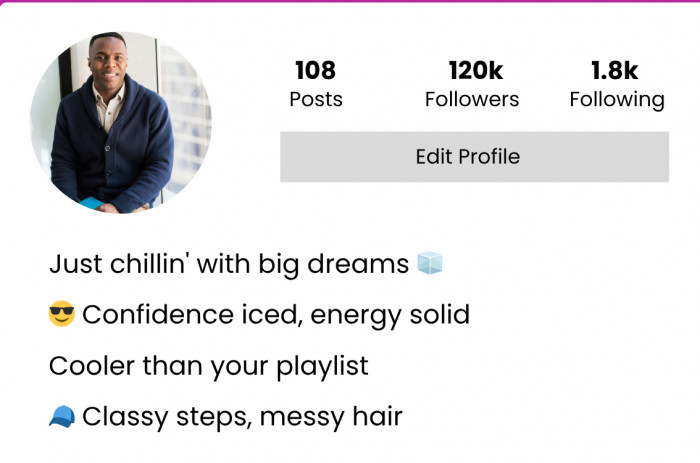
The shop window. Instagram is where people land to size you up before they commit, so the bio works hardest as a quick, scannable snapshot rather than a paragraph.
Its most underused feature is the name field sitting above the bio, the bold line that isn't your handle. It's separate, it's searchable, and most people waste it by repeating their username. Put a keyword there instead. A baker named @sugarhouse gains nothing from "Sugar House" in bold, but a lot from "Sugar House | Custom Cakes."
sugarhouse
Custom cakes & same-day cupcakes in Austin.
Order 48h ahead → pickup only.
Weekly flavours below.
98 / 150 · line breaks included
Use your single clickable link deliberately, and remember that links dropped into captions aren't tappable. A stronger Instagram bio should make the profile clear before asking someone to tap elsewhere. Keep the line breaks to three or four; past that, the stacking eats your budget and the eye gives up.
Principle : Make it skimmable and put a real keyword in the name field. The bio is a shop window, not a diary.
TikTok : 80 chars
The 80-character elevator pitch. This is the tightest field of the five, and it changes the whole exercise. At 80 characters you don't get a bio, you get a sentence. There's no room to be clever and informative, so pick one.
Spend it on positioning plus a single nudge. What you make, who it's for, and maybe one instruction. Looking at strong TikTok bio ideas can help show how much positioning can fit inside that tiny limit. Everything softer: the backstory, the values, the list of things you love belongs in your videos, which is where people actually decide about you anyway.
Too much : Just a girl who loves cooking, sharing recipes, good vibes & helping you eat better every single day 💛
Fits with room to spare : 15-minute dinners for people who hate cooking. New recipe daily.
Note that a clickable link in the TikTok bio is reserved for business and eligible accounts, so for most people the bio can't carry the action at all it has to drive people to search, follow, or watch.
Principle : One sentence, chosen like it's the only one you get because it is.
X / Twitter : 160 chars
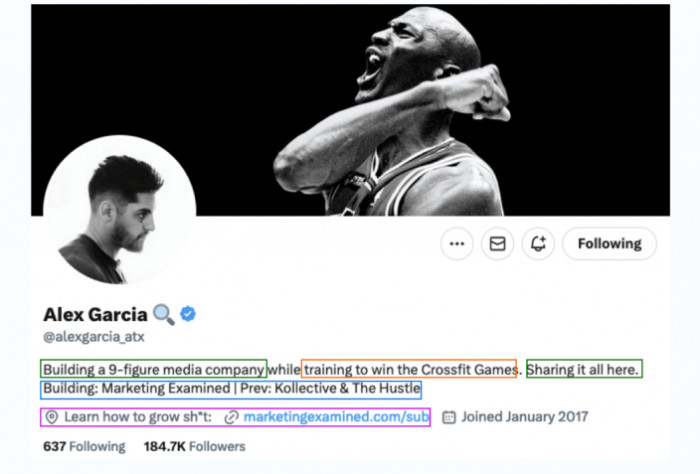
The wit economy. X rewards voice more than any other platform on this list. A bio here is read by people who are already in a scrolling, opinion-forming mood, and a flat résumé-style line disappears instantly. The ones that land have a point of view.A strong X bio usually works the same way: it gives people a clear sense of who is speaking before it tries to sell them anything.
You get a little more room than Instagram, and a separate website field, which frees the bio text to be pure identity and tone. If you do put a link inside the bio text itself, budget for it any URL counts as 23 characters no matter how short it looks, so a link can quietly swallow a seventh of your space.
Lean on your pinned post to do the heavy lifting for the "action" job. That leaves the bio free to simply tell people who's talking and why they'd want to listen.
Principle : Write it in a voice. The pinned post handles the pitch; the bio sets the tone.
Facebook : 101 chars
The quiet 101. Facebook's personal bio is almost as tight as TikTok's, but the room has a completely different feel. It's tied to your real name and a network of people who mostly already know you, so the hard-sell energy that works elsewhere lands awkwardly here.
Restraint reads as confidence on Facebook. A short line of real context your town, your work, a dry joke does more than a packed pitch. This is the one platform where under-writing the field is often the right call.
Daniel Okafor
Carpenter in Leeds. I build kitchen tables that outlive their owners.
68 / 101
Principle : Context over conversion. Say less, in your own voice, to people who already know your name.
WhatsApp : ~139 chars
The semi-private status. WhatsApp's "About" field is the odd one out, and most people treat it wrong by importing marketing language into a space that has none. It's read almost entirely by people who already have your number contacts, clients mid-conversation, family. Nobody discovers you here.
So it works as a signal, not a pitch. Availability ("Replies after 6pm"), a boundary ("Business enquiries → email only"), a tone, a status. For a small business it's genuinely useful as a live notice board; for everyone else it's closer to a mood or a quiet line that says something true.
About
Studio hours Mon–Fri, 9–5. Weekend messages answered Monday. 🌿
62 / 139
Principle : It's a status, not an ad. Use it to set expectations for people already in the conversation.
The link problem
Where a tappable link can live changes what the bio should say, and it varies more than people expect. On a platform with a real clickable link, the bio can end with a destination. On a platform without one, the bio has to do something else entirely: send people to search your name, message you, or watch the next thing you post.
What the "action" job can actually be, platform by platform.
| Platform | Link reality | So the action becomes |
| One live bio link | Tap the link | |
| X | Dedicated website field | Link + pinned post |
| Links display in the field | Visit / message | |
| TikTok | Business accounts only | Follow & watch, or search |
| No link surface | Reply to the chat |
The practical takeaway: don't write "link below" on a platform where there is no link below. On TikTok and WhatsApp especially, the closing line has to earn its own keep instead of pointing at a button that isn't there.
Voice compression: saying more with less
Most weak bios aren't badly written, they're under-edited. The first draft is always loose, and the limit is doing you a favour by forcing the cut. A few habits recover huge amounts of space without losing meaning.
Cut the throat-clearing. "I am a passionate photographer who loves capturing moments" is nine words of warm-up before a single fact. Delete the "I am a," delete "passionate," delete "who loves," and you're left with room for something specific.
Before : Professional photographer available for bookings and collaborations. DM for inquiries. Based in NYC.
After : NYC wedding photographer. 200+ weddings shot. Dates book 6 months out.
Trade adjectives for specifics. Adjectives like "experienced," "passionate," and "dedicated" are claims anyone can make, so readers skip them. A number, a place, or a named thing does the same job and is impossible to fake. "Experienced baker" is noise; "200+ weddings" or "15-minute dinners" is proof.
Let the platform do the work you'd otherwise spell out. You don't need "Follow for more" the Follow button is right there. You don't need "Welcome to my page." The context is already understood, so writing it out just spends characters telling people what they can already see.
Signals and noise
There's really one rule underneath all the others: every character either earns attention or steals it. Once you look at a bio that way, the noise becomes obvious. It's almost always the same handful of things.
● Generic self-description like "passionate," "enthusiast," or "lover of life" these feel personal to write but read as filler, because they're true of nearly everyone and prove nothing.
● Stacked job titles separated by bars ("Entrepreneur | Investor | Speaker | Dreamer") that try to claim everything and end up saying nothing memorable.
● A wall of emoji used as decoration rather than punctuation, which slows the eye down and quietly spends characters you could have used on a real detail.
● Instructions aimed at an audience that doesn't exist yet, like "DM for collabs" on a brand-new account, which signals hope more than offer.
Signal is the opposite of all of it: a specific detail, a bit of proof, one clear action, and a voice that sounds like a person. If a line would survive being read aloud to a stranger without an eye-roll, keep it.
Write once, fit five
The efficient way to handle five platforms isn't five separate brainstorms, it's one idea cut to five lengths. And the direction matters: start with the shortest.
Draft the 80-character TikTok version first, because squeezing a bio down afterwards is painful but letting a tight one breathe is easy. Once you have the 80-character core, expand it to fill Instagram's 150 and X's 160, then adjust the tone for each room, a touch more voice on X, a touch more restraint on Facebook, a status-style line for WhatsApp. Keep all five in one note somewhere so you're editing a living thing, not rewriting from scratch each time.
Then leave it alone until something actually changes. A bio is worth rewriting when any of these shift:
● Your offer or focus changes, so the identity line no longer matches what you actually do now.
● The link destination moves, which quietly breaks the "action" line that pointed at it.
● You've earned a new proof point: a number, a milestone, a credential that's stronger than whatever's in there now.
Final Perspective
The bio isn't the box you fill in last. It's the one line standing between your work and the person deciding whether to see any of it the doorway everything else has to pass through.
The character limit that feels so stingy is the best editor you'll ever have. It won't let you be vague, it won't let you hedge, and it won't let a weak word hide in a crowd. Five rooms, five budgets, one discipline: say the truest useful thing you can, and stop.