

Table of Content
I have written scripts for well over three hundred Reels, most of them for my own accounts and a good number for clients who paid me to fix videos that were not landing.
For the first year I did what almost everyone does. I filmed, I cut it tight, I dropped a trending sound on top, and I waited for the algorithm to notice. It mostly did not. The videos that broke out were never the best looking ones. They were the ones where I had written the first line properly and where every sentence after it earned the next second of attention.
The shift happened when I stopped reading the like count and started reading the retention graph after every post. The pattern was impossible to unsee. Views are won or lost in the writing, long before anyone opens an editor. What follows is the exact process I use to write, tighten, and test a Reel script. There is no theory in here that I have not run through my own drafts folder first.
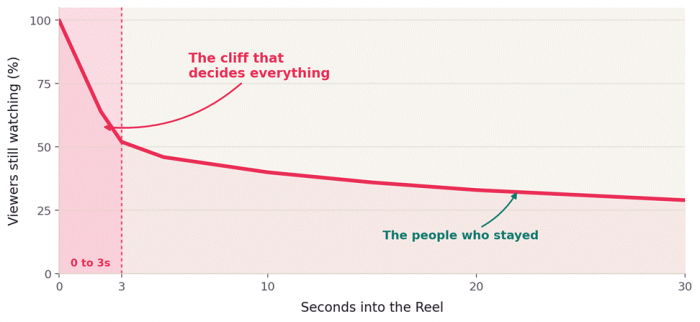
Every Reel has this shape. The only thing your script changes is how steep that first drop is.
The script is the retention lever, not the edit
Most Reel advice fixates on the wrong layer. Trending audio, jump cuts, captions, the ring light. All of it helps at the margins. None of it rescues a video that gives people no reason to stay.
A Reel lives or dies on two numbers: average watch time, and how many people loop back to the start. High retention tells the platform the content is worth showing to a wider audience, so it does. The script is simply the plan that keeps that curve from falling off the cliff you saw above. When I treat the script as the product and the footage as delivery, the numbers move. When I flip that order, they sit flat.
3 sec The window where most of a cold audience decides to stay or scroll | 1 idea The maximum a single Reel should carry. Split anything bigger into two videos | 100%+ Watch time above the clip length means people are looping. That is the score to chase |

The first line is an audition, not an intro
Your opening line is not part of the video. It is the audition for the video. If it fails, nothing else you made gets watched. I write the hook last, once I know precisely what the payoff is, and I write at least five versions before I commit to one.
The job of a hook is narrow. Open a small, specific gap between what the viewer knows right now and what they suddenly want to know next, then make that gap feel worth three seconds. Vague curiosity does not work. Specific tension does. Here are the six openers I reach for most, with lines you can adapt today.
| Hook type | Example line | Why it holds |
|---|---|---|
| The correction | You are salting pasta water at the wrong time. | People stay to check whether they are the one making the mistake. |
| The stakes | I sent 40 cold emails last week and only one line got replies. | A concrete number promises a concrete payoff, not fluff. |
| The callout | If you freelance and still charge hourly, watch this. | Naming a specific viewer makes the right person feel spoken to. |
| The withheld answer | The reason your Reels flop has nothing to do with the algorithm. | It names a problem and delays the cause, so the gap pulls forward. |
| The result first | Show the finished dish, then say how you got there in four steps. | Proof up front buys patience for the method that follows. |
| The forbidden | Do not do the thing every skincare video tells you to do. | A warning feels urgent and personal in a way a tip never does. |
One rule I never break: the spoken hook and the on-screen text should not be the same words. Say one thing out loud, show a slightly different angle in the caption. Two channels, one gap, double the pull.
The anatomy of a script that holds
A Reel script is a timeline, so I write it as one. Every beat has a job and a rough second count. This is the skeleton I start from for a 25 to 35 second talking video, and I adjust the middle depending on how much value I am delivering.
| 0:00 | Hook. The audition line, spoken and shown differently. No greeting, no name, no in this video. You are already mid-thought. |
| 0:02 | Promise. One sentence naming what they walk away with. By the end you will never write a flat subject line again. |
| 0:05 | Payload. The actual value, broken into two or three tight beats. Each beat should survive on its own if the rest were cut. |
| 0:20 | The turn. The one line that reframes everything, or the result that pays off the promise. This is the moment worth screenshotting. |
| 0:26 | The loop. A closing line that either sends them back to the hook or hands them a reason to comment. Never a cold follow for more. |
Notice there is no room for a warm-up. The most expensive real estate in short-form is the second between beats, and a script that respects that never lets the viewer catch their breath long enough to scroll.

Write for the ear, not the page
The biggest tell of a script written like an essay is that it sounds like one when read aloud. Reels are heard, not read. A line that looks fine on paper can be unspeakable on camera. Before anything gets filmed, I read the whole script out loud twice and cut whatever makes me stumble.
One idea per sentence If a sentence leans on an and or a because, split it. Short lines are easier to say and easier to cut around. | Use contractions You are becomes you're. Formal spelling reads as a robot reading a memo. Write the way you actually talk. |
Speak to one person Say you, never you guys or everyone. A Reel is watched alone, on a small screen, close to the face. Match that. | Cut the throat-clearing Delete so, basically, I just wanted to, and in this video. They are dead air with a heartbeat. |

Open a loop, then make them wait
Retention past the hook comes from tension you plant on purpose and resolve on purpose. An open loop is a question or promise you raise early and pay off later, and it is the single most reliable way to pull a viewer through the soft middle where most videos lose people.
The trick is to name the payoff without giving it. The third one is the one nobody expects makes a viewer sit through the first two to reach it. There is one setting that changed everything, and it is not the obvious one keeps them until you reveal it. You can stack a small loop inside every beat, so the moment one closes the next is already open.
| Try this. Take your best beat and move it to last. Then write a single line at the top that hints it exists. You have just turned a flat list into a reason to keep watching. |
Cut every word that does not move the video
The first draft is always too long, and the second one usually still is. My editing pass has one question per line: does this word earn its place, or is it just softening the one next to it? Tightening a script is not about speaking faster. It is about removing the words a viewer's brain skips anyway.
Before, 22 words So I basically just wanted to quickly share a little tip that honestly changed the way that I write all of my captions now. | After, 9 words This one caption trick doubled my saves. Here it is. |
The rewrite is not only shorter. It leads with the payoff, adds a number, and ends on a micro-loop. Same idea, a fraction of the runtime, and nothing for a thumb to escape into.
A call to action that does not kill retention
A cold like, comment and follow tacked on the end does two harmful things at once. It signals the video is over, which gives people permission to leave, and it asks for a favour before you have earned one. I stopped writing them and my saves went up.
Tie it to the value Save this before your next post works because the action serves the viewer, not you. | Ask a real question End on something specific people want to answer. Comments train the algorithm and pull rewatches. | Loop, do not close Let the last line feed the first. A clean loop lifts watch time past 100% without asking for anything. |
Give people a reason to watch twice
Loops are how good Reels quietly double their watch time. A video that ends exactly where it began, in words or in visuals, restarts without a seam, and a viewer often does not notice they have watched it twice until the third pass. That behaviour is gold to the platform.
You build a loop at the script stage, not in the edit. Write the final line so it answers, mirrors, or completes the opening line. If your hook is I quit the one habit that was killing my mornings, your last line can be and that habit was checking my phone before I stood up, which sends the viewer straight back to the hook to confirm it. Density does the rest. When a video is packed enough that a single pass misses something, people rewind on purpose.
The mistakes that flatten a good idea
Every one of these has cost me views on a video that deserved better. They are all fixable in the script, before a camera is ever pointed at anything.
| Burying the hook | Spending the first four seconds on a greeting or setup. By the time the point arrives, the audience has gone. |
| Writing to be read | Long, tidy sentences that sound stiff spoken aloud. If you stumble reading it, so will the viewer's attention. |
| Cramming two videos into one | Two ideas fighting for the same 30 seconds means neither lands. Pick one and let the other be next week's post. |
| No turn, no payoff | A script that only informs and never surprises has nothing to screenshot and no reason to finish. |
| A bolted-on CTA | Follow for more at the end tells the brain the show is over. Loop or ask instead of begging. |
| Explaining the obvious | Over-clarifying context the viewer already understands. Trust them to keep up and keep the pace high. |
A four-part template you can reuse
When I am drafting fast, I fill in these four slots first and worry about polish after. It forces the shape onto the idea before I fall in love with any single line.
| H | Hook The audition line that opens a specific gap. Write five, keep one. |
| P | Promise One sentence naming the payoff so they know why to stay. |
| V | Value Two or three tight beats, each with a micro-loop pulling to the next. |
| L | Loop A closing line that mirrors the hook or asks a real question. |
A worked example in one breath: You are pricing your freelance work wrong (hook). Switch to this in the next 20 seconds and stop leaving money on the table (promise). Charge by outcome, anchor high, and never name the first number (value). Do that and the wrong client filters themselves out before the call even happens (loop back to pricing).
The pre-post checklist
I run every script through this out loud before I film. If any line fails, it gets rewritten, not filmed and fixed later.
| ✓ The first spoken line makes sense with zero context | ✓ Spoken hook and on-screen text say different things |
| ✓ The payoff is named in the first five seconds | ✓ Every sentence carries one idea |
| ✓ At least one loop is open before the midpoint | ✓ There is a turn worth screenshotting |
| ✓ No so, basically, or in this video | ✓ The last line feeds the first or asks a question |
| ✓ The whole thing reads clean out loud in one take | |
The verdict, after 300+ postsScripts win before the camera does The uncomfortable lesson from watching my own retention graphs for two years is that talent, gear, and even editing skill matter far less than I wanted them to. The videos that traveled were the ones I had written with intent: a hook that earned three seconds, a middle that never let the tension drop, and an ending that quietly sent people back to the top. You do not need a bigger following or a better face for the camera to make this work. You need to treat the script as the real product and give it the same care you give the visuals. Start with the four-part template, read everything out loud, and check the retention graph after every post instead of the likes. The graph is the only honest feedback you will get, and it will teach you faster than any guide, including this one. Write the first line like your entire video depends on it, because on a platform built for scrolling, it genuinely does. | |