

Table of Content
- What the platforms reward, and what it means for your script
- Write the last line first
- The hook is a promise, not a greeting
- One video, one turn
- A beat sheet for a 30-second script
- Lines to cut from every draft
- Write for the ear first, then for the thumb
- What AI script tools got right, and where they fell flat
- A 60-second self-edit before you film
- Final verdict from a few hundred scripts in
Most first short-form scripts get written in a notes app on a train, filmed in a hallway, and stall at two hundred views. The gap between that video and the one that finally travels is almost never the camera. It is the script. This guide draws on a few hundred scripts written for a creator channel, two product brands and a podcast that clips its episodes, plus a year of running those same briefs through AI script generators to see whether they could do the job faster.
The short version: the tools are fine at producing a script and poor at producing a story. The videos that took off rarely won on production value or trending audio. They won because the first line made a specific promise, the middle turned once, and the last line paid the promise off in a way that made people watch again or send it to someone.
What follows is the checklist that would have saved that first video. It skips advice you have already read, sticks to what the platforms have said on record about ranking, and shows the rewrites instead of describing them.
What the platforms reward, and what it means for your script
Before rewriting a word, it helps to know what the feed is measuring. None of this is guesswork; all three platforms have described it themselves in help pages, creator analytics or public statements.
Ranking signals the platforms have named, and the script decision each one forces
| Platform | Length ceiling that matters | What the platform has said it measures | Script decision |
|---|---|---|---|
| TikTok | In-app recording runs to 10 minutes. Buffer's study of 1.1 million posts found 86% still run under a minute. | TikTok for Business reports 63% of its highest-performing ads put the key message inside the first 3 seconds, and 90% of ad recall is captured within the first 6. | The premise has to be clear, not teased, before second three. |
| Instagram Reels | Reels up to 3 minutes are eligible for recommendation to non-followers. Longer stays inside your existing audience. | Adam Mosseri named three signals in January 2025: watch time, likes per reach and sends per reach. Sends carry the most weight for reaching new people. | Write one line someone would forward. If nothing is worth sending, the script is not finished. |
| YouTube Shorts | Up to 3 minutes since 15 October 2024 for vertical or square uploads. There is no minimum. | YouTube Studio reports "Viewed vs. swiped away" per Short. Since 31 March 2025 any play counts as a view; engaged views are tracked separately. | The first frame and first sentence decide whether you get a view at all. Treat them as one unit. |

| About the "7-second rule". It is quoted everywhere as platform data. It is not. The number comes from Roger Ailes' 1988 book You Are the Message, about how audiences judge a speaker, and predates every app on this list. What current data does show: Metricool's 2026 studies put average watch time near 8.5 seconds on Reels and about 16 seconds on Shorts. A script that takes seven seconds to get going has spent most of its budget before the point. |
Write the last line first
Nearly every script that arrives for a rescue edit has the same fault. The writer knew how the video started and had no idea how it ended, so the opening promised something vague and the ending trailed off into a request to follow.
The fix is to write in reverse. Decide the payoff, the one sentence a viewer could repeat to a friend, then write an opening line that promises exactly that. Everything in between exists to earn the gap.
Payoff decided first "The cheapest one is the only one still on my desk." | Opening line built from it "I bought the cheapest and the most expensive version of this. Guess which one I still use." |
The opening does not give the answer away. It names the objects, sets up a comparison and implies a result you are about to show. That is the whole job of line one.
The hook is a promise, not a greeting
The biggest retention gain a rewrite can deliver usually comes from cutting the introduction. On a feed the viewer did not choose you; the app placed you in front of them. A greeting asks them to care who you are before you have given a reason. A promise gives the reason first.

Five openers that get cut from client scripts, and what replaces them
| Weak opener | Why it loses the swipe | Rewrite |
|---|---|---|
| "Hey everyone, today I want to talk about sleep." | Introduces the speaker, not the stakes. No object, number or result. | "I fixed my sleep with a four dollar change, and it was not the one you are thinking of." |
| "So a lot of people ask me how I edit." | Vague audience, no tension, and the video becomes about you. | "This is the edit that took my Shorts from 300 views to 40,000. Same footage." |
| "Let's get into it." | Filler that promises nothing and costs a full second. | Delete it. Start on the first real sentence. |
| "Here are five tips for better scripts." | A list is a menu, not a story. Nothing is at stake. | "Four of these five scripting tips are fine. The fifth is the one that doubled my watch time." |
| "Have you ever wondered why your videos don't get views?" | A yes or no question lets the viewer answer "no" and swipe. | "Your video died at second two. This is the frame that killed it." |
Pattern in every rewrite: a concrete object or number, a comparison or contradiction, and a result you will show rather than tell.
One video, one turn
The most useful storytelling rule for short-form comes from Trey Parker and Matt Stone, who explained it to a class at NYU years before vertical video existed. Read your beats in order. If they connect with "and then", you have a list. If they connect with "but" or "therefore", you have a story.
In a 30-second video you get one "but". One reversal, one moment where the thing the viewer expected does not happen. Put it where retention normally sags, between seconds eight and twenty, and give it your best shot, cut or line.
And-then version "I bought a plant. And then I watered it. And then I put it in the window. And then it grew." | But-therefore version "I bought a plant, but every guide said it would die on a north-facing sill, so I ignored all of them. Here is month three." |
Same footage. The second version has stakes, a decision and a promise of proof. The first is a diary entry.
A beat sheet for a 30-second script
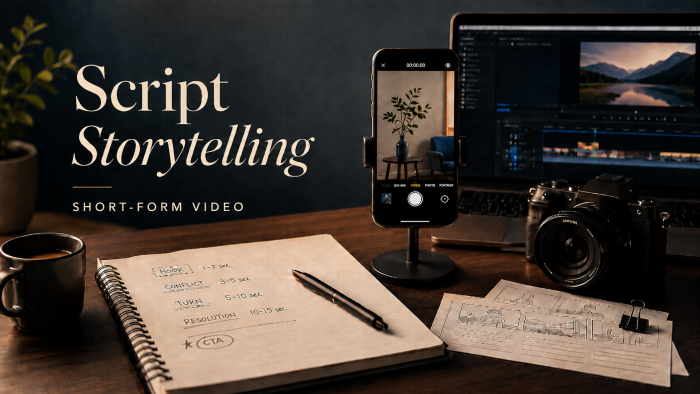
This is the skeleton to start from. It stretches for a 60-second video and collapses for a 15-second one, but the proportions hold well across niches.
| 0 to 3s | Promise | One sentence. Concrete object or number. On-screen text mirrors the key words, not the whole line. |
| 3 to 8s | Stakes | Why this matters to the viewer, not to you. If the video is about your process, the stakes are their result. |
| 8 to 20s | The turn | The single "but". This is where most drop-off happens, so your strongest visual, cut or reveal lives here. |
| 20 to 27s | Payoff | Deliver exactly what line one promised. Not a related thing. The thing. |
| 27 to 30s | Loop or send | A closing line that reframes the opening, or one that someone would forward. Any follow request comes after this, never before. |
A natural on-camera pace sits near 150 words a minute, so 30 seconds is roughly 70 spoken words. Most first drafts run 110 to 130. The next section is where the extra words hide.
Lines to cut from every draft
These are the phrases to delete on first read. Each feels harmless alone; together they cost four to six seconds, a fifth of a 30-second video spent saying nothing. × "Hi, I'm Sam and I run a small studio in Leeds." Identity goes after the promise, if it goes in at all. Viewers decide whether you are worth knowing from what you show them. × "In this video" and "today we're going to" The viewer is already inside the video. Announcing it is a delay. × "Without further ado", "let's dive in", "so, basically" Throat clearing. It buys the speaker time and costs the viewer patience. × "Make sure you like and follow" anywhere before the payoff Asking for payment before delivery. Move it to the last two seconds or drop it. × "Now, moving on to" and other spoken transitions On a phone the cut is the transition. If a section change needs a sentence, the sections are in the wrong order. After cutting, re-time the read. Still over? The script has two ideas and needs to be two videos. |
Write for the ear first, then for the thumb
A script that reads well on a page often sounds stiff out loud. Read every draft aloud with a timer running before you touch a camera. Anything you stumble on, the viewer will too.
For the ear
Use contractions. Keep most sentences under twelve words, one idea each. Put the surprising word at the end, where the pause lands. "It costs four dollars" is flat. "The fix was four dollars" makes the number the point.
For the thumb
All three feeds autoplay, and plenty of that play happens with sound off. TikTok's own creative guidance notes that on-screen text and captions raise view time and recall, which matches what retention curves show. The working rule: every key line gets an overlay of six words or fewer carrying the number or the object, not the full sentence. If overlay and spoken line are identical, one is wasted.
Build a loop, not an ending
Since March 2025 every replay of a Short counts as a view, and on every platform a rewatch adds to watch time. So the last line of a script is not a sign-off. It is a second hook, aimed at the viewer who just finished.
Two ways to write it. The callback ends on the object or phrase you opened with, so the video closes a circle and the thumb drifts back to the start. "That is why the cheap one is still on my desk" sends people back to check the expensive one. The sendable line is one quotable sentence that stands without context. Mosseri has said sends per reach is the signal that reaches new audiences, and a line that survives a group chat is the cheapest reach you will get.
What does not work as a closer: "Let me know in the comments." If you want comments, end on a claim someone will want to argue with.
What AI script tools got right, and where they fell flat
Over the last year the same briefs went through several AI script generators alongside human drafts, and both versions were filmed where the client allowed it. The pattern was consistent enough that the tools now earn a place for a few specific jobs and nothing else.
Where they helped • Turning a 40-minute podcast transcript into eight candidate hooks in a minute, faster than anyone can skim. • Rewriting a stiff draft into spoken register once asked for contractions and short sentences. • Producing twenty variations of one opening line so two or three can be shot and tested. | Where they fell flat • Almost every first draft opened with a rhetorical question, consistently the weakest hook format in retention data. • They default to lists. "Three things you need to know" appeared in most drafts, and lists have no turn. • A follow request was bolted onto the end by reflex, whether or not the video earned it. • They do not know your footage, so they write lines you cannot show. |
They are a good hook-variation engine and a decent editor for spoken rhythm. They are not a storyteller.
A 60-second self-edit before you film
Run this on every script ☐ Line one contains a number, an object or a result. No greeting, no question. ☐ You can say the payoff in one sentence, and line one promises that exact payoff. ☐ There is one "but", and it sits between seconds eight and twenty. ☐ Read aloud, the script comes in at least ten percent under the target length. ☐ Every key line has an on-screen text version of six words or fewer. ☐ The last line either calls back to the first or could be forwarded on its own. |
Final verdict from a few hundred scripts in
If this whole guide had to shrink to one instruction, it would be this: write the last line first, make the first line its promise, and put one "but" between them. Almost every other improvement across a few hundred scripts turns out to be a refinement of those three moves.
The platform data backs it more than most creators expect. TikTok wants the message inside three seconds, Instagram ranks on watch time and sends, YouTube measures whether people swipe before the first sentence finishes. None of those signals reward a clever intro or a trending sound. They reward a story that is clear early, turns once and ends in a way that invites a second look.
As for the AI tools, they earn a permanent place in the process for hook variations and transcript cleanup. But every time one is left to make the story decisions, the video comes back with a rhetorical question up top, a list in the middle and a follow request at the end. That is a script. It is not a story, and the feed can tell the difference in about two seconds.