

Table of Content
- Why the first three seconds carry the test
- Three ways to run a hook test
- Platform-by-platform: what each tool actually lets you test
- The manual method for organic accounts
- Writing variants that are different enough to learn from
- How many viewers a hook test needs
- Mistakes that invalidate the test
- Final verdict after a summer of testing
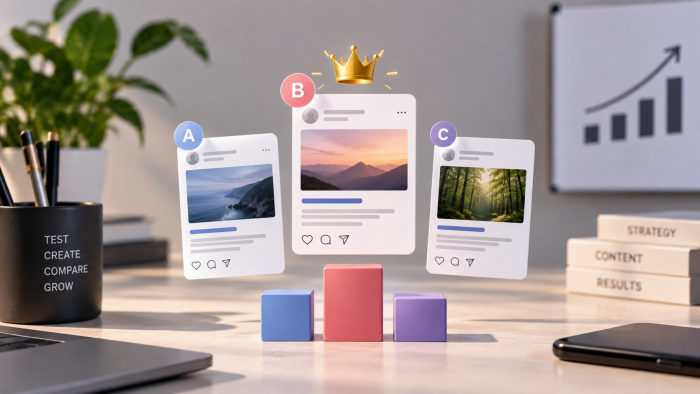
Hook A, result first "I stopped needing an alarm after changing one thing about my evenings." 3-second hold rate: 71% | Hook B, question "Do you ever wake up tired even after eight hours?" 3-second hold rate: 44% |
Hook B pulled more comments. Hook A kept far more people past three seconds and earned twice the shares, so A went to followers.
I did not plan to spend most of the summer rewriting the first sentence of the same video, but that is how it went. In late May I took one 38-second clip about a morning routine and pushed it out eleven different ways: three opening lines as Instagram trial reels, a two-cell split test in TikTok Ads Manager, and three thumbnail and title pairs inside YouTube's Test & Compare. Same footage, same edit, same caption. Only the first two or three seconds changed. I drafted a dozen candidate hooks with an AI writing assistant, cut the ones that sounded like every other account, and let the platforms score the rest.
The spread on that one clip is the panel above: 71 percent of viewers still watching at three seconds for the best line, 44 percent for the worst. Nothing else I changed this year, not posting time, not hashtags, not caption length, moved a number that far. Since then I have logged 34 hook tests across five platforms. Roughly a third produced a clear winner, a third were a wash, and in a third the line I was certain would win came last. That last bucket is the reason this guide exists.
What follows is the process I now use every week: the tools that split the audience for you, a manual method for accounts without them, how to write variants that differ enough to teach you something, and the sample sizes that separate a real winner from a lucky Tuesday.
| Quick answer: To test multiple hooks for the same social media post, keep the footage, caption and posting slot identical and change only the opening line, first frame or thumbnail. Use a native split tool where one exists (Instagram trial reels, YouTube Test & Compare, TikTok and Meta split tests). Otherwise post the variants in matched time slots and compare the share of viewers still watching at three seconds, not raw views. Wait out the full window and repeat before calling a winner. |
Why the first three seconds carry the test
The hook is whatever a person sees before deciding to keep going. On Reels and TikTok that is the first frame plus the first spoken or on-screen line. On YouTube it is the thumbnail and title before the click and the opening seconds after it. On LinkedIn and X it is the text above the fold.
63% Share of the highest click-through TikTok videos that put their key message or product inside the first three seconds. TikTok for Business, creative tips for auction ads | 47% Portion of a Facebook video campaign's total value produced by people who watched under three seconds. Under ten seconds, up to 74 percent. Nielsen for Facebook, 173 brand studies, 2015 | 1 in 3 Well-built experiments at Microsoft that improved their target metric. A third did nothing, and a third made it worse. Ronny Kohavi, former VP of experimentation at Bing |
If seasoned product teams are wrong about their own ideas two times out of three, your instinct about which line will land is not evidence. The test is.
Three ways to run a hook test
Every method I have used falls into one of three buckets. Which one fits depends on ad budget, platform, and how much certainty you need before publishing.
| Method | Where it exists | Audience split | Cost | Time to a result | How much to trust it |
|---|---|---|---|---|---|
| Native organic tools | Instagram trial reels, YouTube Test & Compare | YouTube splits viewers evenly; each trial reel finds its own non-follower audience | Free | About 24 hours on Instagram; days to weeks on YouTube | Medium on Instagram, high on YouTube |
| Paid split tests | Meta, TikTok, LinkedIn and X ad managers | Randomised, non-overlapping groups with equal budgets | Your ad spend | 7 to 14 days; LinkedIn recommends two weeks minimum | High, if the tool's power estimate is above 80 percent |
| Manual matched-slot posting | Any organic account, any platform | None; variants go out in sequence | Free | One to two weeks for three matched pairs | Low for a single pair, medium once three pairs agree |
Platform-by-platform: what each tool actually lets you test
Rules as published by each platform as of September 2026, plus how I use each one for hooks. Check the help pages listed at the end before building a process around any single limit; these tools change quietly.
Instagram trial reels
Organic, free
| Who gets it | Public accounts with at least 1,000 followers. Launched December 2024. |
| How it works | Toggle Trial on the share screen. The reel goes only to non-followers and stays off your grid and followers' feeds. |
| What you see | Views, likes, comments and shares after roughly 24 hours, plus a comparison with earlier trials. |
| Limits | Not a randomised split. Each trial finds its own audience, so post variants at the same hour on similar days. |
For hooks: upload two or three trials with identical footage and different opening seconds. Switch off automatic sharing to followers while testing, or Instagram may publish a variant on views alone within 72 hours.
YouTube Test & Compare
Organic, free
| What you can test | Up to three titles, three thumbnails, or three title and thumbnail pairs on one video. |
| How the winner is picked | Versions are shown evenly, and the one with the highest watch time share wins. If nothing separates them, the first version you uploaded stays. |
| Limits | Desktop YouTube Studio only, advanced features must be enabled, and it does not cover Shorts, Premieres or scheduled livestreams. |
For hooks: the thumbnail and title pair is the pre-click hook, and this is the cleanest test of it anywhere. In-video opening lines still need separate uploads.

TikTok Ads Manager split test
Paid
| What you can test | TikTok names "the initial hooks (the opening 2-3 seconds)" of a video as a testable creative asset, alongside formats and copy. |
| How it works | Two ad groups, one variable. The audience is split into two equal, non-overlapping halves and you pick the key metric that decides the winner. |
| Limits | TikTok tells you to schedule at least seven days. Keep the estimated testing power above 80 percent or the result will not settle. |
For hooks: upload two cuts that differ only in the first three seconds and pick a view-through metric, such as 6-second views, over clicks.
Meta Ads Manager A/B test
Paid
| Where | Ads Manager, Experiments, A/B test, with creative as the variable, across Facebook and Instagram. |
| How it works | Random, non-overlapping groups with the budget split evenly for the whole run. Three ads in one ad set is not a test; delivery drifts toward the early leader. |
| Limits | Check the estimated power figure before publishing, run at least seven days, and change nothing mid-test. |
For hooks: same ad, two or three video cuts. Judge on 3-second plays per impression and ThruPlays, then cost per result last.
LinkedIn and X ad managers
Paid, organic workaround
| Campaign Manager compares two campaigns that differ by one variable, with results in the Testing dashboard. LinkedIn recommends at least two weeks and caps tests at 90 days. | |
| X | Ads Manager creates randomised, mutually exclusive user groups, up to five ad groups with five ads each. It must be switched on before launch and does not support campaign budget optimisation. |
| Organic posts | Neither platform offers a native split for organic posts. The hook is the text above the "see more" cut, and it needs the manual method below. |
For hooks: one campaign or ad group per opening line, everything else mirrored. Both platforms advise one variable per test.
The manual method for organic accounts
Most of my LinkedIn and X hook tests ran this way, as did every Instagram test before trial reels arrived. It is slower and noisier than a split tool, but it works if you keep the sequence strict.

1. Freeze everything except the hook. Same media, caption, hashtags, call to action, link and account. List every variant before you post anything, so you are not tempted to tweak the footage between rounds.
2. Choose the metric before you post. Video: the share of viewers still watching at three seconds, or average watch time. Text: engagements or clicks per impression. Never raw views, which measure distribution luck as much as the hook.
3. Match the slot. Hook A on Tuesday at 9:00, hook B on Thursday at 9:00, then swap the order next week. Skip holidays, launch days and any day you ran ads.
4. Run at least three pairs. On my accounts, organic reach on the same content swings 30 to 50 percent between weekdays. One pair proves nothing. Three pairs that agree prove a lot.
5. Log every post the same way. A sheet with date, platform, hook text, hook type, reach, the chosen metric, and one line of notes. Without it you will remember the wins and forget the losses.
6. Decide on consistency, not size. A hook that wins three pairs by small margins is a better bet than one that wins a single pair by a mile. If it splits two to one, run a fourth pair.
Writing variants that are different enough to learn from
The most common failure I see is testing two versions of the same idea: "3 mistakes slowing your Wi-Fi" against "Three Wi-Fi mistakes to stop making." That is one hook with a haircut. TikTok's split test guidance says to make differences between groups large and obvious, and that holds for organic tests too. Change the type of hook, not the wording. Here is one topic written five ways, with what each type has tended to win in my log.
| Hook type | Example for a video about slow home Wi-Fi | Tends to win on | Risk |
|---|---|---|---|
| Result first | "Your Wi-Fi is slow because of one router setting. Here it is." | 3-second hold rate | Falls flat if the payoff is weak |
| Question | "Why does your Wi-Fi die at 8pm every night?" | Comments | Lowest hold rate in my tests unless oddly specific |
| Contrarian | "Stop buying a new router. It is not the router." | Shares | Polarises; angry replies can hurt saves |
| Specific number | "This 40-second change doubled my download speed." | Clicks and saves | Numbers must be true and repeatable |
| First-person story | "I paid for gigabit internet and got 90 Mbps for two years." | Follows and profile visits | Slower start; needs a strong second line |

How many viewers a hook test needs
This is where most hook tests quietly fall apart. A gap of 100 views between two reels feels decisive and usually means nothing. The table uses a two-sided test at 95 percent confidence and 80 percent power, the same assumptions behind the power estimates Meta and TikTok show during setup.
| Metric | Baseline | Lift you want to detect | Viewers needed per variant |
|---|---|---|---|
| 3-second hold rate | 60% | to 70% | about 360 |
| 3-second hold rate | 60% | to 66% | about 1,000 |
| Link click-through rate | 2.0% | to 3.0% | about 3,800 |
| Link click-through rate | 2.0% | to 2.4% | about 21,100 |
| Retention metrics settle with hundreds of viewers because most people either stay or leave. Click metrics need thousands because so few people click at all. That is why organic hook tests should be judged on hold rate, and why a paid test chasing a small CTR lift needs real budget or a long run. If a platform's power estimate sits under 80 percent before you publish, add budget, cut a variant, or admit you are running a hunch. |
Mistakes that invalidate the test
| Mistake | Why it breaks the result | Fix |
|---|---|---|
| Changing the hook and the music | Two variables, one outcome. You cannot tell which moved the number. | One variable per test. Queue the music test for next week. |
| Calling a paid test after 24 hours | Delivery is still in the learning phase and you have seen one day of the week. | Seven days minimum on Meta and TikTok, two weeks on LinkedIn. |
| Judging on views | Views reflect how widely the platform distributed, not whether people stayed. | Compare hold rate, shares and saves as percentages of reach. |
| Multiple ads in one Meta ad set | Meta shifts spend toward the early leader, so the loser never gets a fair share. | Use Experiments so groups are random and budgets equal. |
Final verdict after a summer of testing
Hook testing is the only optimisation I have done this year that paid for the time it took. The tool that changed my week most was Instagram trial reels, because it removed the fear of posting a dud to followers. It is not a randomised split and I would not bet money on one trial, but three trials at the same hour give a directional answer by the next morning, fast enough to shape the next post. The result I trust most comes from YouTube's Test & Compare, because watch time share is harder to fool than clicks and the tool will not name a winner it cannot support. The cleanest paid test was TikTok's, because it treats the opening seconds as a named variable and splits the audience properly. Meta's power estimate twice stopped me spending on tests that could never have reached a conclusion at my budget. What I would tell anyone starting Monday: • Judge on hold rate. It needs a few hundred viewers per variant, not tens of thousands, and it measures the hook rather than the algorithm's mood. • Write variants that differ in kind. A question against a result-first line teaches you something. Two phrasings of the same claim do not. • Keep testing. My June winner lost to a newer line in August. This month's winner is a baseline, not a rule. |