

Table of Content
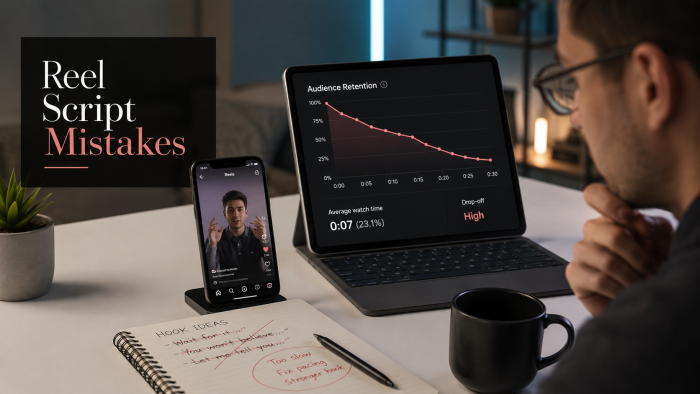
I keep a folder on my desktop called graphs. It holds screenshots of retention curves from reels I have scripted over the last two years, my own and my clients'. Some hold above 90 percent through the first three seconds. Others fall off a cliff so hard you can almost hear the swipe.
After a few hundred scripts for food, fitness and personal finance accounts, I can usually guess the shape of that curve before anything gets filmed, just by reading the draft. That is the uncomfortable part of this job. Most of your watch time is decided in a document, not in the edit. The lighting, the cuts, the trending audio, all of it matters less than the words you planned to say and the order you planned to say them in.
Below are the script mistakes I run into most often, the exact spot where each one shows up on a retention graph, and the rewrites that fixed them for me.
QUICK ANSWER • Most watch time is lost to five script habits: greeting intros, vague hooks, backstory before payoff, padded middles and long outros. • Each mistake leaves a signature on your retention graph, either a sharp cliff or a slow bleed, and each has a specific rewrite. • The fastest wins: delete your first two lines, put a number or a specific claim in the hook, and end within one sentence of your last useful point. |
Why watch time decides your reach
Instagram has been unusually open about this. Adam Mosseri, the head of the platform, has said publicly that the signals that matter most for ranking are watch time, likes per reach and sends per reach, and that watch time leads the pack for both your followers and people who have never seen your account. A reel gets shown to a small pool first. If that pool watches it through, distribution widens. If they swipe at second two, it stops there.
| SIGNAL | WHAT IT TELLS THE PLATFORM |
|---|---|
| Average watch time | The primary ranking signal, for followers and non-followers alike. Completion and replays feed it directly. |
| Sends per reach | How often viewers share the reel in DMs. A heavy signal for reaching people who do not follow you. |
| Likes per reach | Still counted, but it carries less weight than the two above. |
Notice that two of the three signals depend on someone staying long enough to care. Nobody sends a reel they swiped away from. Which is why every fix in this article is really a watch time fix.

9 reel script mistakes that lower watch time
1. The warm-up intro
SHARP CLIFF · DROP AT 0:01
The script opens with a greeting, a name, or a channel reference. It feels polite. On a feed where nobody chose to be there, it reads as a request to wait.
THE DRAFT Hey everyone, welcome back. Today I want to talk about meal prep. |
THE REWRITE Three dinners, one pan, and you will not touch a knife twice. |
WHY IT HURTS Second one carries zero stakes, so the swipe costs the viewer nothing.
THE FIX Delete the first two lines of every draft you write. Almost every script I audit starts at line three.
2. A hook that names a topic, not a promise
SHARP CLIFF · DROP AT 0:02
"Let's talk about sleep" is a label. It tells viewers what shelf the video sits on, not why they should stay on it.
THE DRAFT Here are some tips for better sleep. |
THE REWRITE Your bedroom is probably two degrees too warm, and it is wrecking your deep sleep. |
WHY IT HURTS A topic gives the brain nothing to want. A specific claim opens a gap the viewer needs closed.
THE FIX Rewrite the hook until it contains at least one of these: a number, a named mistake, a specific outcome, or a common enemy.
3. The hook writes a check the script cannot cash
SHARP CLIFF · DROP AT 0:06
The opening promises the one thing nobody tells you, then the body delivers advice the viewer has heard forty times. The graph holds for a few seconds, then collapses at the reveal.
WHY IT HURTS The mismatch reads as a small betrayal. Watch time dies at the payoff, sends never happen, and viewers remember who did it.
THE FIX Write the payoff first. Then write the biggest hook that payoff can honestly cover. Never the other way around.
4. Backstory before payoff
SHARP CLIFF · DROP AT 0:04
"Quick bit of context first." Then thirty words about how you discovered the tip, your credentials, or what the old method used to look like.
THE DRAFT So before I get into it, a little backstory on why I started doing this. |
THE REWRITE Pull the chicken at 155, not 165. Here is why that works. |
WHY IT HURTS Context feels essential to the writer and optional to the viewer. They came for the answer, not the origin story.
THE FIX Deliver value first and earn the right to context. If the backstory genuinely matters, drip one line of it after the first payoff lands.
5. Writing for the eye instead of the ear
SLOW BLEED · BLEED FROM 0:03
Long compound sentences, formal connectors, words you would never say across a kitchen table. It reads fine in the doc and dies on camera, because your delivery stiffens to match the prose.
THE DRAFT Additionally, it is important to consider the various factors that influence consistency. |
THE REWRITE One more thing matters here. Consistency. And it comes down to two habits. |
WHY IT HURTS Listeners process speech in short chunks. When a sentence takes eight seconds to resolve, attention drifts long before it ends.
THE FIX Read every draft out loud once. Anywhere you stumble or need a breath mid-sentence, break it in two.
6. One idea stretched over the whole runtime
SLOW BLEED · BLEED FROM 0:12
A twelve second idea padded to thirty five with restatements. "So basically, what I mean is." Viewers feel the exact moment new information stops arriving, even if they cannot say why they left.
WHY IT HURTS The graph flatlines, then slides. Average watch time on a padded 35 second reel usually loses to full retention on a tight 14 second one, and the short version picks up replays on top.
THE FIX Cut every sentence that repeats a point already made. If the substance runs fourteen seconds, post fourteen seconds.

7. No open loops anywhere in the middle
SHARP CLIFF · DROP AT 0:07
A flat list where every point closes completely before the next begins. Tip one, done. Tip two, done. Each closed point is a clean exit door, and viewers take it.
WHY IT HURTS Once curiosity is satisfied, leaving costs nothing. The drop lands right after your first complete point.
THE FIX Seed one forward reference early, something like "the third one saved me the most money," then hold your strongest point for last and say that you are doing it.
8. A script with words but no visual plan
SLOW BLEED · BLEED FROM 0:05
The page is a wall of dialogue. No b-roll notes, no on-screen text, no shot changes. So the final video becomes one static talking head, no matter how sharp the writing is.
WHY IT HURTS The eye gets bored faster than the ear. When the frame never changes, even good lines bleed viewers steadily.
THE FIX Script in two columns, words on the left, visuals on the right. Plan something visible to change every two to four seconds: a cut, a prop, a zoom, a text card.
9. The long goodbye
SHARP CLIFF · DROP AT 0:22
"So yeah, that is pretty much it. Let me know in the comments, and do not forget to like and follow for more." Ten seconds of outro stapled to the end of every video.
THE DRAFT Anyway, that is it for today, make sure you follow for more tips like this one. |
THE REWRITE Same breast, half the chew. I test one kitchen myth like this every week. |
WHY IT HURTS Completion rate falls off a shelf the moment value ends, and endings that trail away kill the replays that looping reels collect.
THE FIX End within one sentence of your last useful point. Move the follow ask into the middle as a single short line, and write a final line that sits naturally next to your first, so the loop feels intentional.
Match your retention graph to the mistake
Open the insights on your last underperforming reel, find where the line breaks, and work backwards from the timestamp.
| WHERE THE GRAPH BREAKS | LIKELY SCRIPT MISTAKE | FASTEST FIX |
|---|---|---|
| 0:00 to 0:02 | Greeting intro or a topic-label hook | Cut the first two lines, add a number or claim to the hook |
| 0:03 to 0:05 | Backstory or setup before any payoff | Move the answer to the front, drip context later |
| 0:05 to 0:08 | Hook overpromised, or first point fully closed | Write payoff first, seed a forward reference |
| Slow slide, no cliff | Padding, ear-unfriendly sentences, static visuals | Read aloud, cut repeats, plan a change every few seconds |
| Final quarter | Long outro and CTA stack | End on value, single mid-script follow ask, loop the last line |
The 60 second script audit

The audit pass costs a pen and about a minute. It saves the video.
- I run this on every draft, mine included. Any line that fails gets rewritten before recording.
- The first line makes a specific promise. No greeting, no name, no "today we are talking about."
- The payoff, or a clear piece of it, arrives before any backstory.
- The hook only promises what the script actually delivers.
- Read aloud once with zero stumbles. Every stumble marks a sentence to split.
- Every sentence adds new information. Restatements are cut, not softened.
- One forward reference sits in the first third, and the strongest point comes last.
- A visual change is planned every two to four seconds, written into the script.
- The follow ask is one line, mid-script. The final line lands within a breath of the last useful point.
One script, before and after
A 30 second cooking reel about juicier chicken. The before version is a lightly disguised composite of drafts I have actually received.

BEFORE · 5 MISTAKES Hey guys, welcome back. So a lot of you have been asking how I get my chicken so juicy, and honestly it took me years to figure this out. Quick backstory, when I started cooking I dried out every single breast I made. Anyway, the trick is temperature, you want to pull it early. So yeah, that is basically it, like and follow for more, and comment what I should cook next. | AFTER · SAME IDEA You are overcooking your chicken by exactly ten degrees. Pull it at 155, not 165, and rest it on the board. Carryover heat finishes the job while the juices settle back in. Five minutes, then slice across the grain. Same breast, half the chew. I test one kitchen myth like this every week. |
Final VerdictThe graph does not lie, and that is good news My first drafts are still bad. After a few hundred of these, they open with throat clearing and end with a ramble, same as everyone's. The difference is the pass that comes after: first two lines deleted, one read out loud, repeats cut, ending trimmed to the bone. That pass takes me maybe six minutes, and it is worth more than any gear I have bought. So here is what I would actually do tonight. Pull up your weakest reel from the last month, find the exact second the graph breaks, and match it to the table above. Rewrite that one script with the checklist open beside it, film it, and compare the two curves. The first time you watch a cliff turn into a slope because of something you changed in a document, this stops being theory. It becomes the most fixable problem in your entire process. |