

Table of Content
- Best Free AI Instagram Name Generators Compared
- 1. Ahrefs: Best for Niche-Based Instagram Names
- 2. Buffer: Best for Personal Branding
- 3. Vista Social: Best for Category-Based Names
- 4. Hootsuite: Best for Name Brainstorming
- 5. Mention: Best for Personal and Business Accounts
- 6. RecurPost: Best for Quick Username Ideas
- Which Generator Offers the Most Control?
- What Makes a Generated Instagram Name Good?
- Final Verdict
Choosing an Instagram username sounds simple until the names you like are already taken or the available alternatives look awkward. AI name generators make the search easier, but they differ in how much control they give you over the suggestions.
I compared six free AI Instagram name generators, focusing on their naming process, customization settings, output structure, and practical limitations. Some are better for personal brands, while others are more suitable for niche pages and business accounts.
Best Free AI Instagram Name Generators Compared
| Tool | Best for | Main advantage |
| Ahrefs | Niche-based Instagram accounts | Detailed descriptions and tone selection |
| Buffer | Personal branding | Four distinct naming tones |
| Vista Social | Category-focused accounts | Simple category and topic inputs |
| Hootsuite | Creative brainstorming | Keyword-based name exploration |
| Mention | Personal and business profiles | Account-type customization |
| RecurPost | Quick username discovery | Ten suggestions per generation |
1. Ahrefs: Best for Niche-Based Instagram Names
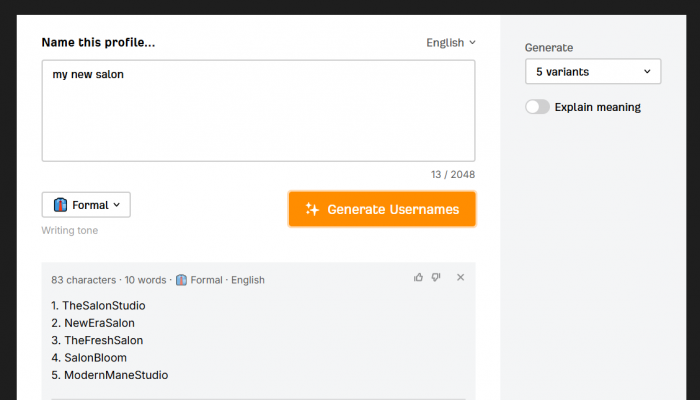
Ahrefs Instagram Name Generator offers more room for describing an account than most basic username generators. Its main input field accepts detailed descriptions, and the additional tone controls help direct the naming style.
The interface is straightforward. It includes a description field, tone selection, and an option to generate multiple variations. One useful addition is the ability to request an explanation of a generated name, particularly for unusual combinations that do not immediately communicate their meaning.
Ahrefs is better suited to detailed creative direction than quick keyword mixing. Its longer input field allows specific information about an account's niche, content focus, and identity. That makes it more appropriate for creators who already understand their positioning.
| Naming scorecard | Assessment |
| Naming approach | Detailed account descriptions |
| Creative control | Prompt length, tone, and variations |
| Output format | Multiple AI-generated name suggestions |
| Main limitation | No guaranteed username availability |
My assessment: Ahrefs offers the most useful input flexibility for niche-focused naming. Its description-based approach provides more control over the direction of the suggestions than generators limited to a few keywords.
2. Buffer: Best for Personal Branding
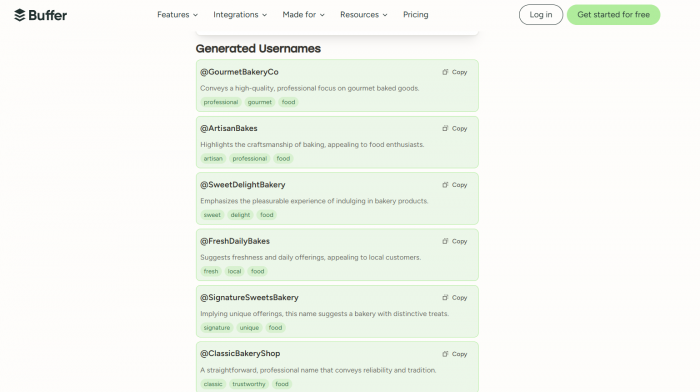
Buffer's Instagram Name Generator takes a more structured approach. Instead of relying entirely on a written prompt, it separates the creator's name, relevant keywords, and preferred tone. Understanding the difference between an Instagram name and username also helps creators make better naming decisions for their profiles.
The four tone options are Playful, Professional, Minimal, and Creative. They give the naming process a clear structure and make it easier to explore different styles while keeping the same personal or brand identity.
Buffer also designs its output around Instagram's username character restrictions. This is an important practical difference because a creative suggestion is not particularly useful if it contains unsupported characters or exceeds the platform's length limit.
The main restriction concerns repeated use. Without a free Buffer account, the generator limits the number of suggestion sets available each day.
| Naming scorecard | Assessment |
| Naming approach | Personal name and keyword combinations |
| Creative control | Four predefined tones |
| Output format | Instagram-oriented username suggestions |
| Main limitation | Daily generation limits without an account |
My assessment: Buffer offers the clearest naming controls for personal branding. The separation between name, keywords, and tone makes the process more organized and helps prevent the original identity from getting lost among unrelated words.
3. Vista Social: Best for Category-Based Names
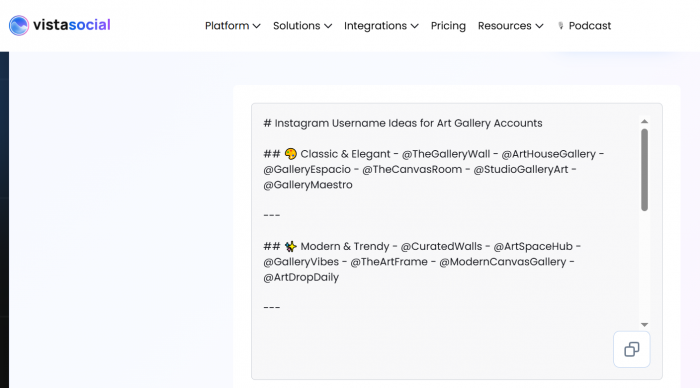
Vista Social's Instagram Name Generator uses two main inputs: category and topic. The interface is more restrictive than Ahrefs, but that is also what makes it easier to use.
The category selection establishes the broad subject of the account, while the topic field provides additional direction. There is no need to build a detailed prompt or manually describe several naming preferences.
The approach is particularly appropriate for content-led accounts. A creator can keep the naming process focused on a particular category instead of trying to combine personal identity, industry terminology, and brand personality in one instruction.
The trade-off is limited flexibility. Its structured inputs do not provide the same freedom to define subtle stylistic preferences or exclude particular naming patterns.
| Naming scorecard | Assessment |
| Naming approach | Category and topic combinations |
| Creative control | Category selection and topic input |
| Output format | Niche-oriented username suggestions |
| Main limitation | Limited detailed style customization |
My assessment: Vista Social is the most straightforward option for category-focused accounts. Its interface keeps the naming process narrow and organized, although it offers less creative control than description-based generators.
4. Hootsuite: Best for Name Brainstorming
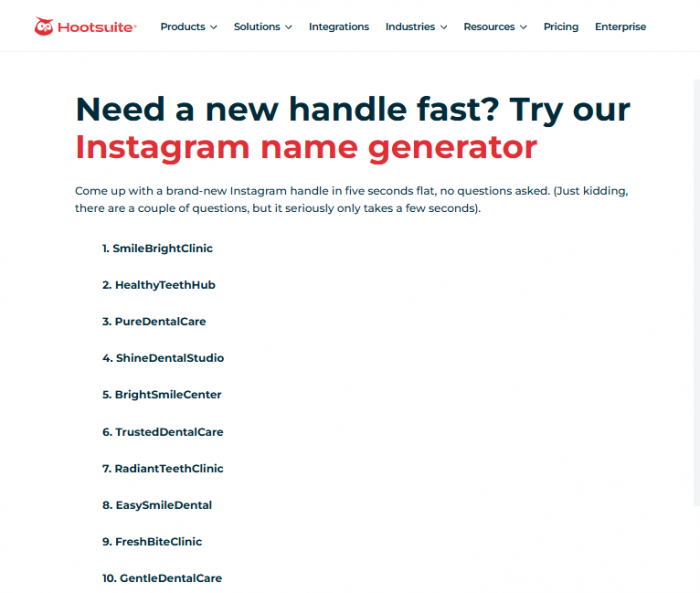
Hootsuite's AI Username Generator focuses on developing usernames from keywords and concepts related to an account. Its naming approach is more open-ended than the category-based structure offered by Vista Social. Keywords provide the starting point, while different combinations allow exploration of personal, descriptive, and brand-oriented naming directions.
Hootsuite also provides supporting resources with username ideas for different account categories. These references are useful for examining common naming styles and distinguishing straightforward descriptive handles from more creative brand names.
Its main weakness is the dependence on keyword quality. Broad terms provide less direction and can lead to familiar combinations. More distinctive names require a clearer set of identifying words.
| Naming scorecard | Assessment |
| Naming approach | Keyword-led generation |
| Creative control | User-selected naming concepts |
| Output format | Multiple username variations |
| Main limitation | Generic keywords can produce familiar patterns |
My assessment: Hootsuite works better as a brainstorming resource than a highly controlled naming system. It provides a useful starting point for exploring different account identities, but the suggestions still need careful filtering.
5. Mention: Best for Personal and Business Accounts
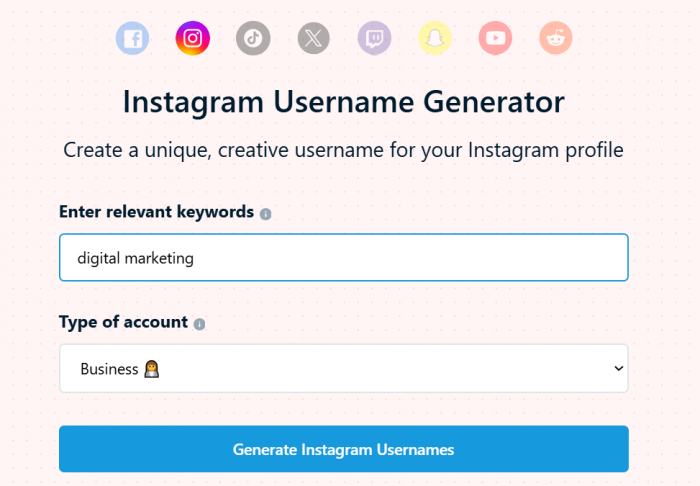
Mention's Instagram Username Generator includes a useful distinction between personal and business accounts. Users enter keywords and select the account type before generating username suggestions.
The account-type selection gives Mention a different approach from generators that rely exclusively on keywords. It recognizes that a casual personal profile and a professional creator account have different naming requirements.
The interface also keeps the process simple. There are no extensive customization menus or complicated settings to work through, and repeated name generation is available without a paid subscription.
Mention does not verify whether the resulting usernames are registered on Instagram. Its suggestions therefore need an availability check before being treated as final options.
| Naming scorecard | Assessment |
| Naming approach | Keywords combined with account type |
| Creative control | Personal or business selection |
| Output format | AI-generated username ideas |
| Main limitation | No confirmed live availability checking |
My assessment: Mention has a useful advantage for professional accounts because it separates personal and business naming intentions. It is simpler than Ahrefs and Buffer, but that simplicity also means fewer opportunities to refine the naming style.
6. RecurPost: Best for Quick Username Ideas
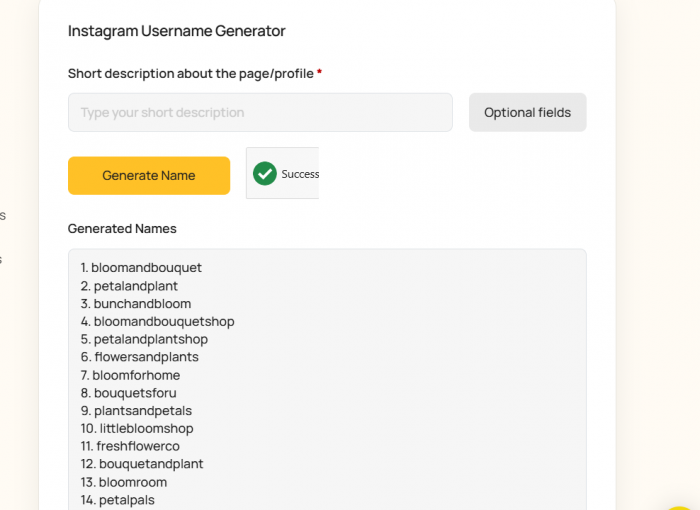
RecurPost's Instagram Username Generator produces ten name suggestions from a short description. It also includes optional industry and account-type settings.
The numbered output is one of its practical advantages. Instead of returning a single suggestion, it provides a collection of names that can be compared and copied individually.
The interface does not require registration and avoids unnecessary setup. This makes it suitable for quick brainstorming, particularly when the account's subject and identity have already been established.
RecurPost is also clear about its restrictions. The generator does not check whether a username is available on Instagram or automatically guarantee compliance with the platform's character limit. Both details must be checked separately.
| Naming scorecard | Assessment |
| Naming approach | Description-based generation |
| Creative control | Industry and account-type options |
| Output format | Ten suggestions per generation |
| Main limitation | No automatic length or availability validation |
My assessment: RecurPost has one of the simplest output formats. It is useful for producing a quick shortlist, but the suggestions require more manual checking before a final name is selected.
Which Generator Offers the Most Control?
The biggest difference between these tools is not the number of suggestions they produce. It is the information they accept before producing them.
| Naming requirement | Most suitable tool |
| Detailed niche descriptions | Ahrefs |
| Personal name and brand tone | Buffer |
| Category-specific naming | Vista Social |
| General creative brainstorming | Hootsuite |
| Personal or business distinction | Mention |
| Multiple quick suggestions | RecurPost |
Ahrefs provides the most flexible descriptive input, while Buffer offers more structured controls. Vista Social and Mention simplify the process by narrowing the user's choices.
Hootsuite is more appropriate for exploring naming possibilities, whereas RecurPost emphasizes speed and a manageable list of suggestions.
What Makes a Generated Instagram Name Good?
The most creative suggestion is not necessarily the strongest username. A name needs to work in search results, profile mentions, social links, and everyday conversations. Exploring short usernames can help creators identify naming patterns that are easier to spell, remember, and share.
I use four criteria to evaluate the quality of an Instagram username:
● Readability: The name should be understandable without unusual spelling, repeated punctuation, or unnecessary characters. A username that requires explanation is harder to communicate.
● Memorability: Short, recognizable combinations are generally easier to recall than long names containing several unrelated words.
● Identity: The handle should reflect the creator or account without relying on generic labels that could apply to hundreds of similar profiles.
● Long-term relevance: A username should remain appropriate as the account grows. Names tied too closely to temporary trends or narrow content formats can become restrictive.
AI generators are useful for discovering combinations, but none of these naming approaches replaces the need to evaluate originality, clarity, and availability.
Final Verdict
Buffer is my top recommendation for personal branding because it provides a clear combination of name, keyword, and tone controls. Its approach is structured enough to guide the results without requiring complicated prompts.
Ahrefs offers more room for detailed niche descriptions, making it particularly useful for accounts with a defined content focus. Vista Social is easier for category-based naming, while Hootsuite provides broader brainstorming options.
Mention offers a useful distinction between personal and business accounts, and RecurPost is convenient for generating ten suggestions quickly. All six tools provide free name generation, so choosing between them should depend on the type of control required rather than price.
The final username should be easy to recognize, practical to use, and relevant to the creator's long-term identity. AI can expand the available naming ideas, but originality, availability, and suitability still require a final human check.