

Table of Content
- Best AI Ad Creative Generators at a Glance
- 1. AdCreative.ai: Best for Multiple Ad Variations
- 2. Creatify: Best for Product Video Ads
- 3. Predis.ai: Best for Social Media Ad Content
- 4. Canva: Best for Editable Branded Ads
- 5. Arcads: Best for AI Actor and UGC-Style Ads
- 6. Pencil AI: Best for Creative Testing and Iteration
- 7. Meta Advantage+ Creative: Best for Native Meta Ad Enhancements
- 8. The Brief: Best for Multi-Format Ad Production
- Which AI Ad Generator Should You Choose?
- Final Verdict
A Facebook or Instagram campaign rarely succeeds with just one creative. Advertisers often need different visuals, hooks, and messages to identify what attracts clicks and conversions. Producing those variations manually can consume hours before testing even begins.
AI ad creative generators help with that production work, but they serve different purposes. Some turn product images into advertisements, others create videos with AI presenters, and a few connect creative development with campaign data. Here are eight options, compared by their actual capabilities, limitations, and pricing.
Best AI Ad Creative Generators at a Glance
| AI Tool | Best For | Starting Price |
| AdCreative.ai | Multiple static ad variations | $39/month |
| Creatify | Product video advertisements | Free plan; $39/month |
| Predis.ai | Social ads and content | $19/month, billed annually |
| Canva | Editable branded creatives | Free; $144/year for Pro |
| Arcads | AI actors and UGC-style ads | Trial; paid pricing in-app |
| Pencil AI | Creative testing and iteration | $14/month |
| Meta Advantage+ Creative | Native Meta ad enhancements | Included in Ads Manager |
| The Brief | Multi-format ad production | $29/month, billed annually |
Note : Prices are indicative advertised starting rates as of November 2026. Credits, billing periods, and regional pricing may affect the final cost.
1. AdCreative.ai: Best for Multiple Ad Variations

AdCreative.ai helps advertisers generate multiple visual concepts from existing product information and brand assets. It is particularly useful for e-commerce businesses testing different layouts, headlines, and promotional messages without designing every variation individually.
The platform also provides AI-based creative scoring, giving marketers an additional reference when deciding which designs to test.
How It Handles Ad Creation
Users create a brand profile, upload assets, and enter campaign details. The platform generates advertising designs and copy, which can be selected, adjusted, and exported for Facebook and Instagram campaigns.
Key Creative Capabilities
● Batch generation: Produces several advertising concepts from the same product or campaign brief.
● Brand customization: Incorporates logos, brand colors, and visual assets into generated creatives.
● Creative scoring: Assigns predictive scores to help marketers shortlist advertising designs for testing.
Pros and Cons
| Pros | Cons |
| Reduces preparation time for campaigns requiring multiple variations. | Typography and image placement may need manual corrections. |
| Useful for agencies managing several product campaigns. | Creative scores do not guarantee better conversion rates. |
| Supports consistent designs across different brands. | Less suitable for advanced video production. |
Pricing: A free trial is available. Paid plans start at approximately $39/month, depending on subscription terms and generation allowances.
2. Creatify: Best for Product Video Ads

Creatify converts product information into short promotional videos. Instead of requiring original footage for every advertisement, it can build video concepts using product pages, AI-generated scenes, virtual presenters, and scripted narration.
It is particularly relevant for product demonstrations, Instagram Reels, and Facebook video campaigns that require frequent creative changes.
How It Handles Ad Creation
Users provide a product URL, image, or brief. Creatify develops a video script and visual sequence, after which users can select AI actors, voices, and creative styles before editing and exporting the result.
Key Creative Capabilities
● URL-to-video generation: Creates promotional videos using information from supported product pages.
● AI avatars: Adds virtual presenters and synthetic voiceovers to product advertisements.
● Script variations: Generates alternative openings and promotional messages for testing different angles.
Pros and Cons
| Pros | Cons |
| Reduces filming requirements for short product advertisements. | Complex physical demonstrations may appear inaccurate. |
| Allows multiple presenter styles without separate recording sessions. | AI-generated movements and voices can occasionally look unnatural. |
| Suitable for creating several video concepts from one product. | Revisions and rendering can consume generation credits. |
Pricing: A limited free plan is available. Paid plans start at approximately $39/month, with additional credits and features in higher tiers.
3. Predis.ai: Best for Social Media Ad Content

Predis.ai combines advertising creative generation with social media content production. It is suitable for small businesses and social media managers who prepare promotional posts, advertising visuals, captions, and regular Facebook or Instagram content.
Its broader content workflow makes it useful when advertising is only one part of a business's social media responsibilities.
How It Handles Ad Creation
Users enter a product description or campaign prompt. Predis.ai generates images, videos, and accompanying copy that can be edited for the selected platform. It also provides scheduling and content management features.
Key Creative Capabilities
● Social ad generation: Creates promotional images and videos using product information or text instructions.
● Copywriting assistance: Generates promotional captions, advertising messages, and calls to action alongside visuals.
● Content management: Supports publishing workflows and competitor-related analysis for social media planning.
Pros and Cons
| Pros | Cons |
| Combines promotional content and regular social media production. | Less specialized in performance ad optimization. |
| Useful for teams managing multiple social accounts. | Complex designs may require external editing. |
| Reduces dependence on separate caption and scheduling tools. | Output quality depends on the supplied campaign details. |
Pricing: Paid plans start at approximately $19/month with annual billing. Trial access and higher-credit plans are available.
4. Canva: Best for Editable Branded Ads
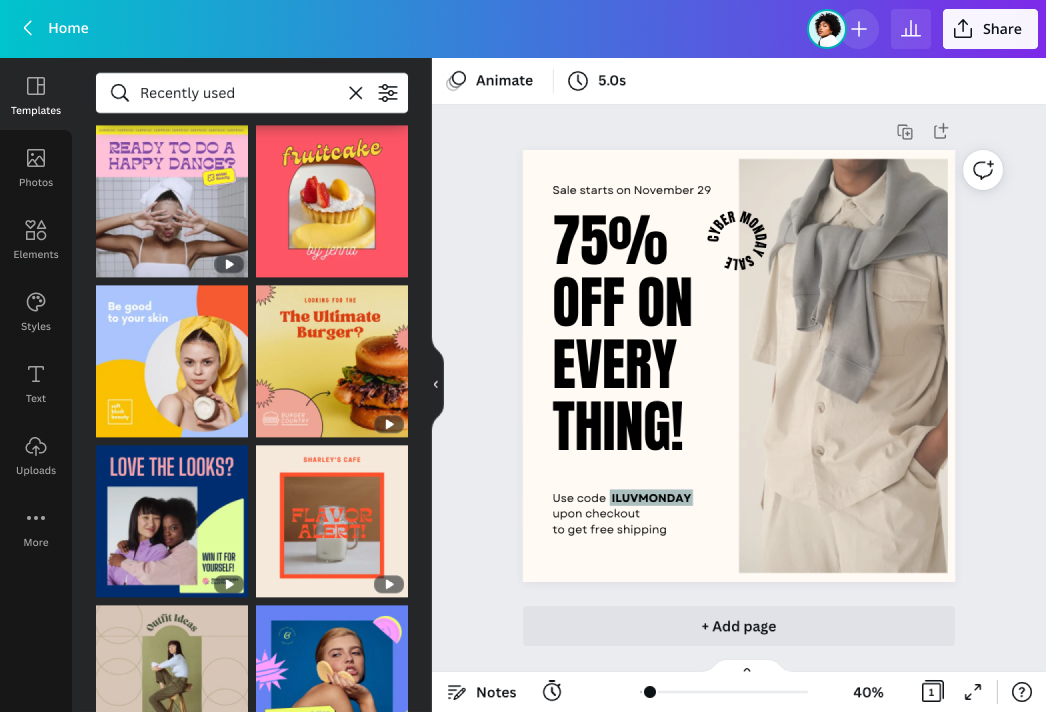
Canva combines AI-assisted design with direct control over advertising layouts. Unlike tools that generate mostly finished creatives, Canva allows marketers to adjust individual design elements, including promotional text, images, colors, and product placement.
This makes it useful for businesses running seasonal offers or campaigns that require frequent changes while maintaining a consistent visual identity.
How It Handles Ad Creation
Users select a template or create a design from scratch. Canva's AI features help generate images, backgrounds, and text. The resulting design can be edited and exported in dimensions suitable for Facebook and Instagram placements.
Key Creative Capabilities
● AI image generation: Creates supporting visuals and backgrounds for promotional designs.
● Brand Kits: Stores approved logos, fonts, and colors for consistent advertising materials.
● Format adaptation: Helps adjust layouts for different placements, including Feed posts and vertical Stories.
Pros and Cons
| Pros | Cons |
| Provides detailed control over advertising designs. | Requires more manual involvement than automated generators. |
| Accessible to users without professional design experience. | Premium assets and some AI tools require paid access. |
| Suitable for branded promotional campaigns. | Lacks specialized advertising performance analysis. |
Pricing: A free plan is available. Canva Pro costs approximately $144/year in the US, with regional pricing differences.
5. Arcads: Best for AI Actor and UGC-Style Ads

Arcads specializes in advertisements featuring virtual actors who deliver promotional scripts. It is designed for brands producing presenter-led videos without arranging a separate filming session for every message or creative variation.
Its AI actors can appear in conversational advertising formats commonly used for product introductions and app promotions.
How It Handles Ad Creation
Users enter a script or creative prompt, choose an AI actor, and configure the video. Arcads generates a presenter-led advertisement with synchronized speech and facial movements, with options for different voices and languages.
Key Creative Capabilities
● AI actor selection: Offers virtual presenters with different appearances and speaking styles.
● Script-to-video production: Converts promotional text into narrated videos featuring AI presenters.
● Localized variations: Supports different languages and voices for adapting advertisements to regional audiences.
Pros and Cons
| Pros | Cons |
| Avoids repeated filming for scripted advertising concepts. | AI presenters may lack the credibility of genuine customer experiences. |
| Makes it easier to test different scripts and presenters. | Detailed product interactions may not look convincing. |
| Supports multilingual advertising production. | Advertisers must avoid presenting fictional testimonials as authentic. |
Pricing: A 72-hour trial with credits is available. Paid plans use credit allowances, with current prices displayed through the subscription interface.
6. Pencil AI: Best for Creative Testing and Iteration
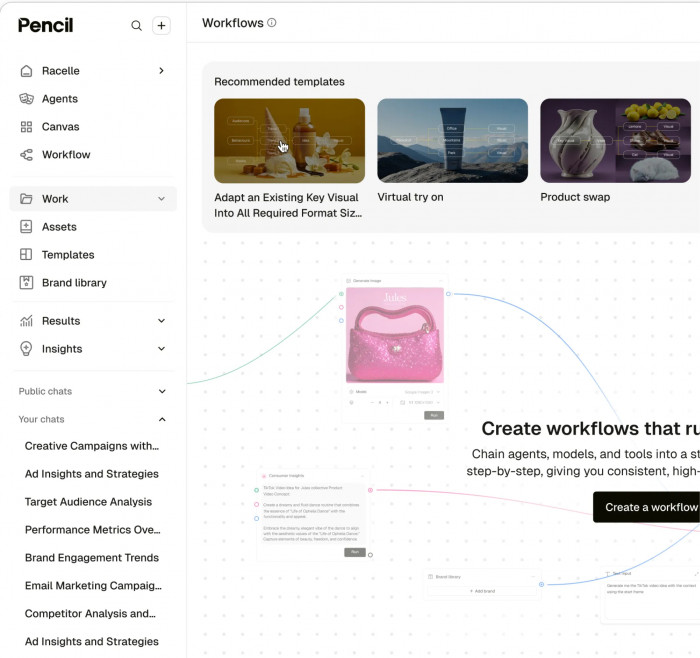
Pencil AI combines advertising asset generation with creative analysis. It is aimed at performance marketing teams that regularly develop new advertisements and want to use campaign insights when planning their next creative concepts.
Unlike basic design generators, Pencil supports workflows that connect creative development with advertising performance information.
How It Handles Ad Creation
Users generate advertising copy, images, and videos through Pencil's AI tools. Supported advertising integrations allow teams to access performance-related insights and use them while developing new variations.
Key Creative Capabilities
● Multi-format generation: Produces advertising assets across text, images, and video.
● Creative analysis: Provides predictive assessments and insights to support creative selection.
● Advertising integrations: Connects creative workflows with supported campaign management and tracking environments.
Pros and Cons
| Pros | Cons |
| Supports data-informed creative experimentation. | Predictive assessments may not match actual campaign outcomes. |
| Useful for teams developing new advertising concepts frequently. | Certain capabilities depend on integrations and available data. |
| Combines creative production with advertising insights. | More complex than necessary for occasional advertisers. |
Pricing: Core starts at approximately $14/month with limited generations. Growth starts around $55/month, while enterprise pricing is customized.
7. Meta Advantage+ Creative: Best for Native Meta Ad Enhancements

Meta Advantage+ Creative provides automated creative enhancements directly within Meta Ads Manager. Rather than generating complete campaigns independently, it helps adapt existing advertising materials for eligible Facebook and Instagram placements.
Its primary advantage is working inside the same environment advertisers use to configure and launch Meta campaigns.
How It Handles Ad Creation
Advertisers upload their images, videos, and copy while setting up campaigns. Depending on account eligibility and available settings, Meta can suggest creative enhancements that users can review before publishing.
Key Creative Capabilities
● Image expansion: Extends existing images to fit different advertising dimensions.
● Text variations: Generates alternative advertising text based on original campaign messaging.
● Automatic enhancements: Offers selected visual and formatting adjustments within eligible Meta ad workflows.
Pros and Cons
| Pros | Cons |
| Requires no separate creative-generator subscription. | Cannot replace a complete advertising design platform. |
| Convenient for advertisers already using Meta Ads Manager. | Available features vary by campaign and account. |
| Reduces some manual placement adjustments. | Automated changes require review for brand accuracy. |
Pricing: Available within eligible Meta Ads Manager workflows without a separate subscription. Standard advertising costs still apply.
8. The Brief: Best for Multi-Format Ad Production

The Brief, formerly Creatopy, is designed for producing coordinated advertising assets across multiple sizes and formats. It is particularly relevant for agencies managing campaigns that require numerous versions of the same promotional concept.
Its production tools help teams reuse designs while adjusting dimensions, assets, and presentation for different advertising placements.
How It Handles Ad Creation
Users develop advertising designs using templates, uploaded materials, and AI-assisted features. The platform supports editing, resizing, animation, and exporting multiple creative variations.
Key Creative Capabilities
● Multi-size production: Adapts campaign designs into different advertising dimensions.
● AI-assisted asset creation: Supports generated visuals, video elements, and promotional copy.
● Campaign organization: Helps manage brand assets and related advertising designs across projects.
Pros and Cons
| Pros | Cons |
| Suitable for producing large sets of coordinated advertising assets. | May be excessive for occasional advertising needs. |
| Reduces repetitive resizing and formatting work. | Advanced production features require higher-tier plans. |
| Helps agencies maintain design consistency across campaigns. | The broader workflow involves a learning curve. |
Pricing: A seven-day trial is available. Pro starts at approximately $29/month with annual billing, with advanced features available in higher plans.
Which AI Ad Generator Should You Choose?
The selection depends on the type of advertising assets a business produces and how frequently new creatives are required.
| Advertising Need | Recommended Tool | Reason |
| Frequent static ad variations | AdCreative.ai | Automated concepts and creative scoring |
| Product-focused video campaigns | Creatify | Product-to-video generation |
| Social media ads and posts | Predis.ai | Integrated content production |
| Branded promotional designs | Canva | Detailed editing and brand controls |
| AI presenter advertisements | Arcads | Virtual actors and scripted videos |
| Creative performance analysis | Pencil AI | Campaign-oriented creative insights |
| Existing Facebook and Instagram ads | Meta Advantage+ Creative | Native creative enhancements |
| Large-scale, multi-size campaigns | The Brief | Coordinated format production |
Subscription price should not be the only deciding factor. Advertisers should consider generation credits, commercial usage permissions, export quality, and the number of revisions typically required to produce one usable asset.
For video tools, rendering costs and language support may matter more than template quantity. For static advertising platforms, editing flexibility and accurate product representation can have greater practical value.
Final Verdict
AdCreative.ai is a practical option for producing multiple static advertising concepts, while Creatify and Arcads are better suited to AI-generated video campaigns. Canva provides greater editing control, and Predis.ai works well for teams combining promotional content with regular social media publishing.
For advertisers managing frequent creative experiments, Pencil AI offers campaign-related analysis. The Brief supports large-scale, multi-format production, while Meta Advantage+ Creative provides enhancements directly inside Meta Ads Manager.
Businesses should choose based on production volume, creative format, editing requirements, and usable output per subscription. The value of these tools comes from reducing creative production work while leaving advertisers enough control to maintain accuracy, test distinct messages, and improve campaigns using actual performance data.