

Artlist AI brings image, video, voiceover, music and 3D generation into a single creative workspace, with access to over 100 AI models from developers including Google, ElevenLabs, ByteDance and OpenAI. Originally known for its licensed music and stock footage, Artlist has evolved into a broader content production platform with dedicated tools for AI filmmaking, visual editing and creative automation.
I explored its capabilities through AFTER HOURS, a fictional premium cold brew coffee brand. The project covered five different content formats, revealing where Artlist offers genuine creative value and where its outputs still need refinement before becoming campaign-ready assets.
What Is Artlist AI?
Artlist AI is a creative production platform designed for social media creators, filmmakers, marketers, video editors and businesses. It combines multiple generative AI technologies with an established library of professionally produced creative assets.
What distinguishes Artlist from many standalone AI generators is its production environment. Instead of limiting users to a particular generation model, it provides model selection, reusable references, project management and dedicated editing tools within the same workspace.
The platform supports original content generation alongside the transformation of existing assets. Its wider ecosystem includes licensed music, stock footage, sound effects, video templates and LUTs, although access to these resources depends on the subscription.
My Creative Approach
For the AFTER HOURS campaign, I worked with a cobalt-blue and cream colour palette, premium coffee branding and a late-night creative lifestyle theme. Using a shared concept across five generators provided a clearer understanding of Artlist's production capabilities, particularly its handling of visual identity and different content formats.
| Feature | Selected model | Creative objective |
| AI Image | V7 | Branded product photography |
| AI Video | Seedance 2.5 | Lifestyle advertisement |
| AI Voiceover | Eleven v3 | Commercial narration |
| AI Music | Lyria 3 Pro | Custom brand soundtrack |
| AI 3D | Hyper3D Rodin v2.5 Fast | Product visualization |
Each generation involved a different production requirement, from accurate branding and realistic materials to visual storytelling, audio direction and three-dimensional product representation.
1. AI Image Generation
Artlist's image generator provides control over model selection, aspect ratio, visual references and prompt-based composition. I started with a branded product photograph intended for Instagram advertising, selecting the V7 model and a 4:5 aspect ratio.
Prompt used:
Create a high-end advertising photograph for a cold brew coffee brand called "AFTER HOURS". Feature a matte cobalt-blue coffee mug with bold cream text "AFTER HOURS" and smaller text "Vanilla Cold Brew". Place the mug on a stainless-steel countertop surrounded by crushed ice, scattered coffee beans and condensation droplets. Use hard afternoon sunlight, dramatic diagonal shadows and a modern editorial style. Make the branding text legible and the materials realistic.
The resulting product composition featured a dark blue ceramic mug filled with iced coffee, surrounded by coffee beans, vanilla flowers and scattered ice. The directional sunlight produced convincing shadows, while the reflections on the countertop added depth to the photograph.
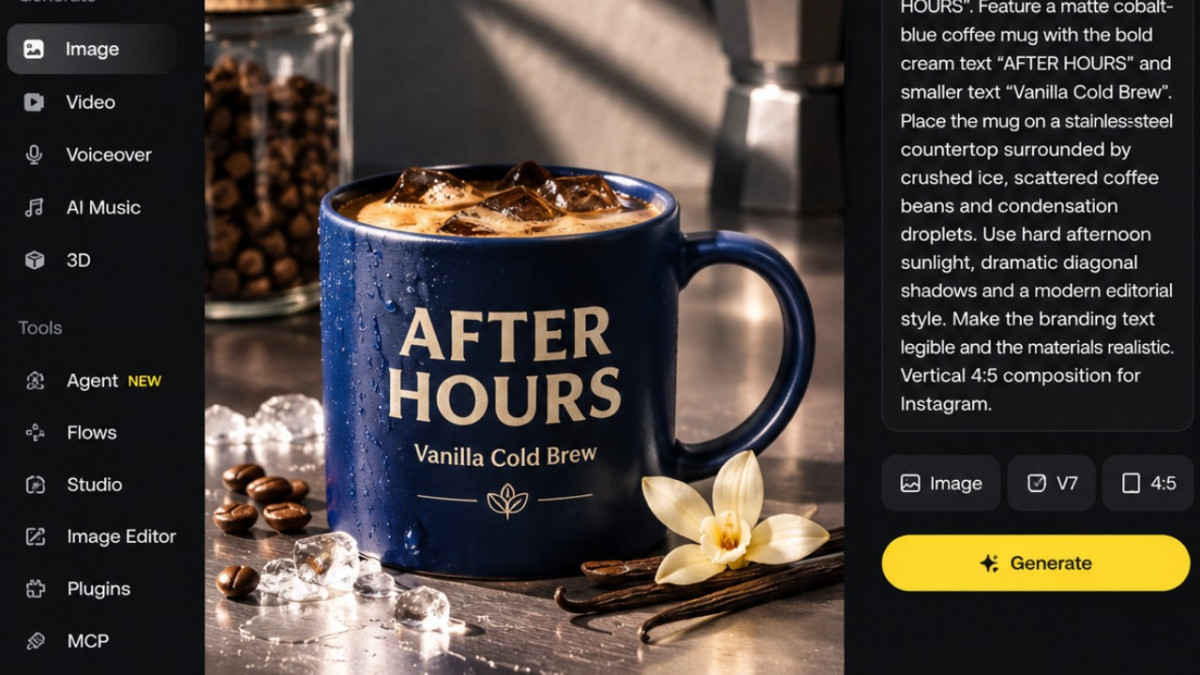
What stood out was the typography. Both the brand name and product description were clearly readable, an important detail that image generators often struggle with. The ceramic finish and condensation droplets also gave the product a convincing commercial appearance.
The additional variations offered overhead, side and pouring perspectives. Branding visibility differed between compositions, but the visual variety was useful for repurposing content into carousel posts and promotional assets without repeating the same product angle.
The image generator was particularly effective for product-focused content, where material accuracy, readable typography and controlled lighting matter more than elaborate artistic effects.
2. AI Video Generation
Rather than producing another stationary product visual, I developed a short lifestyle advertisement around the experience of drinking cold brew during a late-night creative session.
I selected Seedance 2.5 with a 10-second duration and a 9:16 aspect ratio, targeting short-form social media content.
Creative instructions:
Create a 10-second lifestyle advertisement for a cold brew coffee brand. A young creative professional sits alone in a contemporary design studio late at night, surrounded by colour swatches, sketches and unfinished artwork. Show a close-up of their hand opening a cold brew coffee bottle, followed by a shot of coffee pouring over ice in a transparent glass. End with the person taking a sip and returning to their artwork with renewed concentration. Use cinematic editing, realistic hand movements, warm desk lighting and cool nighttime tones.
The generated sequence followed five distinct stages: working at the desk, opening the coffee bottle, pouring the beverage, taking a sip and returning to the artwork.
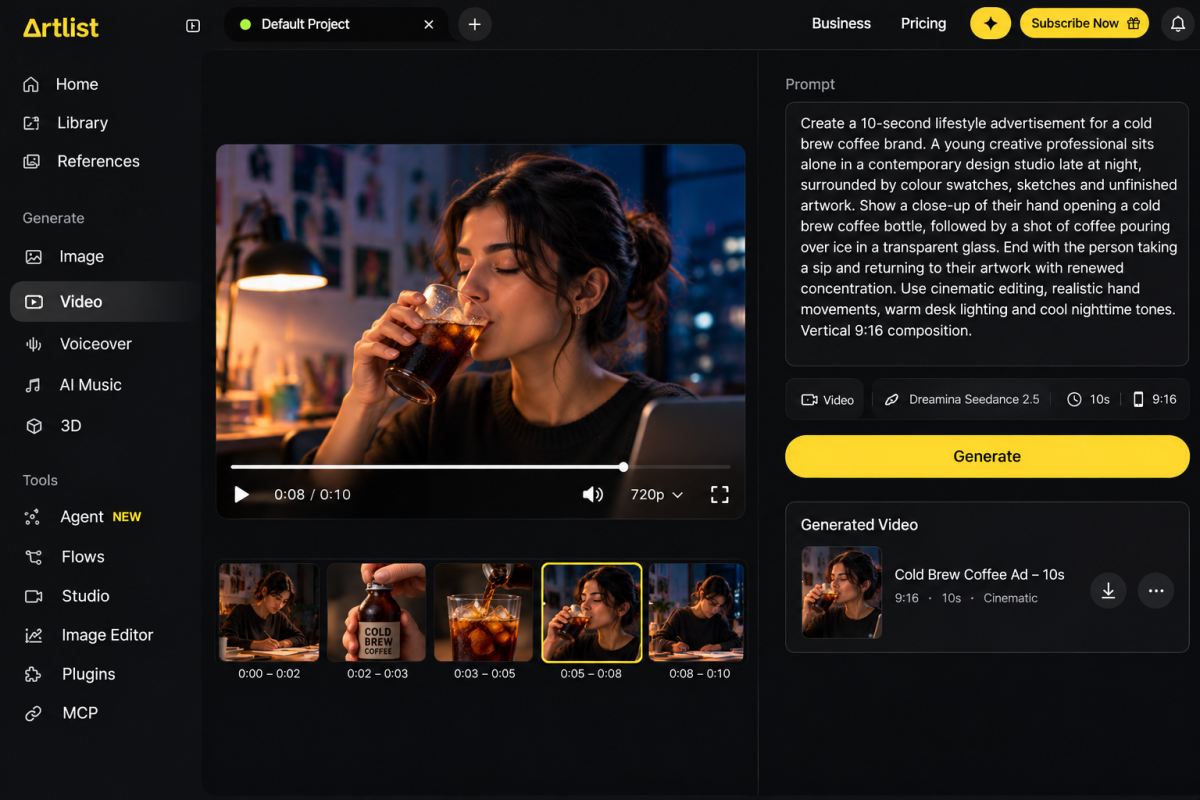
The visible scenes maintained a consistent nighttime atmosphere. Warm desk lighting contrasted naturally with the cooler background, while the character's clothing and appearance remained recognizable across the displayed frames.
The main shortcoming was product continuity. The video introduced a brown coffee bottle with generic labeling instead of carrying forward the cobalt-blue AFTER HOURS mug. The revised prompt requested a bottle, but the resulting packaging lacked the established brand identity.
This highlighted the importance of Artlist's reference-based generation tools for connected advertising campaigns. Text instructions alone did not preserve every visual element across the two content formats.
The sequence established the intended advertising narrative, although the displayed frames do not establish the quality of motion and transitions throughout playback.
3. AI Voiceover Generation
For the narration, I wanted a conversational commercial voice rather than an exaggerated advertising delivery. Artlist's voice library includes different accents, languages and speech models, including ElevenLabs' expressive voice generation technology.
I chose Eleven v3 with the Suburb voice, American English and no additional voice effects.
Narration script:
It's 11:47 p.m. The city is getting quieter, but your best ideas are just getting started.
Crack open something different.
Smooth cold brew. A hint of vanilla. No unnecessary distractions.
AFTER HOURS. Made for the moments when the rest of the world clocks out.
The generated voiceover was presented as a 15-second audio asset. Its length fits common short-form advertising placements, while the script moves from an opening hook to product characteristics and a closing brand message.
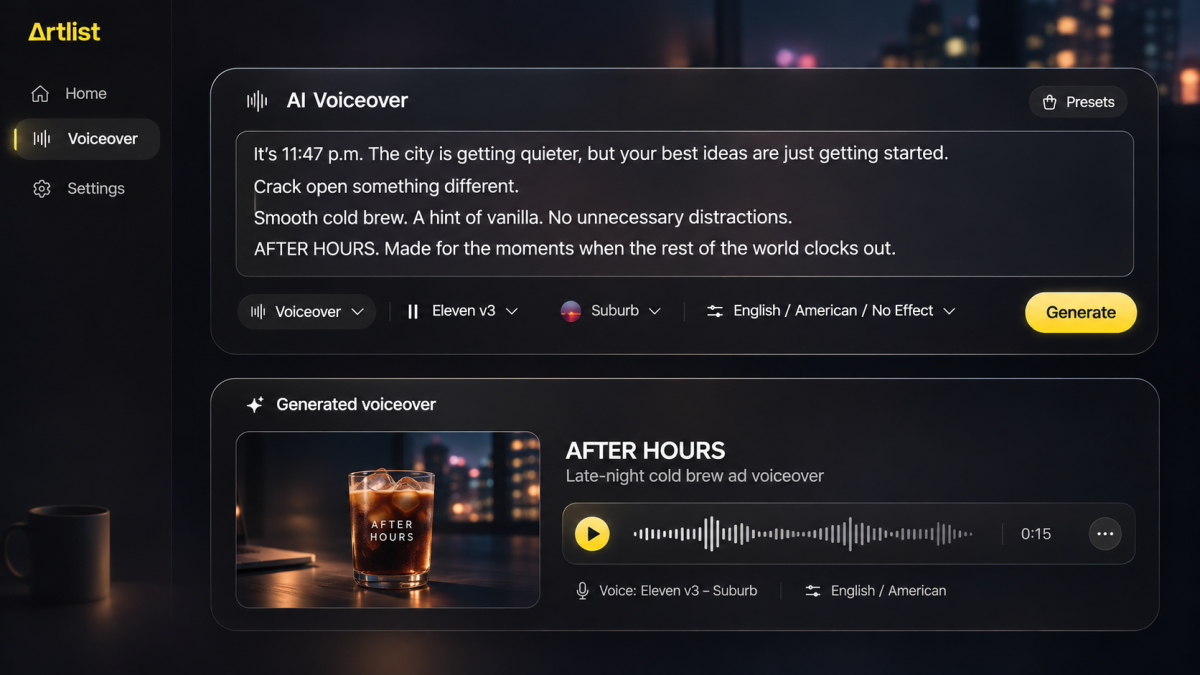
One consideration was the amount of dialogue within the available runtime. The script contains several natural stopping points, but fitting everything into 15 seconds leaves limited room for a slower, premium commercial delivery.
Artlist's voice selection and straightforward script-based workflow reduce the production steps involved in preparing commercial narration. Pronunciation, vocal expression and pause placement remain playback-level quality checks rather than qualities established by the audio waveform.
This feature is particularly relevant to faceless content creators, product marketers and YouTubers who require narration without arranging separate recording sessions.
4. AI Music Generation
Artlist's AI music generator offers an alternative to browsing existing stock tracks. It accepts detailed musical instructions covering instruments, tempo, genre, atmosphere and composition structure, giving creators greater control over their campaign's audio identity.
For AFTER HOURS, I wanted an instrumental soundtrack that complemented the late-night setting without competing with the commercial narration. I selected Google's Lyria 3 Pro model and specified a 30-second composition.
Music generation prompt:
Compose a 30-second instrumental soundtrack for a late-night urban cold brew commercial at approximately 92 BPM. Begin with atmospheric vinyl crackle and muted Rhodes piano chords. Introduce a deep syncopated bassline, brushed percussion and restrained electronic beats after five seconds. Add a subtle melodic rise around the midpoint, then finish with a clean, distinctive three-note musical signature suitable for a brand reveal. Blend alternative jazz with modern lo-fi electronica. No vocals, abrupt transitions or overpowering drums.
The resulting track, titled After Hours – Cold Brew Theme, was presented with a 30-second duration, 92 BPM and an alternative jazz and lo-fi electronica classification.
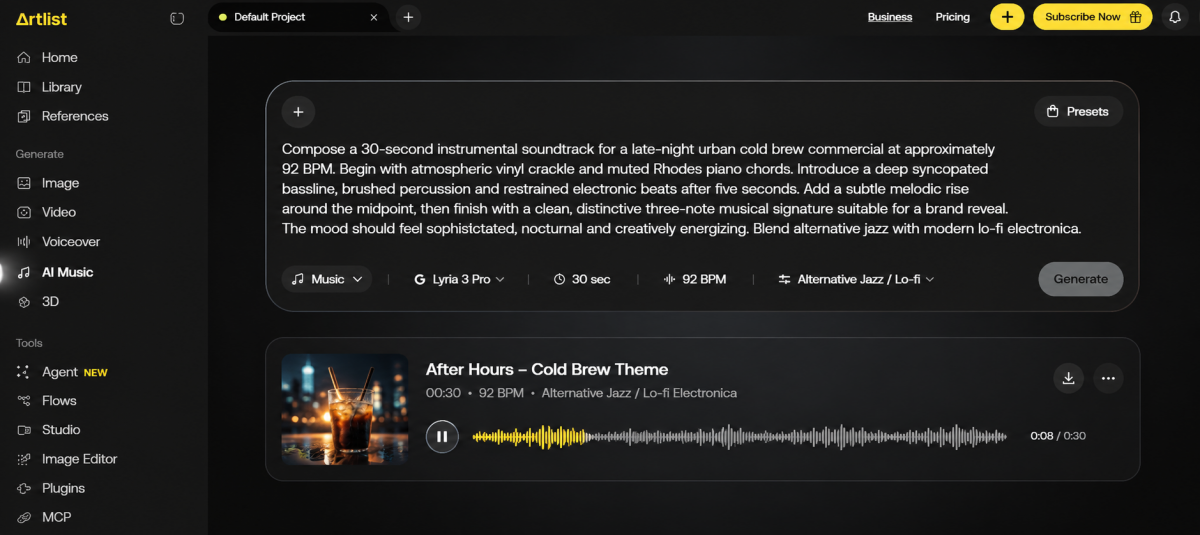
The selected musical direction complements the campaign's urban nighttime aesthetic. Specifying instrumental music also kept the creative brief compatible with the separate voiceover.
What makes this feature useful is the level of creative direction available through a single prompt. Instead of searching through dozens of stock tracks, creators can define the musical structure around their content. Instrument clarity, actual tempo and the requested three-note ending remain important listening checks before incorporating the track into a finished advertisement.
5. AI 3D Model Generation
The 3D generator was one of the more interesting additions to Artlist's creative toolkit. It supports generating textured three-dimensional objects from written descriptions or reference images, extending its applications into product visualization and commercial design.
I recreated the original AFTER HOURS coffee mug using Hyper3D Rodin v2.5 Fast with the Standard quality setting.
Generation prompt:
Create a realistic, fully rotatable 3D model of a premium coffee mug for a cold brew coffee brand "AFTER HOURS". Use a matte cobalt-blue ceramic mug with bold cream lettering that reads "AFTER HOURS" and smaller text "Vanilla Cold Brew". Add a subtle crescent moon symbol above the title and a minimal coffee-bean emblem below. Include realistic surface texture, condensation droplets and iced coffee with ice cubes. Maintain accurate proportions, a sturdy handle and consistent branding across all angles. Generate the mug as an isolated 3D asset without any background or surrounding objects.
The product preview displayed a well-defined ceramic mug with a curved handle, readable branding, condensation droplets and visible ice cubes. The front, rear, side, top and bottom perspectives provided a more comprehensive representation of the product than a conventional generated photograph.
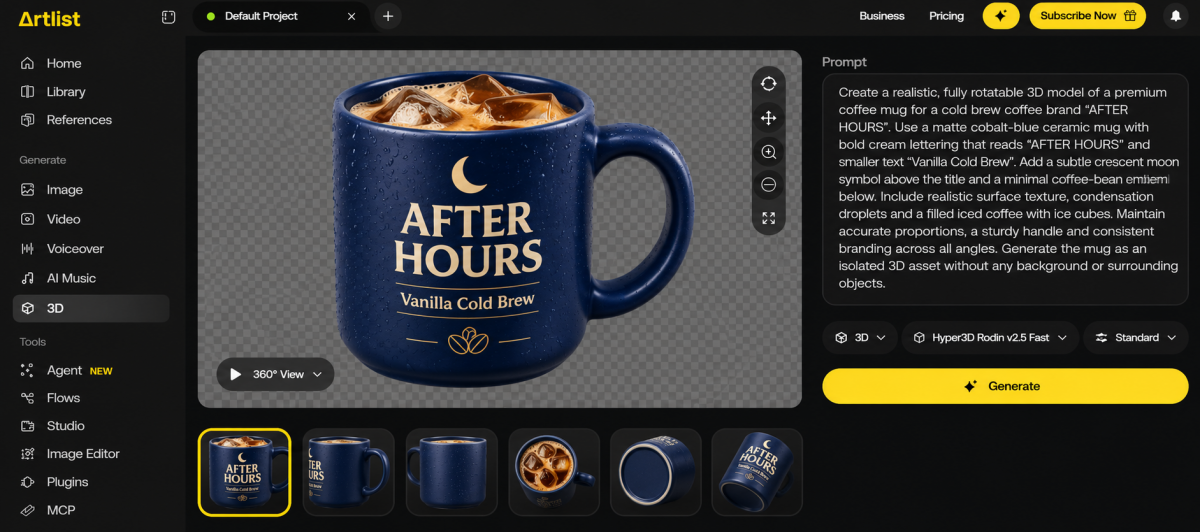
The ceramic finish retained its visual character across the displayed angles, and the handle appeared structurally consistent. The crescent moon and coffee-bean emblem also added recognizable branding details.
There was a slight difference between the original product photograph and the 3D design, particularly in the typography arrangement and decorative elements. Maintaining identical brand guidelines requires greater control over these details.
The visual output was promising for product presentations and rotating advertisements. Professional animation workflows, however, also depend on mesh quality, texture mapping and exported file compatibility, which require separate inspection.
Other Features Worth Exploring
Artlist's wider capabilities address several production requirements beyond generating individual images, videos and audio tracks. Its additional tools are particularly relevant to projects involving repeated characters, multiple scenes and recurring brand assets.
● Artlist Studio: A dedicated AI filmmaking environment for developing cinematic sequences, composing scenes, directing camera angles and maintaining character and location references.
● Creative Agent: A conversational assistant that helps develop creative concepts, refine instructions and select appropriate generation models and settings.
● Flows: A node-based workspace for connecting different AI generation processes and establishing reusable production workflows.
● Image Editor: Provides targeted visual modifications, background removal and layer-based editing without regenerating an entire composition.
● AI Avatars and Lip Sync: Supports speaking digital presenters and the synchronization of character movements with dialogue.
● References and Style Kits: Stores reusable creative references to maintain recognizable characters, products and visual styles across projects.
● AI Presets: Offers more than 70 predefined creative effects and workflows, reducing the amount of manual prompt preparation.
● Plugins and Integrations: Connects Artlist with supported external editing software and AI environments.
Artlist also maintains its professional catalog of music, sound effects, footage, templates and LUTs. This combination of generated and professionally produced assets remains an important distinction between Artlist and standalone AI generators.
AI Models and Flexibility
Artlist's multi-model architecture allows creators to choose generation technology according to the requirements of individual projects. Image models differ in typography handling and visual interpretation, while video models vary in their motion capabilities, supported references and scene controls.
| Generation category | Notable AI models |
| AI Image | Nano Banana, GPT Image, FLUX, Seedream and V7 |
| AI Video | Google Veo, Kling, Seedance and Runway |
| AI Voiceover | Eleven v3, Eleven Multilingual and Artlist voices |
| AI Music | Google Lyria models |
| AI 3D | Hyper3D Rodin models |
Model selection also affects credit consumption. Higher-resolution images, longer video sequences and advanced generation settings generally require a larger portion of the available credit balance.
This flexibility is valuable for creators who work across different content formats, although learning the strengths and restrictions of individual models remains part of the production process.
Where Artlist AI Delivers Value
Artlist is particularly useful for creators who need several types of digital assets rather than a single generation feature. The AFTER HOURS campaign illustrates how a structured approach to AI content production can support five distinct production components around one creative direction.
| Content category | Practical applications |
| Social media | Instagram Reels, carousels and promotional graphics |
| E-commerce | Product photography, demonstrations and 3D assets |
| Digital advertising | Commercial videos, narration and branded soundtracks |
| YouTube | Supplementary footage, thumbnails and voiceovers |
| Filmmaking | Storyboards, scene development and concept visualization |
| Creative agencies | Multi-format campaigns and client deliverables |
The platform is less compelling for occasional users who only need basic graphics or a handful of monthly generations. Its broader functionality and shared credit system make greater economic sense for creators with recurring production requirements.
For professional campaigns, Artlist is most useful during concept development and asset production. Final editing, brand compliance and technical quality control remain separate responsibilities.
Commercial Rights and Licensing
Artlist includes commercial usage rights with its paid AI plans, making its generated content relevant to monetized social media channels, advertising and commercial creative projects.
Its traditional stock assets operate under separate licensing conditions. Subscription coverage, project publication and distribution requirements remain important when combining licensed music or footage with AI-generated material.
Commercial usage permission also differs from exclusive copyright ownership. Third-party trademarks, copyrighted reference material and recognizable individuals introduce additional rights considerations that the subscription alone does not resolve.
Businesses and agencies should select a license that covers their organizational structure and client work rather than evaluating subscriptions solely through generation credits.
Is Artlist AI Genuine?
Yes, Artlist AI is a legitimate creative production platform operated by Artlist, an established company that entered the digital music licensing market in 2016.
Its official licensing documentation, established subscription services, professional stock catalog and integration of recognized AI technologies distinguish it from lesser-known generation websites with unclear ownership or commercial policies.
The company maintains a dedicated help center covering subscription management, generation credits, model availability and licensing conditions. However, its credibility as a business does not remove the need to assess individual generated outputs before commercial publication.
Advantages and Limitations
The campaign's five content formats highlight both the benefits of Artlist's combined production environment and the areas that require greater creative control.
Advantages
● Access to multiple generation models through a shared subscription reduces the need for separate AI services.
● Image, video, voiceover, music and 3D tools support different stages of commercial content production.
● Detailed creative prompts provide control over composition, storytelling, musical direction and product presentation.
● Reference management and dedicated production tools support more organized campaign development.
● Paid plans include commercial licensing under the applicable subscription terms.
Limitations
● Product appearance and branding are not automatically preserved across different generation models.
● Credit consumption varies considerably according to the selected model and output settings.
● Free generation allowances are limited and restricted to selected models.
● Unlimited generation does not extend to every available AI model.
● Complex video and 3D assets require technical inspection before professional use.
Artlist AI Pricing
Artlist offers a free trial and several paid AI Suite subscriptions. The free account includes two image generations, one video, three voiceovers, two music tracks and 2,000 dedicated Artlist Studio credits.
| Plan | Starting price | Monthly AI credits |
| Free Trial | $0 | Limited generations |
| AI Starter | $11.99/month | 16,500 |
| AI Core | $23.99/month | 40,000 |
| AI Pro | $59.99/month | 120,000 |
| Enterprise | Custom pricing available | Customized |
Prices are advertised USD monthly equivalents for annual subscriptions.
The paid plans provide shared generation credits, while higher subscription tiers include unlimited access to selected models and additional production capabilities.
Artlist also offers combined subscriptions for creators who require both AI generation tools and professionally licensed stock assets.
Its official pricing guide and subscription page currently differ in some plan names and credit tiers. The figures above follow its advertised subscription page. Creators should confirm the included models, music allowances and unlimited generation conditions before subscribing.
Final Verdict
Artlist AI stands out for its ability to bring several creative production requirements into one workspace. The AFTER HOURS campaign demonstrated promising product imagery, structured visual storytelling and detailed 3D product representation, alongside dedicated tools for custom narration and music production.
Its strongest advantage is the breadth of its creative environment rather than the performance of any single AI model. Brand consistency and variable credit consumption remain its principal limitations.
Artlist AI is particularly useful for social media creators, digital marketers, filmmakers and agencies producing recurring commercial content across multiple formats. Its combination of generative AI, professional stock assets and dedicated production tools makes it a worthwhile platform for serious content creation.