

Facebook stopped paying creators through in-stream ads, Ads on Reels and the Performance Bonus. All three were folded into one program, Facebook Content Monetization, and the entry requirements everyone had memorised went with them. There is no published follower count to hit and no watch-minutes target to clear. The program is invite-only, and Meta publishes no rate per view or per 1,000 views.
That leaves new creators working from guides that still quote retired numbers. This article covers what the current program pays for, how qualified views decide your earnings, how invitations actually arrive, where Creator Fast Track, the Breakthrough Bonus and Stars fit, and what a creator starting from zero can realistically build in twelve months.
What Is Facebook Content Monetization
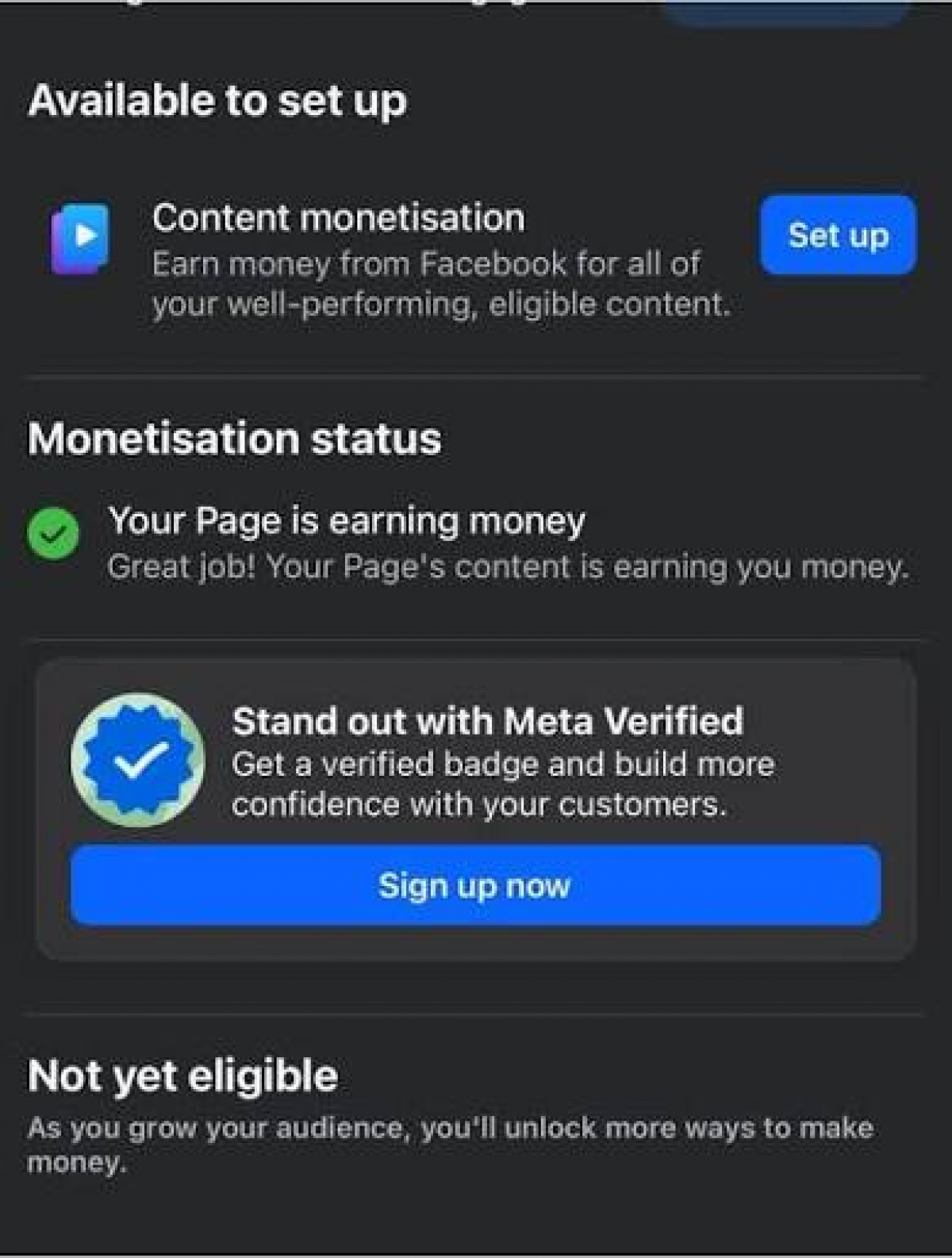
Facebook Content Monetization is Meta's single payout program for creators. It covers eligible public reels, photos, stories and text posts, and pays based on how individual pieces of content perform rather than on a fixed rate per view.
For years Facebook ran several overlapping payment schemes, each with its own thresholds and dashboard. That has collapsed into one system with one set of metrics and one way in. The trade-off is that the program has no rate card, because payouts track how individual posts perform which makes income harder to forecast than YouTube's ad share.
Changes to Facebook's Monetization Programs
The merger was announced on 2 October 2024, with the last day to earn under the old programs falling on 31 August 2025. The creators had roughly eleven months of notice.
The reason this still causes confusion is that the old thresholds were specific and widely republished. In-stream ads required 600,000 minutes viewed in 60 days. That figure remains the most quoted number in search results on Facebook monetization, and it has been attached to a closed program for over a year.
| Old program | Status | What replaced it |
| In-stream ads | Ended 31 August 2025 | Content Monetization |
| Ads on Reels | Ended 31 August 2025 | Content Monetization |
| Performance Bonus | Ended 31 August 2025 | Content Monetization |
| Facebook Stars | Still running, separate | Unchanged |
A quick filter for anything you read on this subject: if an article names a follower or watch-minutes threshold as the requirement for Content Monetization and never mentions August 2025, it is describing a program that no longer exists.
How the Program Works
Meta's current guidance states that Content Monetization is invite-only. Invitations come through official in-product channels the Facebook app, email, Meta Business Suite and the Professional dashboard. Meta has said it plans to open enrolment to everyone, but that has not happened yet.
Under the old system, monetization was a threshold you crossed. Under the current one, it's a selection you're included in. You can make yourself a more obvious candidate; you cannot trigger the outcome.
That reorders what's worth doing. Content built to move a counter looks different from content built to be worth inviting, and only the second kind holds its value if the rules change again.
Qualified Views and Non-Qualified Views
This is the mechanic that explains why a reel with a million views can pay far less than expected.
Facebook does not pay on the view count shown on the post. It pays on qualified views that may be eligible to earn with non-qualified views reported separately alongside a breakdown of why they didn't count, where the dashboard supplies one. Posts watched for under five seconds do not count at all. Reels must run at least 10 seconds and stories at least 5 seconds to be eligible.
Three consequences follow:
● A high view count on a short, fast-scrolled reel can produce very little qualified volume. If most of your audience leaves inside five seconds, those views inflate your public numbers and contribute nothing to earnings.
● The gap between total and qualified views is a diagnostic. A persistently low ratio points to a problem with hooks, pacing or audience geography, and the dashboard now names the reason where it can.
● Two posts with identical view counts can earn very differently, because qualified-view share varies by format, by where the audience sits and by how the content was surfaced. An account-wide average hides this.
Track the ratio per post, the way you'd track retention. Improving hooks and watch time can help keep viewers engaged beyond the opening seconds, while the gap between total and qualified views shows how much attention translates into earning potential. That tells you more about your content's performance than follower growth alone.
Understanding the Earnings Rate
Since 18 March 2026, the dashboard has shown three linked metrics: Qualified Views, Earnings Rate approximate earnings per 1,000 qualified views and a non-qualified views breakdown.
That gives you a usable calculation: estimated earnings = qualified views ÷ 1,000 × earnings rate. A post with 240,000 qualified views at a rate of $1.80 per thousand works out to roughly $432 for the period.
The limitation is in the inputs. Meta publishes no rate per view or per 1,000 views, and says earnings depend on numerous factors including qualified views and watch time, as determined solely by Meta. It has also said payouts may not be linear, with no direct correlation between a reel's plays and its earnings.
So every "Facebook pays $X per 1,000 views" figure online is somebody's undisclosed sample, usually from a different country and niche. Your own earnings rate is the only number that governs your account. Log it monthly after three or four months it tells you which formats and topics actually earn for you.
Eligibility and Invitations
Meta publishes no follower minimum for Content Monetization. There is no application either, only an interest form that states explicitly that it is not an application and does not guarantee an invitation. The stated baseline is an established presence of at least 30 days and residency in an eligible country.
To check your status: open Meta Business Suite on a computer, click Monetization in the left menu, then View Page eligibility in the Status section. Check it periodically, since status can change without notice.
What you control and what you don't splits cleanly:
● In your hands: Running a Page or Professional Mode profile rather than a personal profile, posting original material, and maintaining a consistent publishing schedule. A professional Facebook page also needs a clear identity, complete profile information, and relevant content that reflects its purpose. Staying clear of policy strikes remains essential for monetization eligibility.
● Not in your hands: when Meta runs an invitation wave, which markets it prioritises, and whether your account falls into that batch. Creators have reported invitations at a few hundred followers and silence at several hundred thousand.
The form takes a minute to submit. Refreshing the dashboard afterwards costs attention better spent on the first list.
Creator Fast Track
Creator Fast Track launched on 18 March 2026 for the US and Canada, with the UK and Australia added to the program page between the 5 May and 12 May 2026 captures. It is the only place Meta attaches guaranteed dollar figures to posting on Facebook.
Requirements: more than 20,000 followers on Instagram, TikTok or YouTube, at least 30,000 video views on that account in the past 60 days, and status as a new or returning creator meaning anyone who has posted a Facebook reel in the last six months is excluded. Accepted creators post 15 reels a month across at least 10 separate days, with no minimum view requirement attached to the payments.
| Followers elsewhere | Monthly guarantee | Duration |
| 20,000 – 99,999 | $100 – $450 | 3 months |
| 100,000 – 999,999 | $1,000 | 3 months |
| 1,000,000+ | $3,000 | 3 months |
The six-month exclusion is the detail worth noticing. A creator who has been posting to Facebook consistently is locked out, while someone who has never used the platform walks in with guaranteed pay. Fast Track is an acquisition budget, not a loyalty reward.
For scale, a creator with 100,000 followers posting the minimum 15 reels receives $1,000 regardless of performance; matching that on TikTok at typical rates would take between one and 2.5 million qualified views. The guarantee removes volatility for one quarter, after which you return to performance-based pay. Logging your qualified views and earnings rate against the guaranteed payment during those three months tells you exactly what your Facebook audience is worth without it.
Breakthrough Bonus
The Breakthrough Bonus is United States only. Creators 18 or older living in the US, active on another social app, with a professional Instagram account and a Facebook Page, can apply on mobile for up to $5,000 in bonuses across their first 90 days. Acceptance also leads to a Content Monetization invitation, which is the more valuable half of the offer.
It runs alongside Fast Track rather than replacing it, so US creators should check both. Creators outside the US can skip it a lot of coverage presents it as a general option when it isn't.
Facebook Stars
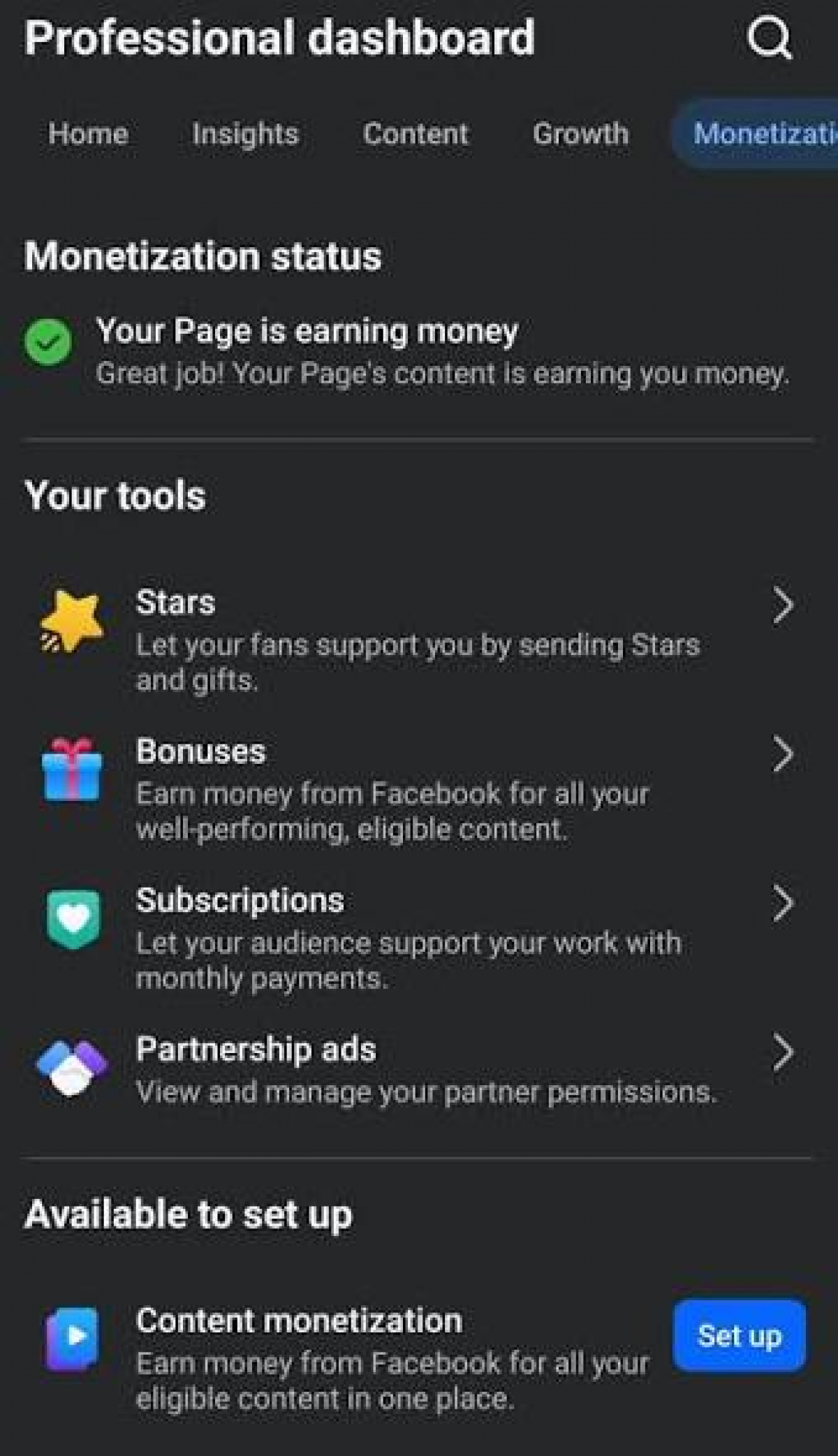
Stars carries the one published threshold a new creator can realistically reach: 500 followers maintained for 30 consecutive days, plus the standard age, country and policy conditions.
Stars is direct tipping rather than a share of ad revenue, which makes it a different business. Tips come from a specific person responding to something specific, usually during a live broadcast. That makes the income smaller and less predictable than ad share, but far more informative.
For a creator with no monetization access, the value beyond the money is evidence: it's the earliest proof that an audience will pay you directly. That relationship is portable. Ad-share eligibility doesn't belong to the platform, and the platform has restructured it twice.
Supported Countries and Languages
Reels earn only when published in the countries and languages on Meta's list, which currently runs to around 70 countries. The program is invitation-only in all of them.
Availability is binary. If your country or publishing language isn't on the list, watch time changes nothing, and the sensible move is building off-platform income instead of monitoring your eligibility page.
Inside eligible markets, earnings follow advertiser demand rather than audience size. A creator with 200,000 viewers in a low-spend market and one with 20,000 viewers in a high-spend market have different ceilings. This is the main reason reported earnings figures swing so wildly between creators, and why comparing your rate to a stranger's without knowing their audience geography is meaningless.
Policy Compliance and Eligibility Risks
Access is revocable, and keeping it is stricter than getting it. Community standards violations, spam or misleading content, copyright strikes and undisclosed branded content can all block eligibility. A single active strike can cut off every monetization feature at once.
Originality catches the most people. Reused, low-effort or recycled material is among the most common disqualifiers, and that includes content technically yours but assembled with minimal added value compilations, reuploads with a new caption, lightly re-cut footage.
Three habits reduce the risk:
● Keep a record of where every clip, image and audio track came from, including licences. Reconstructing that from memory six months after a claim arrives is close to impossible.
● Disclose branded content through Facebook's tagging tools, not just the caption. Undisclosed partnerships are treated as a policy violation, not a stylistic choice.
● Check your Page's standing on a schedule rather than after a problem. Strikes expire, but you need to know they exist before they accumulate.
Other Ways to Earn on Facebook
Meta has said Facebook paid creators nearly $3 billion in 2025, up 35% year over year and its highest annual total. It is also a royalty rather than a salary, and it has been restructured twice in roughly two years.
Content Monetization works better as one line of income than as the whole of it. The realistic alternatives, roughly in order of how soon a new creator can access them:
● Brand partnerships require no invitation and often pay better per view than platform share, especially for small accounts with a clearly defined audience. A 5,000-follower page in a specific niche is sellable; a 50,000-follower general-interest page frequently isn't.
● Affiliate and commerce, including Facebook Shops, where income tracks what your audience buys rather than what a view is valued at.
● Paid subscriptions, which convert a small share of an audience into predictable monthly revenue and are far less sensitive to algorithmic swings.
● Off-platform assets an email list, a product, a service. The slowest to build and the only one that survives a platform changing its terms.
Timeline for New Creators
Months 1–3 go to setup and signal. Move to a Page or Professional Mode, publish consistently, submit the interest form once, and turn on Stars at 500 followers. Expect no money. The output is a body of original work and a publishing habit.
Months 4–8 are for learning what your audience responds to. Watch retention and completion rates closely; those drive qualified views even before you can see a qualified-view count. An invitation, if it comes, most often lands in this window.
Months 9–12 are when the numbers become readable. With access, you'll have enough earnings-rate history to identify which formats pay. Without it, you'll still have an audience worth taking to brands.
Monetization is a lagging indicator of audience value rather than a target to aim at. Creators who chase the invitation tend to produce the thin, repetitive, high-frequency output that gets flagged as low-effort, which is the most reliable way to disqualify yourself.
Getting Started
For the first week, in order:
1. Convert to a Facebook Page or switch your profile to Professional Mode. A personal profile alone is not eligible for anything.
2. Check your actual status in Meta Business Suite under Monetization, then View Page eligibility, and note what it says.
3. Submit the interest form once from your Professional or Business Dashboard, then leave it.
4. Turn on Stars if you're past 500 followers, and plan something live worth tipping for.
5. Audit your back catalogue for anything reused or unoriginal and remove what you can't defend.
6. Start a monthly log total views, qualified views where visible, earnings rate, earnings. In six months it becomes the most useful document you own.
Conclusion
Facebook Content Monetization is broader than the programs it replaced it pays across reels, video, photos, stories and text and the March 2026 dashboard metrics gave creators their first real visibility into which views earn and why. What it took away was predictability. Access is granted rather than earned, no rate is published, and the only guaranteed money sits with Creator Fast Track, which is reserved for creators who built their audience elsewhere.
For someone starting now, the practical sequence is short: set the account up correctly, submit the interest form once, turn on Stars at 500 followers, and put the rest of your effort into brand work and anything you own outright. Treat a Content Monetization invitation as an addition to that, not the thing you're waiting on.