


Table of Content
- Where the clock starts on each platform
- The three jobs a hook has to do
- Hook writing tips that held viewers on my channel
- Six hook formulas with examples
- The 20-minute hook writing routine I use now
- Mistakes that flatten the graph
- What happened when I let AI write the hooks
- How to check whether the hook worked
- Final verdict
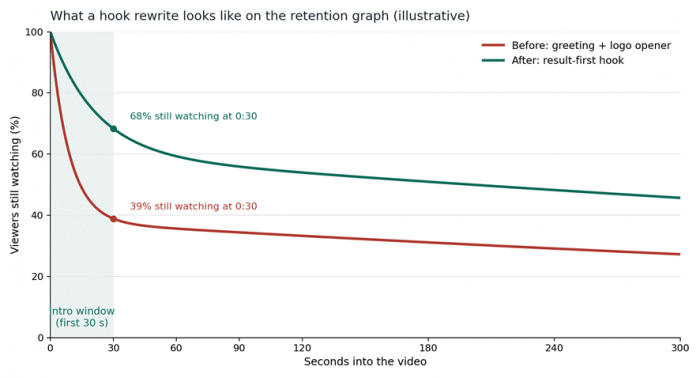
For most of last year I treated the opening of a video as a formality. Write the script, film it, tack a “hey everyone, welcome back” on the front, publish. The audience retention report in YouTube Studio is what finally broke me of it. Upload after upload showed the same shape: a cliff in the first 20 seconds, then a flat line made up of whoever happened to stay.
So I spent the better part of this year changing one variable at a time. Same channel, same topics, same editing style. Only the first 30 seconds changed. I rewrote openings, filmed two versions of several of them, and kept a spreadsheet of what the Intro number did each time. I also ran a few weeks of hooks through AI writing tools to see whether they could shortcut the work, and I’ll be straight about what happened there.
Everything below is what moved the graph. It’s laid out in tables and short cards so you can pull the pieces that fit your format instead of reading a lecture. If you only take one thing away, take this: the hook is not the first line you write. It’s the last.
Where the clock starts on each platform
A hook doesn’t have one length. Each platform scores the opening in a different window, and if you write for the wrong window you end up optimizing the wrong thing.
| Platform | Where the stay-or-leave decision happens | What the platform measures |
|---|---|---|
| YouTube long-form | First 30 seconds | The “Intro” key moment in Studio: the share of viewers still watching at 0:30, compared against your last 10 videos of similar length |
| YouTube Shorts | First 1 to 2 seconds | Viewed vs swiped away, plus average view duration |
| TikTok | First 3 seconds | Average watch time and watched-full-video rate. TikTok for Business tells advertisers to land the content proposition inside the first 3 seconds |
| Instagram Reels | First 3 seconds | Watch time and average watch time in Insights |
| Facebook and Meta ads | First 3 seconds | Hook rate (3-second plays divided by impressions). Facebook’s own data: 65% of people who watch 3 seconds watch at least 10, and 45% reach 30 |
| YouTube’s help documentation for the Intro metric says the number tends to be high when the first 30 seconds match what the title and thumbnail set up. That’s the whole game in one sentence. A hook’s first job is confirming the click was a good decision. |

The three jobs a hook has to do
Confirm the click Say the title’s promise back in different words, inside the first sentence. Viewers who feel misled leave before second ten. | Open a gap Name one specific thing the viewer doesn’t know yet but now wants to. This is information gap theory (Loewenstein, 1994): curiosity kicks in when we notice the distance between what we know and what we want to know. | Prove the gap closes soon Flash a piece of the payoff, mention a timeframe, or show the result. People stay when the ending feels reachable. |
Hook writing tips that held viewers on my channel
These are ordered roughly by how much each one moved my Intro percentage. The first three did most of the work.
Write the hook after the edit is locked You can only promise what exists. Every “in this video we’ll cover” opener I ever wrote came from not knowing yet which moment was the best one. Once the edit is done, find the single strongest five seconds and build the opening around getting the viewer there. | Pay off the title in the first sentence Not “today I’m going to show you how to fix audio drift.” “Your audio drifts because your camera and recorder count time differently. Here’s the two-minute fix.” The viewer clicked on a promise. Repeat it, in fresh words, immediately. |
Show the ending first Open on the finished cabinet, the final score, the before-and-after split screen. Then say “here’s how that happened.” My biggest single retention gain on a long-form video came from moving a three-second shot of the result from minute eleven to second one. | Swap adjectives for numbers and objects “An affordable mic that sounds surprisingly good” is forgettable. “This $49 mic beat my $400 one in a blind test.” Dollar figures, timeframes, and named objects give the brain something to hold onto. |
Say who the video is for, out loud “If you’re editing 4K on a laptop with 8GB of RAM, this one’s for you.” Filtering hooks lose the wrong viewers at second five instead of second forty. Retention is a share of people still watching, so shedding a mismatched viewer early costs far less than losing them after they’ve dragged the graph down. | Put the tension on screen as text A large share of feed video plays silent. Facebook’s own numbers put it at 85% back in 2016, and captions lifted watch time by about 12% in their tests. Your first frame needs the hook readable with the sound off: one line of large text that states the problem or the result. |
Move the greeting, the logo, and the sponsor Greeting: gone. Logo sting: under one second or gone. Sponsor: at the first flat stretch of the graph, usually 60 to 90 seconds in, once the people who were leaving have left. A sponsor read at 0:20 was the single worst thing I ever did to a retention curve. | Close the loop before the viewer gives up on it The curiosity gap works, but a gap held open too long turns into irritation. If the hook asks a question, give at least half the answer within the first quarter of the video, then open a new loop. Rolling gaps beat one giant tease. |

Six hook formulas with examples
| Formula | What it sounds like | Works best for |
|---|---|---|
| Result first | “This kitchen was a storage room six hours ago.” | Transformations, builds, tutorials with a visible outcome |
| Mistake reveal | “Most people set this wrong on day one and pay for it for years.” | Educational, finance, software |
| Filter | “If you’ve been told you need a $2,000 camera, watch this.” | Niche audiences, buyer guides |
| Stakes | “Skip this step and the whole batch goes in the bin.” | Cooking, DIY, anything with a costly failure |
| Contrarian | “The rule about posting daily is why your reach dropped.” | Commentary, marketing, opinion |
| Live demonstration | “Watch what happens when I add the second pump.” | Product tests, science, experiments |
| None of these open with a question. I stopped using “ever wondered” after noticing it was the most common opener in AI-generated drafts, which means viewers have heard it a thousand times already. |
The second hook nobody writes
Find the first dip Open the retention graph on your last five uploads and look for the first place the line drops after the Intro window. On my channel it was almost always between 1:30 and 2:30, right where the setup ended and the explanation began. | Plant a promise just before it Ten seconds ahead of that dip, add one sentence that points forward: “The part that fixed it for good is in about a minute.” Then deliver on time. This is the same gap-and-payoff mechanic as the opening hook, used a second time, and it did more for average view duration than anything I changed in the edit. |
The 20-minute hook writing routine I use now

1. Lock the edit first. Watch it back once at 1.5x and note the strongest five-second moment and the biggest payoff.
2. Write the title’s promise as one plain sentence. If you can’t, the title is the problem, not the hook.
3. Write ten openers in ten minutes. No editing, no judging. Half of them will be bad, and that’s the point.
4. Read each one aloud with a timer running. Cut anything that takes more than eight seconds to reach a specific claim, number, or image.
5. Film the best two. Same lighting, same setup, only the words change.
6. Publish one and check the Intro figure after 48 hours, since retention data takes a day or two to settle. Compare it to your typical retention line, which YouTube draws from your last 10 videos of similar length. If it lands below the line, use the second version on the next upload and compare again.
Mistakes that flatten the graph
| Mistake | What the retention graph shows | Fix |
|---|---|---|
| “Welcome back to the channel” | Sharp cliff between 0:03 and 0:10 | Delete it. Greet later or never. |
| Music-only cold open with no speech | Dip around 0:10 to 0:15 | Run the spoken hook under the music from frame one. |
| Hook promises more than the video delivers | High click-through, low Intro | Rewrite the hook to match the payoff, or fix the thumbnail. |
| Agenda intro (“we’ll cover five things”) | Slow, steady bleed for 40 seconds | Start with thing one. The list can come later. |
| Sponsor read before 0:30 | Cliff at the exact second the read starts | Move it to the first flat stretch, usually 60 to 90 seconds. |
| Hook answers the whole question | No cliff, but a low flat line from the start | Give the “what,” hold the “how” and “why” for later. |
What happened when I let AI write the hooks
Two months of AI-drafted openers I ran roughly two months of videos with AI-generated openers feeding the ten-draft step. The tools were fast and structurally competent: every draft had a claim, a stake, and a promise. What they couldn’t do was see my footage or know my audience. Left unedited, the drafts leaned hard on three patterns (question openers, “imagine if,” and “here’s the truth about”), and those were the uploads that came in under my typical retention line. Rewritten in my own voice with a real number or a real object swapped in, they held up fine. My take after two months: useful as a volume generator for step three, not as a final draft. Treat the output as raw material, never as the thing you film. |
How to check whether the hook worked
| Platform | The number to watch | Where it lives | How to judge it |
|---|---|---|---|
| YouTube long-form | Intro (share still watching at 0:30) | Studio, Analytics, Engagement tab, “Key moments for audience retention” | Compare against typical retention from your last 10 similar-length videos. The report needs 100+ views and a video over 60 seconds before it appears. |
| YouTube Shorts | Viewed vs swiped away | Shorts analytics in Studio | Track the trend across uploads. A single Short tells you very little. |
| TikTok | Average watch time, watched full video | TikTok Analytics, video level | Same rule: read the trend across five or more videos, not one number. |
| Meta ads | Hook rate (3-second plays divided by impressions) | Ads Manager, custom column | Compare hook variants against each other with the rest of the ad held identical. |
| There’s no universal benchmark worth trusting, because retention naturally drops as videos get longer. YouTube’s own comparison tool measures you against your own recent uploads, and that is the only comparison I still pay attention to. |
Final verdict
After a year of testing, the thing that surprised me most was how little of hook writing is about cleverness. Every opening that held viewers did the same plain things: it repeated the title’s promise in ordinary words, it put a specific number or object on screen within a few seconds, and it made the payoff feel close. The openings that failed were the ones where I was trying to sound interesting instead of being specific. If your graph currently looks like a cliff, don’t rewrite your whole channel. Take the next video, finish the edit, write ten openers, film two, and watch what the Intro number does. That one loop taught me more in three uploads than a year of reading advice about grabbing attention. And keep the AI tools in their lane. They’re a fine way to get ten rough drafts on the page in a minute and a poor way to get the one that ships. The version that holds viewers still comes from knowing what’s in your footage and who is sitting on the other side of the screen. |