


Table of Content
That’s the uncomfortable truth buried inside the numbers. Video now accounts for roughly 82% of all internet traffic, and short-form has become the format people actually live in. More than 90% of Gen Z and Millennials watch it daily. YouTube Shorts alone crossed 200 billion daily views in early 2026 (up from about 70 billion just two years earlier, according to YouTube CEO Neal Mohan), while reaching 2 billion monthly users. Instagram Reels drive roughly 22% more engagement than any other Instagram post type.
The reach is sitting right there. The bottleneck isn’t distribution. The platforms will happily put your video in front of strangers. The bottleneck is whether your script earns the watch time that triggers that distribution.
That’s exactly what AI script generators are built for. But the market is now crowded with tools that all promise “viral scripts in seconds,” and most listicles just rank whatever pays the highest affiliate commission. This guide takes a different approach: we start with the data on why scripts matter, define what actually separates a good tool from a gimmick, then match real tools to real use cases, so you pick the one that fits your workflow, not someone’s referral link.
Your script is the highest-leverage thing you’ll touch all week
Before comparing tools, it’s worth understanding precisely where a script does its work, because the data is blunt about it.
A landmark Facebook/Nielsen study found that 47% of a video’s total value is delivered in the first three seconds. Nearly half of your brand recall, message retention, and intent to act happens before most viewers have even decided to commit. The same research found that 65% of people who make it through the first three seconds keep watching to ten seconds, and 45% stay past thirty. The hook isn’t part of the video. It’s the gatekeeper to the rest of it.
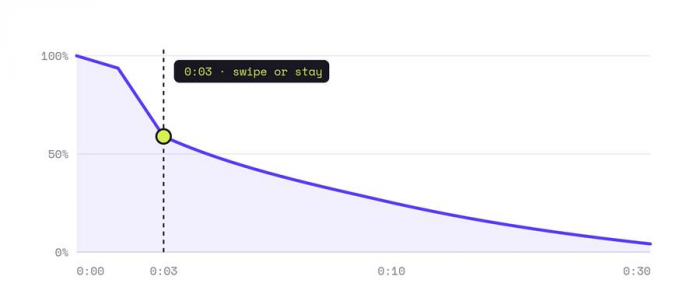
Audience retention collapses fastest in the opening seconds, the make-or-break window every script has to win first. Pattern based on Facebook/Nielsen value data and YouTube viewed-vs-swiped retention curves.
On the platform side, the mechanics are equally direct. Since YouTube’s 2025 Shorts overhaul, every new Short is seeded to a small test audience that answers a single question: did they swipe away, or stay? Creator Paddy Galloway’s analysis of 3.3 billion Shorts found that videos with a viewed-versus-swiped ratio of 70–90% performed best, while anything under 60% saw distribution collapse almost immediately. Separate analysis suggests Shorts that open with a hook in the first two seconds retain about 19% more viewers than those with a slow start.
Then there’s the compounding effect. Short-form video earns roughly 2.5× more engagement than long-form on social, YouTube channels that consistently post Shorts grow about 50% faster than those that don’t, and roughly 74% of Shorts views come from non-subscribers, meaning short-form is the discovery engine that feeds everything else you make.
Here’s why that matters for tooling: the script is where the hook, the pacing, the mid-video retention beats, and the call to action all get decided. It’s the cheapest part of production to change and the most expensive to get wrong. Staring at a blank document for an hour is the single worst use of a creator’s time, and it’s the exact friction these tools remove.
What separates a good AI script generator from a gimmick
“Generates scripts with AI” describes both genuinely useful software and a thin wrapper around a chatbot. Use these five criteria to tell them apart.
• It understands the format, not just the topic. A blog-writing tool hands you polished paragraphs you can’t read aloud. A real video script tool thinks in spoken language, short sentences, scene-by-scene structure, and on-screen text cues, and it knows a 30-second Reel and a 12-minute explainer are different animals.
• It generates hook variations, not one safe opener. Because the first three seconds carry 47% of the value, the ability to spin up five or ten different hooks for one topic, so you can A/B test them, is worth more than almost any other feature. The best creators test 3–5 openers per concept.
• It builds in retention architecture. Strong scripts use pattern interrupts, mid-video re-hooks, and a promise-then-payoff structure. Tools that bake this in hold attention; tools that don’t just give you a tidy essay.
• It adapts to your tone and niche. Finance, fitness, comedy, and B2B SaaS each have a native rhythm. A tool that lets you set tone, audience, and length, or that learns your brand voice, saves far more editing time than a one-size-fits-all generator.
• It fits how you already work. Some tools stop at the script; others carry you straight into voiceover, captions, and a finished video. Neither is better; it depends on whether you film yourself or build faceless content. Match the tool to your pipeline.
A useful sanity check: generic chatbots can produce text, but they don’t inherently understand pacing, retention loops, or verbal CTAs. The tools worth paying for encode video-specific logic, or let you direct a general model with that logic yourself.
The best AI script generators for Reels & YouTube
Rather than a fake #1 to #10 ranking, here are the strongest options grouped by what you’re actually trying to do. Pick the category that matches your situation, then the tool.
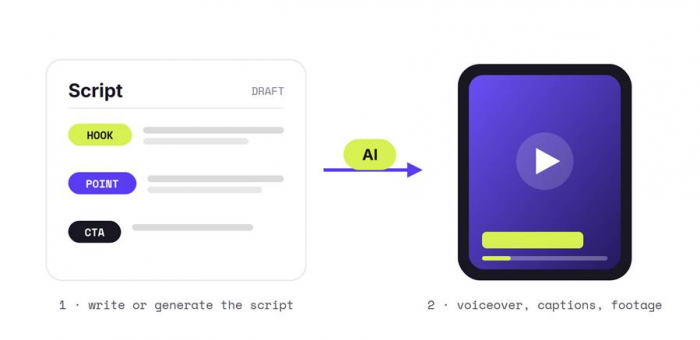
What “all-in-one” tools collapse into a single step: the script becomes the spine, and the voiceover, captions, and footage get generated around it.
All-in-one: script and video in one place
Idea to finished, captioned video without switching apps. Ideal if you want to compress production time.
• VEED is the most versatile pick for short-form. Describe your idea, choose tone and audience, and get a full script with a hook, key points, and a CTA, then turn it into a video with AI voiceover, avatars, captions, and stock footage. Strength: a frictionless script-to-video jump. Trade-off: limited fine-grained control, and watermark-free export needs a paid plan.
• Pictory is built for repurposing: turning blog posts, webinars, or long videos into short clips with auto-generated scripts and captions. A natural fit for bloggers and educators feeding a Shorts pipeline from existing content.
• InVideo AI leans into text-to-video: describe the video you want and it drafts the script and assembles scenes. Good for marketers who want a near-complete draft to refine.
• Descript treats the script as the editing timeline itself: write, record, and edit in one document, with transcription and voice features. It shines for tutorials, explainers, and video podcasts.
Short-form specialists: punchy hooks and scroll-stopping copy
When the job is fast, witty, high-volume Reels and Shorts copy.
• Copy.ai is fast and genuinely good at the snappy, conversational tone short-form rewards, with dedicated social templates and multiple voice options. A favorite among solo creators and small-brand marketers on a budget.
• Jasper is the heavier, team-grade option: define tone, structure, audience, and length, and lock in a consistent brand voice across many scripts. Best when you produce at scale or need brand governance.
• Quillbot’s free script generator is a no-friction way to get a quick first draft for YouTube, Reels, or TikTok when you just need to beat the blank page.
YouTube-focused: research, ideas, and long-form structure
YouTube success is as much about what you make as how it’s written, so these blend ideation with scripting.
• Subscribr is purpose-built for YouTube creators: it surfaces video ideas from outlier and competitor data and helps you draft a full script fast, exactly the strategic-plus-structural combination long-form needs.
• OpusClip is the repurposing powerhouse: it finds the most engaging segments of a long video, scripts and clips them into Shorts, and adds captions. Best if you already produce long-form and want Shorts as a byproduct.
Flexible general-purpose models: maximum control, lowest cost
ChatGPT, Claude, and Gemini are the most flexible and cheapest places to start. They won’t automatically know YouTube pacing, but with a strong, specific prompt they can produce excellent, fully customizable scripts and unlimited hook variations. For developers building a repeatable script-drafting workflow, the OfoxAI API documentation provides API access that can be integrated into a custom workflow for generating scripts programmatically. This is API access for building your own process, not an end-to-end video editor or a guarantee of audience engagement. The catch: you’re still the director, and output quality tracks prompt quality.
AT A GLANCE
| Tool | Best for | Platforms | Script → video? | Cost model |
|---|---|---|---|---|
| VEED | Fast end-to-end short-form | Reels, Shorts, TikTok, YouTube | Yes | Free tier + paid |
| Pictory | Repurposing blogs / long video | Shorts, Reels, YouTube | Yes | Paid (trial) |
| InVideo AI | Text-to-video drafts | Reels, Shorts, YouTube | Yes | Free tier + paid |
| Descript | Tutorials, explainers, podcasts | YouTube long-form | Yes | Free tier + paid |
| Copy.ai | Punchy short-form copy | Reels, Shorts, TikTok | Script only | Free tier + paid |
| Jasper | Brand voice at scale | All formats | Script only | Paid |
| Quillbot | Quick free drafts | Reels, Shorts, YouTube | Script only | Free + paid |
| Subscribr | YouTube ideas + scripts | YouTube, Shorts | Script only | Free tier + paid |
| OpusClip | Long-to-Shorts repurposing | Shorts, Reels, TikTok | Clips | Free tier + paid |
| ChatGPT / Claude / Gemini | Full control, any niche | All formats | Script only | Free tier + paid |
Pricing tiers and features change frequently, so confirm the current plan on each tool’s site before committing.
How to actually get great scripts out of these tools
The tool is only half the equation. The creators who win treat AI as a fast first-drafting partner, then add the 10–30% only a human can. Here’s the sequence that consistently works.
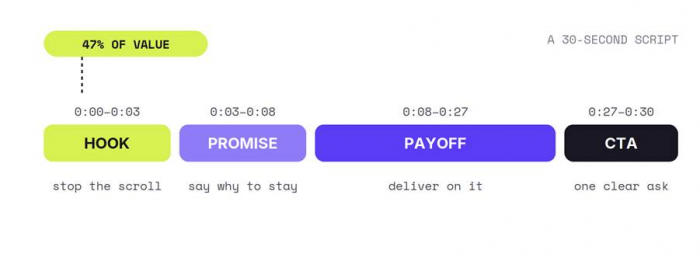
Anatomy of a 30-second script. The hook is small but decisive, and the payoff has to honor what it promised, or the drop-off tells the algorithm to pull back your reach.
1. Feed it a sharp prompt. Vague input produces vague scripts. A reliable formula:
PROMPT FORMULA
[topic] + [target audience] + [goal] + [tone] + [length]
e.g. “A 30-second Reel for first-time home buyers explaining why pre-approval matters, urgent and reassuring tone, with three hooks to choose from.”
2. Always generate multiple hooks. Since the opening seconds decide everything, ask for five to ten hook variations and pick the one most likely to stop the scroll. Structures the data favors: a bold result (“I cut my editing time by 70% with one change”), a pointed question (“Why do your Reels stall at 200 views?”), a contrarian take (“Unpopular opinion: posting daily is hurting you”), or a “stop scrolling if…” qualifier that filters for your exact audience.
3. Write for sound-off. Well over 60% of mobile viewers, by some measures up to 85%, watch without sound. Make sure your hook and key promise land as on-screen text, not just narration. Good tools draft caption-friendly lines; if yours doesn’t, add them in editing.
4. Match length to the format. Most marketers find short-form performs best under 60 seconds, with the majority citing 60 seconds as the optimal ceiling, though 40–60-second Shorts can earn higher engagement when every five seconds delivers new value. Let the content, not a vanity number, set the runtime.
5. Read it aloud and make it yours. The script should sound like you, match how your community talks, and deliver on exactly what the hook promised.
The honest limitations
AI script generators are a genuine force multiplier, but they are not a “press button, go viral” machine, and any guide that pretends otherwise is selling something.
Realistically, AI gets you 70–90% of the way to a finished script. The remaining slice (your voice, your specific examples, the timing of a punchline) is where the actual differentiation lives, and it’s still yours to add.
There’s also a subtler trap the data exposes: a hook is a qualification tool, not a retention guarantee. Analyses of viral content show videos can hit 90%+ engagement in the first three seconds and still collapse to under 20% retention by completion. When AI hands you an irresistible opener, it’s tempting to ship it, but if the body doesn’t pay off the promise, the algorithm detects the drop-off and throttles your reach. A clickbait mismatch might beat the three-second test and still tank your channel’s long-term trust. Spend roughly as much energy on the payoff as on the hook.
Finally, generic tools produce generic content. If everyone in your niche prompts the same model the same way, you’ll all sound identical. The edge comes from a unique point of view and real expertise, things AI can structure and accelerate, but not originate.
Quick picks: which one should you start with?
• Total beginner, lowest budget: start with ChatGPT, Claude, or Gemini plus the prompt formula above. Free, flexible, and you’ll learn what good structure feels like.
• Solo creator who wants speed: VEED (idea to captioned video in minutes) or Copy.ai (fast, scroll-stopping copy).
• Repurposing long-form into Shorts: OpusClip or Pictory.
• Serious YouTube channel: Subscribr for ideas and structure, paired with Descript for longer talking-head edits.
• Marketing team, brand consistency: Jasper.
The bottom line
The opportunity in short-form has never been larger: 200 billion daily Shorts views, Reels outpacing every other format, and algorithms eager to hand non-subscribers to anyone who can hold attention. The constraint is no longer reach; it’s the quality and consistency of the script behind the hook.
That’s the precise job an AI script generator does well: it kills the blank page, produces hooks you can test, and frees the hours you’d lose to drafting so you can reinvest them in strategy, originality, and payoff. Pick the tool that fits your pipeline, prompt it sharply, generate options, and keep the human judgment that turns a competent script into one that’s unmistakably yours. Do that consistently, and the 47% that lives in your first three seconds starts working for you instead of against you.