


Table of Content
Why Keywords Beat Hashtags in 2026
For years, Instagram growth advice started and ended with hashtags. That era is over. Since late 2024, Instagram's discovery systems have prioritized keywords in captions over hashtag matching, and Meta's own guidance now recommends just 3 to 5 highly relevant hashtags per post instead of the old wall of 30.
Two other changes raised the stakes. First, since mid-2025, public posts from professional accounts are indexed by Google by default, which means a well-written caption can pull traffic from outside the app entirely. Second, Instagram's AI now reads almost everything you publish: caption text, alt text, on-screen text, and even the audio in your Reels, then matches it against what people type into the search bar.
| STAT | WHAT IT TELLS YOU | SOURCE |
| 87% | of marketers used generative AI in at least one recurring workflow in Q1 2026, up from 51% in Q1 2024 | Adobe Digital Trends 2026 |
| 45.9% | of social media teams already use AI specifically for caption writing | Sociality.io 2026 survey |
| 25%+ | of social users now turn to platforms like Instagram for product discovery, not just entertainment | 2026 Content Strategy Report via Sprout Social |
Put simply: people search on Instagram the way they search on Google, the algorithm reads captions the way Google reads web pages, and nearly half of social teams already use AI to write them. The winners are the accounts that combine all three, using AI for speed and structure while keeping keywords natural and the voice human.
WHAT KEYWORD-RICH ACTUALLY MEANS A keyword-rich caption is not a stuffed caption. It contains one primary search phrase your audience actually types (like easy meal prep ideas) plus 2 or 3 supporting phrases, woven into sentences a real person would say out loud. |
Anatomy of a Search-Friendly Caption
Instagram truncates captions after roughly the first 125 characters, and the algorithm weighs the beginning of your text more heavily than the end. That makes the structure below your default template.
1. Keyword-led hook. Your primary keyword inside the first 125 characters, before the fold. Example: 5 easy meal prep ideas for busy weekdays, each under 20 minutes.
2. Value body. Two or three supporting phrases like high protein lunch, written the way your audience actually talks, with a concrete promise.
3. Engagement ask. One question or save-worthy call to action. Saves and DM shares are top ranking signals.
4. 3 to 5 niche hashtags. Category labels placed last, mirroring the caption keywords, such as #mealprepideas #highproteinmeals #lunchboxrecipes.
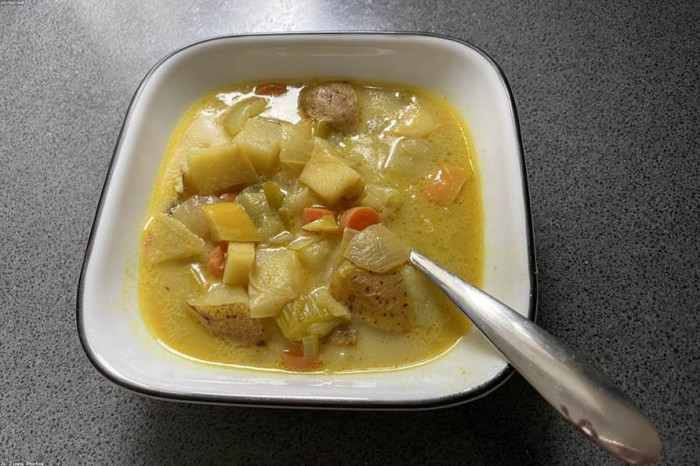
The post is the proof; the caption is the metadata. Describe exactly what the camera sees, using the words people search. Photo: Flickr Creative Commons, via LoremFlickr
The 6-Step AI Caption Workflow
AI is genuinely good at three parts of this job: generating keyword lists fast, producing structured first drafts, and rewriting for length and tone. It is bad at knowing your audience and sounding like you. The workflow below assigns each step to the right worker, and it takes about 10 minutes per post once you have run it a few times.
Step 1: Mine real search phrases with AI
Start in the Instagram search bar: type your topic and note the autocomplete suggestions, because those are literal queries people run. Then hand that seed list to your AI tool and ask it to expand into broad terms, long-tail phrases, and question-style searches. Cross-check anything important against a keyword tool such as Google Keyword Planner or Semrush.
Step 2: Pick 1 primary + 2-3 supporting keywords
One post, one main idea. Choose a single primary phrase with clear intent, like small apartment plants, then 2 or 3 supporting phrases such as low light houseplants or plant care for beginners. Long-tail phrases convert better because they match specific searches with less competition.
| KEYWORD TYPE | EXAMPLE | BEST FOR |
| Broad | meal prep | Bio, name field, recurring themes |
| Long-tail | high protein meal prep for beginners | Caption hooks, Reel titles |
| Question | what to meal prep for the week | Carousel covers, FAQ-style posts |
| Local | meal prep delivery austin | Location-based businesses |
Step 3: Draft with a constrained prompt
Vague prompts produce generic captions. Give the AI your keywords, format, length, tone, and structure rules in one message (templates in the next section). Ask for 3 variations so you can pick the strongest hook instead of settling for the first output.
Step 4: Front-load the first 125 characters
Check that your primary keyword lands in the first sentence and that the visible preview works as a standalone hook. “Happy Monday!” tells the algorithm nothing. “Here is a 15-minute full body dumbbell workout you can do at home” tells it everything.

Ten minutes per post: research with AI, draft with constraints, then edit with your own thumbs. Photo: Flickr Creative Commons, via LoremFlickr
Step 5: Humanize before you publish
This step is not optional: 78.4% of social teams say AI-generated content gets moderate or extensive editing before it goes live. Read the caption out loud, cut filler, swap in your own phrases and specifics, and delete anything that sounds like every other account. Roughly a third of consumers say obviously AI-generated brand content puts them off, so the human pass protects both reach and trust.
Step 6: Finish the metadata around the caption
Keywords in the caption work harder when the rest of the post agrees with them. Before posting, complete the placement checklist below, then proofread once more: editing a caption hours after publishing can partially reset how the post gets indexed.
• First 125 characters: primary keyword in sentence one, before the fold.
• Caption body: 2-3 supporting phrases woven naturally into full sentences.
• Alt text: describe the image naturally and include one keyword if it fits.
• Hashtags (3-5): niche tags that mirror your caption keywords, placed last.
• On-screen text + audio: say the keyword aloud and show it in overlays; enable auto-captions.
• Bio + name field: your evergreen broad keyword lives here, searchable 24/7.
What the Numbers Say About AI Captions
If using AI for captions still feels like cheating, the market has moved on. Caption writing is now the third most common AI use case among social media teams: 59.5% use AI for analytics and reporting, 59.5% for ideation and trend research, 45.9% for caption writing, and 40.5% for visual and video creation (Sociality.io, 2026).
Adoption is compounding, too. Adobe's Digital Trends 2026 report found that 87% of marketers used generative AI in at least one recurring workflow in Q1 2026, up 36 points from 51% in Q1 2024. Among social teams, 28.2% say more than half of their posts are already AI-assisted, 44.7% report that AI-assisted content performs better than fully manual content (against just 5.3% who say worse), and 61.5% expect their AI tool budget to increase in 2026.
READ THAT AGAIN Nearly half of teams say AI-assisted posts outperform manual ones, but 78.4% edit before publishing. The advantage comes from the combination, not the automation. |
Copy-Paste Prompt Templates
These three prompts map to steps 1, 3, and 5 of the workflow. Replace the bracketed variables, and paste 2 or 3 of your past captions into the voice prompt so the AI learns from real examples rather than adjectives.
PROMPT 1 · KEYWORD RESEARCH You are an Instagram SEO strategist. My niche is [niche] and my audience is [audience + their goal]. List 15 phrases this audience would type into the Instagram search bar, grouped as: broad terms, long-tail phrases (4-6 words), and question searches. For each phrase, add a one-line note on search intent. |
PROMPT 2 · CAPTION DRAFT Write 3 Instagram caption options for a [Reel / carousel / photo] about [topic]. Primary keyword: [phrase]. Supporting keywords: [2-3 phrases]. Rules: primary keyword appears naturally in the first sentence, the first 125 characters work as a standalone hook, total length 80-120 words, tone is [tone], end with one question or save-worthy CTA, then suggest 4 niche hashtags. No keyword stuffing, no clickbait, no emojis in the first line. |
PROMPT 3 · VOICE + HUMANIZE PASS Here are 3 captions I wrote myself: [paste examples]. Rewrite this draft in the same voice: [paste AI draft]. Keep the primary keyword in the first sentence, cut every filler word, keep it under 110 words, and make it sound like one person talking to one follower. |
Do This, Not That
Instagram's semantic search understands meaning, not just exact strings, so it recognizes keyword stuffing as spam and vague captions as noise. The comparison below shows the same post written both ways.
DON'T PUBLISH THIS “Vibes ☕ #coffee #coffeetime #coffeelover #love #instagood #happy #mood #photooftheday #aesthetic #daily” No searchable phrase, no topic signal, and 10 broad hashtags that dilute rather than categorize. The algorithm has nothing to match against a real query. | PUBLISH THIS INSTEAD “This iced brown sugar latte recipe takes 5 minutes and 3 ingredients. Full measurements below, save it for tomorrow morning. #icedlatterecipe #homebarista #coffeeathome” Long-tail keyword in the first sentence, a concrete promise, a save-focused CTA, and 3 niche hashtags that mirror the caption. |

Same latte, two captions: one is invisible to search, the other ranks for iced latte recipe for months. Photo: Flickr Creative Commons, via LoremFlickr
Five mistakes that quietly kill reach
1. Keyword stuffing. Repeating a phrase five times reads as spam to both people and the ranking system. Once in the hook, once or twice naturally after that.
2. Publishing raw AI output. Unedited drafts flatten your voice into everyone else's. The 78.4% of teams who edit before publishing are the ones whose content performs.
3. Burying keywords in the first comment. Text in comments is indexed far more weakly than caption text. Critical keywords belong in the caption itself.
4. Mismatched signals. If your caption says morning routine but your hashtags say #travel, you send the algorithm a confusing category signal.
5. Chasing broad terms only. You will not outrank giant accounts for fitness, but you can absolutely win apartment friendly leg workout.
How to Measure Whether It's Working
Keyword-rich captions are a discovery play, so measure discovery. In Instagram Insights, watch these four numbers for 30 days before and after adopting the workflow:
• Views from non-followers. The clearest sign that search and Explore are surfacing your posts to new people.
• Saves and sends. Instagram head Adam Mosseri has confirmed that watch time, likes per reach, and sends per reach are the top ranking signals, with DM shares carrying special weight. An estimated 694,000 Reels are shared by DM every minute, so save-this and send-this CTAs feed the exact metrics that expand reach.
• Profile visits per post. Search traffic tends to click through to check who you are; a keyword-matched bio converts that visit into a follow.
• Top-performing keywords. Every 2 weeks, note which primary keywords drove your best non-follower reach, then feed that list back into Prompt 1. This turns the workflow into a compounding loop instead of a one-time trick.