


Table of Content
- Quick verdict: what you actually need to know
- September 2026 update: what has changed since my original test
- What is Cheaterbuster AI?
- I ran the full funnel: every step, graded
- How it scores, category by category
- Pricing, and the subscription trap
- Billing and user-review update
- Pros and cons
- What real users say
- How accurate is it, really?
- Accuracy and privacy clarification
- Best Cheaterbuster AI alternatives
- Final verdict
Quick verdict: what you actually need to know
• It is a real, working service, not malware or an outright scam. ScamAdviser rates the domain Very Likely Safe, and some people genuinely do find profiles with it.
• It only searches Tinder. Despite the broad catch a cheater framing, it does not scan Bumble, Hinge or the wider web. If your concern is anywhere else, it cannot help.
• The pricing changed, and that is the catch. Older reviews quote a one-time roughly $18 search. The current funnel signs you up to a recurring subscription ($19.99/mo, or $44.99 to $54.94 billed upfront). This is the single biggest source of complaints.
• The results are a paywall. After a roughly 12-step emotional quiz and a teaser (early signals detected), you hit payment before seeing anything real. Several testers then hit a second paywall to unlock a single profile.
• Accuracy is conditional. Claimed 97 to 99%; independent testing puts it nearer 80 to 90% with perfect inputs, collapsing toward 44% with vague details or common names.
Worth a look if
• You specifically suspect Tinder, in a large city
• You have a clear photo plus accurate age plus exact location
• You want a fast, anonymous check the person will not be notified about
• You are comfortable cancelling a subscription promptly
Skip it if
• They might be on any other app or the open web
• You only have a common name and a rough location
• You want a guaranteed one-time charge and a refund option
• You would rather rebuild trust through a conversation than surveillance
September 2026 update: what has changed since my original test
Since my original hands-on test, Cheaterbuster has expanded how it describes its service. Its current documentation refers more broadly to dating-app searches, facial-recognition tools, social analysis and publicly available information.
That does not necessarily mean every search covers every major dating app, so the original Tinder-focused testing in this review should still be treated as the specific experience tested here.
What is Cheaterbuster AI?
Cheaterbuster is a Tinder profile-discovery tool. You feed it a first name, an age, a location and (optionally) a face photo, and it searches Tinder public-facing data for matching profiles, returning photos, bio snippets, distance and, when available, a last-active timestamp. The whole point is that it is anonymous to the target: the person you are searching for is never notified.
It is not new. The product launched in 2016 as Swipebuster, rebranded to Cheaterbuster, and has since wrapped itself in an AI and facial-recognition layer. Under the hood it is best understood as reverse-image matching plus name, age and location filtering against Tinder data. It is useful, but not the all-seeing infidelity detector the marketing implies. As the testers behind one Indie Hackers write-up put it bluntly: if the profile is hidden or private, this cannot conjure it. That is not magic, it is just matching.
| At a glance | Detail |
|---|---|
| What it does | Finds active Tinder profiles from a name, age, location and optional photo |
| Apps searched | Tinder only (no Bumble, Hinge, or web-wide search) |
| Key feature | Facial-recognition matching (the one genuinely useful input) |
| Output | Profile list with photos, bio, distance, last-active (behind paywall) |
| Anonymity | Target is not notified; search is private |
| Pricing model | Recurring subscription (was previously pay-per-search) |
| Refund policy | No clear refund guarantee |
| Free version | None. Beware sites advertising Cheaterbuster free (likely scams) |
| Our score | 4.3 / 10, proceed with caution |
How it works
You do not need a Tinder account. You answer a long questionnaire about the person, optionally upload a photo and their Instagram or TikTok handle, and the system runs its match against Tinder public data. A few minutes later it claims to have results. That is the elevator pitch, and it is accurate as far as it goes.
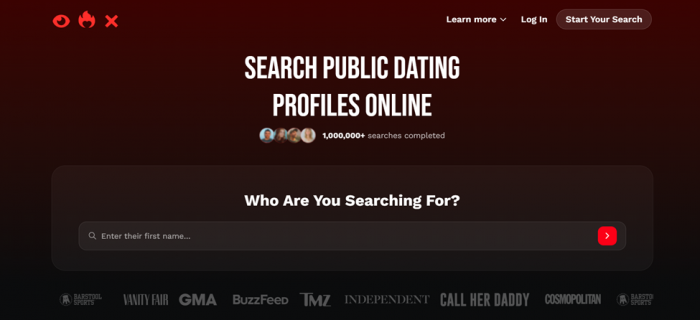
What the pitch leaves out is the shape of that questionnaire, which is the most revealing part of the whole product. So I ran it myself, step by step, and graded each screen for what it is actually doing.
I ran the full funnel: every step, graded
I logged in with email (Google sign-in was offered), entered a real test subject, and screen-recorded the entire flow. Each step below is graded Functional (does a real job), Persuasion (engineered to build investment) or Red flag (manipulative or misleading).
Step 01: Name and age
Verdict: Functional (with a nudge)
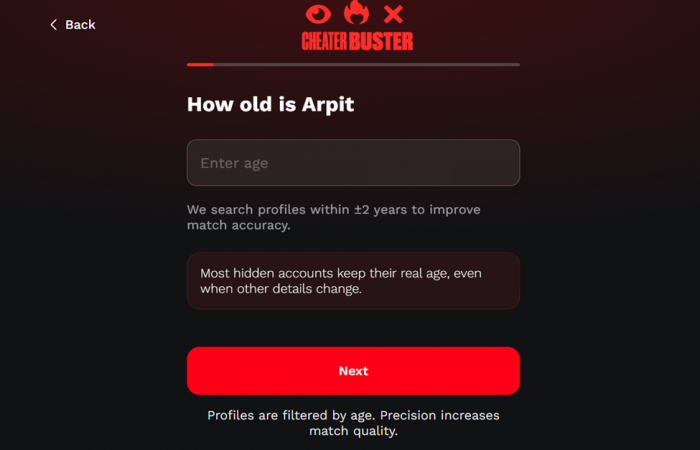
Age genuinely helps narrow a Tinder match, so this earns its place. But note the helper text: most hidden accounts keep their real age. It is a small nudge that quietly reframes a neutral data field as evidence of hiding. Clean input, gentle manipulation.
Step 02: Gender
Verdict: Functional
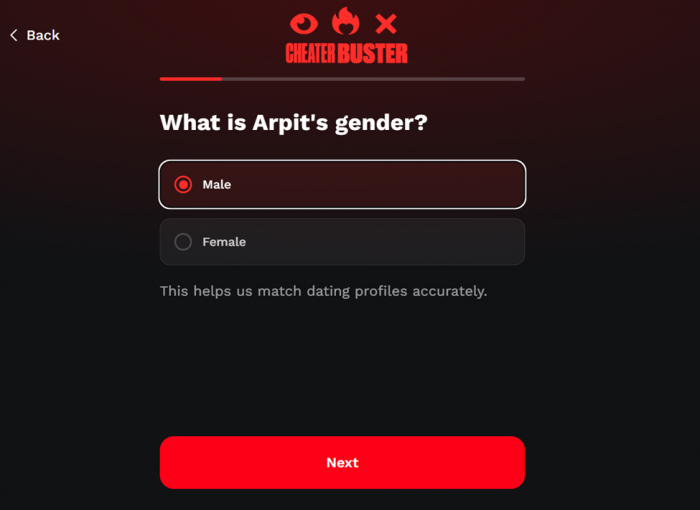
Used to filter Tinder results. Fair enough. No notes here. This is one of the few screens that exists purely to improve the search rather than to manage your emotions.
Step 03: Your relationship with them
Verdict: Persuasion
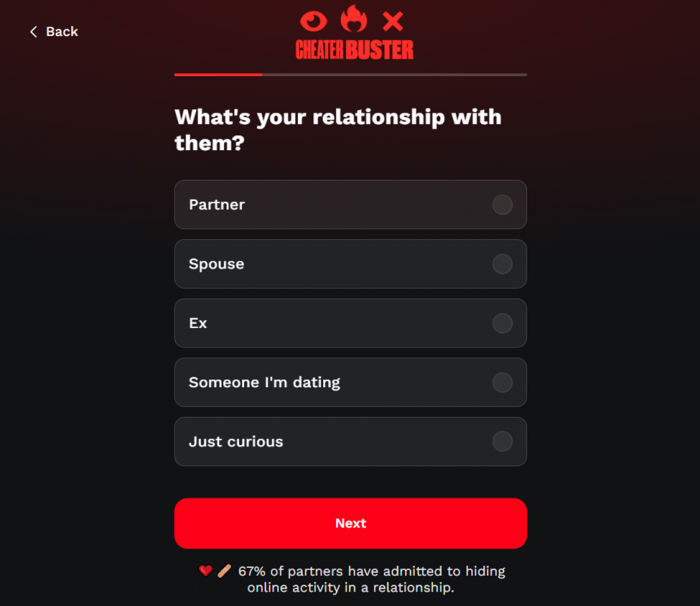
Partner, spouse, ex, dating, just curious. This has zero bearing on a Tinder lookup; it segments you emotionally and primes the funnel tone. The footnote (67% of partners admitted to hiding online activity) is an unsourced stat designed to validate suspicion before you have seen a shred of data.
Step 04: Have you noticed any of these?
Verdict: Red flag (Barnum effect)
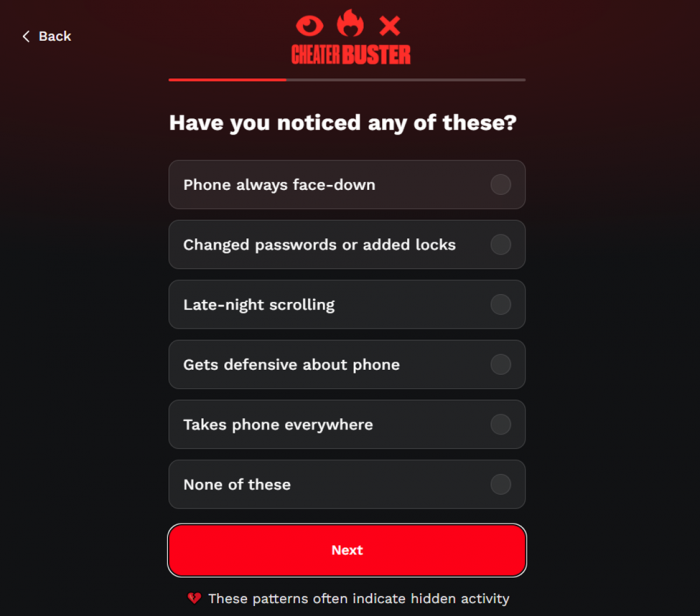
Phone face-down. Takes phone everywhere. Late-night scrolling. These warning signs describe almost every smartphone owner alive: a textbook Barnum or Forer checklist that manufactures certainty out of normal behaviour. You will tick a few, feel your suspicion confirmed, and be more likely to pay. This is the funnel emotional engine.
Step 05: Location
Verdict: Functional
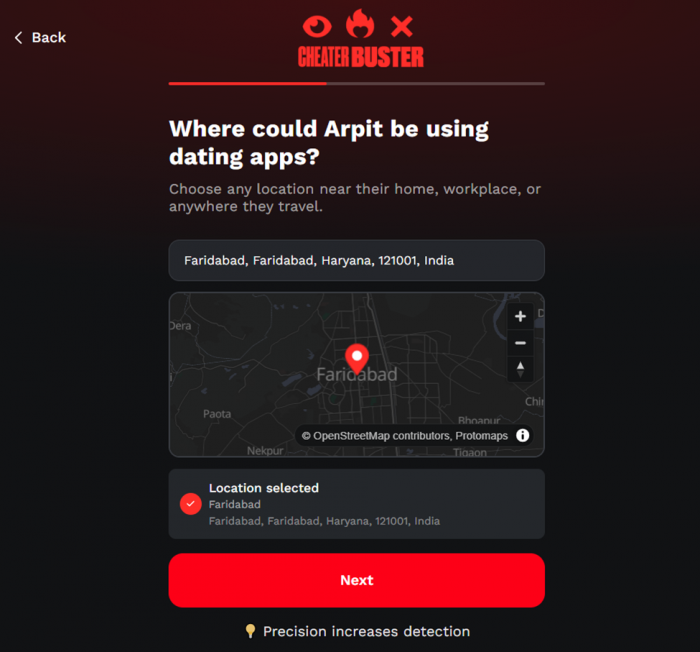
A genuine OSINT input: Tinder is location-based, so a precise pin materially improves match quality. The map UI is clean and the geocoding worked (it found Faridabad without fuss). Precision really does matter here; a vague city in a dense area will bury you in false positives.
Step 06: Do they travel often?
Verdict: Persuasion
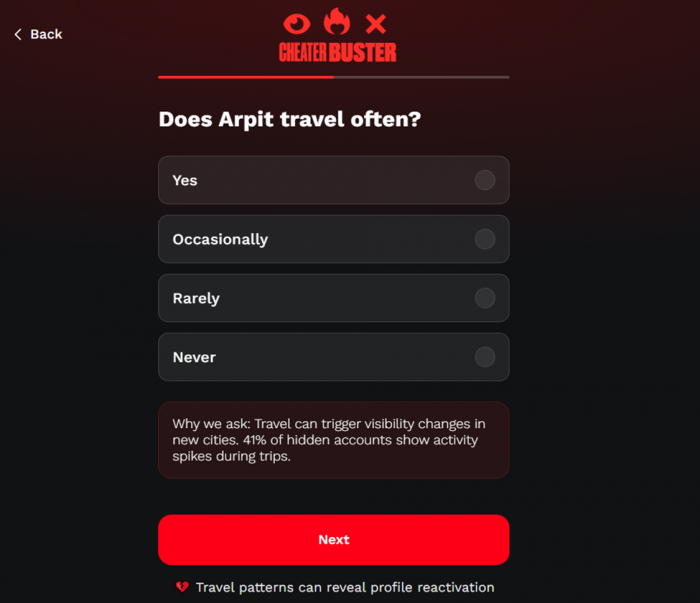
Dressed up with a why we ask rationale and another invented figure (41% of hidden accounts show activity spikes during trips). Travel can theoretically affect Tinder visibility, but in practice this screen is here to deepen your sense that there is a sophisticated investigation underway.
Step 07: When are they most active?
Verdict: Engagement bait
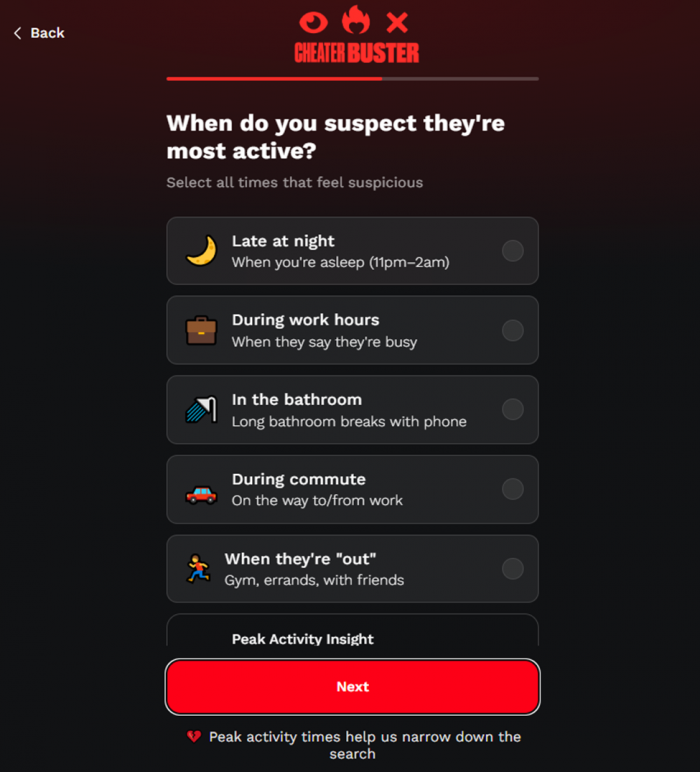
Late at night when you are asleep. Long bathroom breaks with phone. None of this feeds a profile lookup; it is pure narrative-building, inviting you to picture scenarios and stew. By now you have answered seven emotionally charged questions and seen no actual results.
Step 08: Add a face photo
Verdict: Functional (privacy flag)
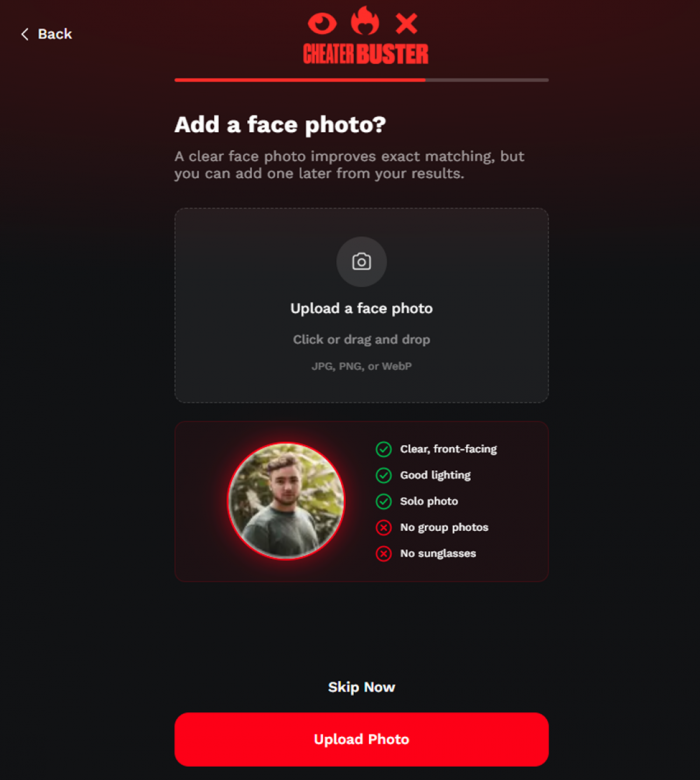
This is the input that actually moves accuracy: facial recognition is the difference-maker, and the guidance (front-facing, good lighting, no sunglasses) is sensible. The flip side: you are uploading someone else biometric data without their consent. Treat that seriously, and check the data-retention policy before you do.
Step 09: Their social handles (Instagram and TikTok)
Verdict: Scope creep
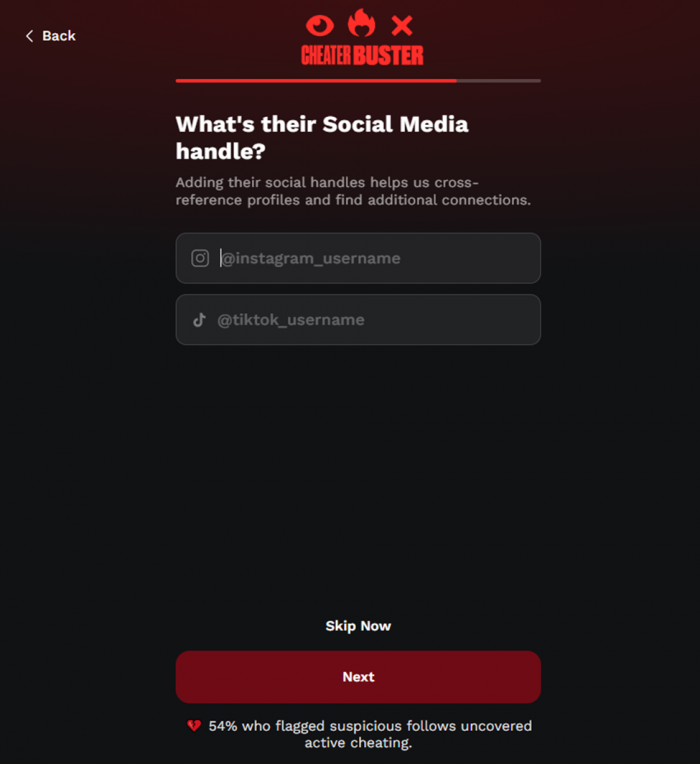
Here the Tinder tool quietly expands into social-media surveillance. The unsourced line (54% who flagged suspicious follows uncovered active cheating) does the persuading. It is also where the product starts collecting a richer profile of the target than a simple dating-app check needs.
Step 10: Micro-cheating signals to track
Verdict: Red flag (pseudoscience)
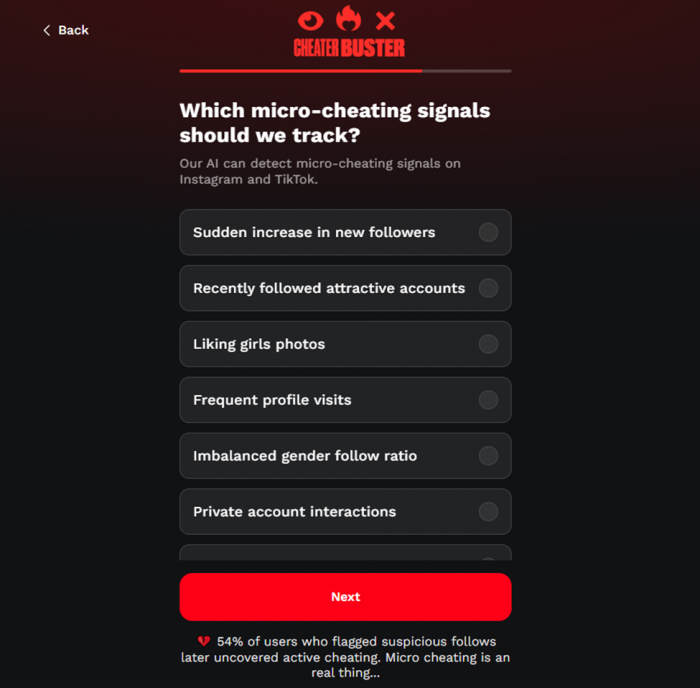
Liking girls photos. Imbalanced gender follow ratio. Recently followed attractive accounts. These are framed as detectable infidelity signals, but they are vague, judgemental and prove nothing; liking a photo is not evidence. This screen gamifies jealousy and is, to me, the most genuinely unhealthy part of the experience.
Step 11: Scanning profiles
Verdict: Red flag (manufactured suspense)
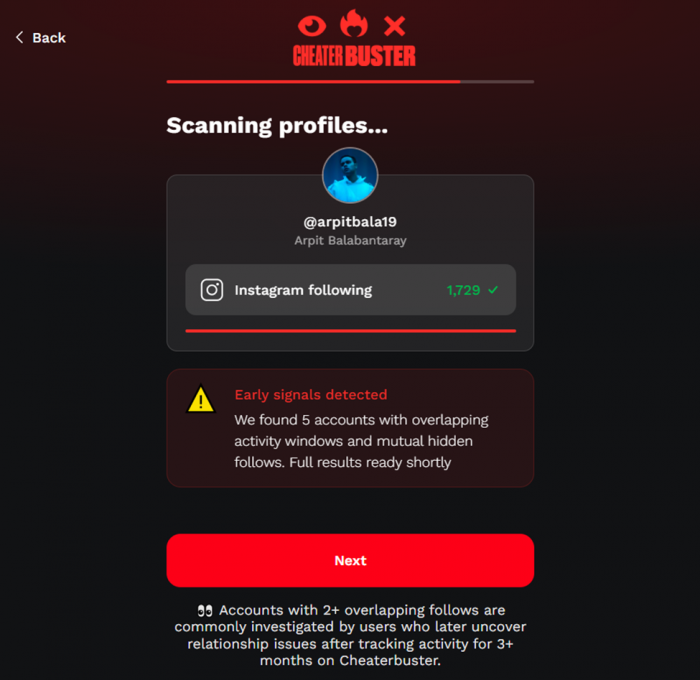
It did pull my test subject real public Instagram (handle, display name, 1,729 following), so the social lookup is partially live. Then the dramatic part: a yellow Early signals detected banner claiming 5 accounts with overlapping activity. There is no way to verify what (if anything) that means. It is a cliff-hanger, perfectly timed to land right before the bill.
Step 12: And then, the paywall
Verdict: Red flag (sunk-cost paywall)
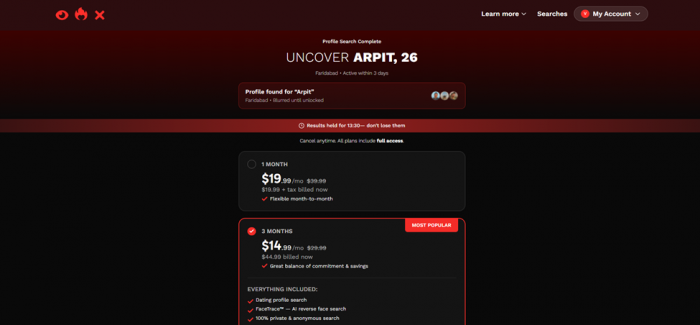
Twelve steps of emotional investment, a teaser of results, and the payoff is a subscription page: $19.99/mo monthly, $14.99/mo billed as $44.99 for three months, or $9.99/mo billed as $54.94 for six. The result I was promised is on the other side of a recurring charge: a clean sunk-cost conversion. This is the moment the whole funnel was built around.
You answer twelve emotional questions, get told early signals detected, and the reward for all of it is a subscription page. The funnel is not built to find an answer. It is built to find your credit card. REVIEWER TAKEAWAY |
How it scores, category by category
Marks out of 10, weighted by what matters most to someone using this in a stressful moment: do you get a real answer, at a fair and transparent price, without getting burned?
| Category | Score | What drove the mark |
|---|---|---|
| Results and accuracy | 5.5 / 10 | Works with good inputs in big cities, but Tinder-only and beaten by incognito |
| Ease of use | 8.0 / 10 | The interface itself is genuinely slick and fast |
| Privacy and ethics | 4.0 / 10 | Anonymous to the target, but relies on biometric uploads |
| Honest marketing | 3.0 / 10 | Unsourced stats and manufactured suspense throughout |
| Value for money | 3.0 / 10 | Subscription pricing, no refund, narrow scope |
| Billing transparency | 2.5 / 10 | Recurring charges and difficult cancellation |
Pricing, and the subscription trap
Here is the most important context in this entire review. For years, Cheaterbuster was described as a simple pay-per-search tool at roughly $18 a look. The funnel I tested no longer works that way; it sells subscriptions, with the bulk of the money taken upfront. These are the live prices from the paywall:
| Plan | Headline price | Billed now | Reality check |
|---|---|---|---|
| 1 Month | $19.99 / mo | $19.99 + tax | Month-to-month; renews until cancelled |
| 3 Months (Most Popular) | $14.99 / mo | $44.99 | Three months taken in one charge |
| 6 Months (Best Value) | $9.99 / mo | $54.94 | Lowest monthly rate, largest upfront commitment |
Billing and user-review update
Cheaterbuster's current FAQ says subscriptions can be cancelled through a user's account and that subscriptions may include ongoing updates for an active search.
Its terms also state that dissatisfied customers can contact the company within three days of an order and that qualifying refund requests may be approved after review. This should not be interpreted as an unconditional money-back guarantee.
There has also been an important change on Trustpilot. The Trustpilot rating shown in the original version of this review should now be treated as a historical snapshot. Trustpilot currently does not display an overall Cheaterbuster rating and says the rating is unavailable because of a breach of its guidelines. Trustpilot also states that it removed a number of fake reviews from the profile.
This does not establish who created those reviews, so it would be inaccurate to directly accuse Cheaterbuster of posting them without further evidence.
The billing complaint you must read first By a wide margin, the most common negative review across Trustpilot and Reddit is not about accuracy; it is about money. Users report expecting a one-time charge and instead being enrolled in a recurring subscription, seeing repeat charges, and struggling to cancel (with reports that even password reset and support are slow or unresponsive). Some also describe a second paywall to unlock a single profile after already paying. If you do subscribe, set a calendar reminder to cancel immediately and keep a record of the transaction. |
Pros and cons
What works
• Polished, fast, genuinely easy to use
• Anonymous: the target is never notified
• No Tinder account or login required
• Facial recognition meaningfully boosts accuracy
• Legitimate company (rated Very Likely Safe)
• Strong results in big cities with good inputs
What does not
• Tinder-only: misses every other app and the open web
• Recurring subscription with frequent billing complaints
• No clear refund policy; cancellation reported as difficult
• Manipulative funnel: Barnum checklists, unsourced stats
• Results gated behind a paywall (sometimes two)
• Useless against hidden or incognito profiles
• Accuracy collapses with common names or vague data
What real users say
Sentiment is sharply split, and it splits along one line: people who found what they were looking for love it; people who did not feel scammed. And almost everyone has something to say about the billing.
| Source | Score | The takeaway |
|---|---|---|
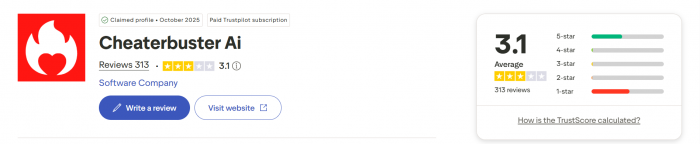
| Trustpilot | ~3.1 / 5 | Praise for accurate matches and a clean interface; heavy criticism over recurring charges and refunds |
| Apple App Store | 4.7 / 5 | Liked for ease of use; questioned on result consistency |
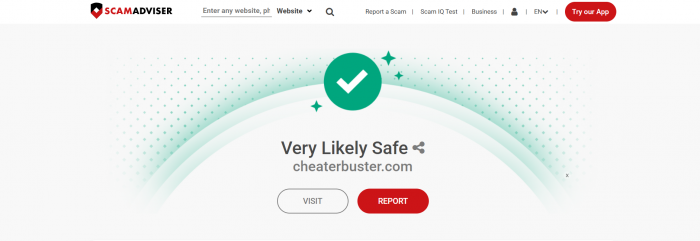
| ScamAdviser | Very Likely Safe | Domain age, HTTPS and reputation check out; it is a legitimate site |
| Mixed to negative | About 65% of threads lean mixed-to-negative, mostly on cost and inconclusive results | |
| Aggregate satisfaction | ~73% | Across review platforms, but skewed heavily by input quality and city size |
A representative spread of voices
Paraphrased from public reviews on Trustpilot, Reddit and app stores to capture the recurring themes.
It confirmed what I had suspected for months and saved me from a much bigger mistake. Fast, and they never knew I looked. 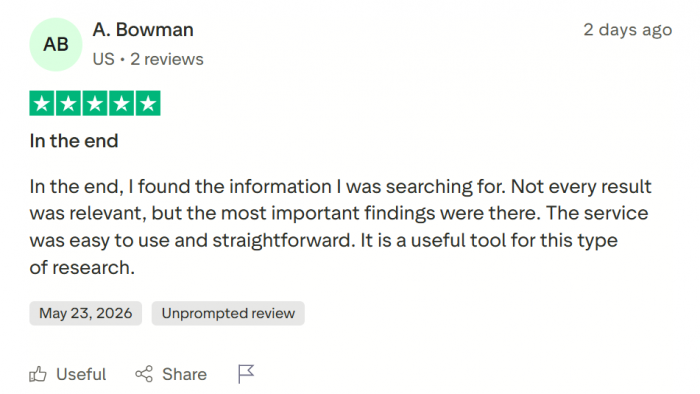 POSITIVE THEME · TRUSTPILOT |
I thought I was buying one report. It turned out to be a subscription and I was charged twice before I noticed. 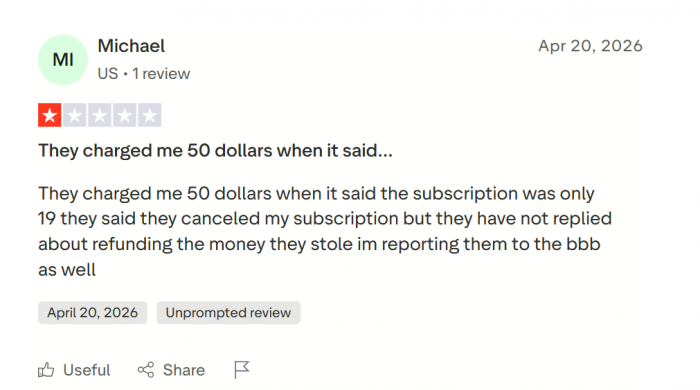 BILLING THEME · TRUSTPILOT AND REDDIT |
It pulled a long, blurry list, then asked me to pay again just to see one profile clearly. Vague at best. DOUBLE-PAYWALL THEME · REVIEW BLOGS |
Cancelling was the hard part. Support was slow and the charges kept coming after I had tried to stop them. CANCELLATION THEME · REDDIT |
How accurate is it, really?
Cheaterbuster advertises 97 to 99% accuracy. Independent hands-on testing (notably by AllAboutAI) tells a more conditional story: accuracy is real but entirely dependent on input quality and population density. Give it a clear photo, exact age and a precise location in a major city and it performs; give it a common name and a rough region and it falls apart. And against Tinder incognito or Platinum visibility settings, it simply returns no match.
| Scenario | Reported satisfaction | What it means for you |
|---|---|---|
| Claimed (vendor) | 97 to 99% | Best-case marketing figure |
| Precise inputs (name + age + location + photo) | ~89% | The sweet spot: this is how to use it |
| Large metro areas | ~82% | Dense Tinder pools help matching |
| Small towns or rural | ~61% | Thin data hurts results |
| Vague or incomplete details | ~44% | Common name plus rough location is near coin-flip |
| Hidden or incognito profile | No match | Cannot beat Tinder privacy settings |
Figures aggregated from independent testing and user-review analysis; treat them as directional, not laboratory-precise.
Accuracy and privacy clarification
The accuracy figures mentioned above should not all be treated as equivalent technical accuracy measurements. Some are company-reported figures, while others come from testing or reported user-satisfaction data.
A failed Cheaterbuster search also does not prove that someone has no dating profile. Dating platforms can restrict profile visibility, and search tools may not have access to every account or signal.
The most accurate interpretation of a “no match” result is that Cheaterbuster did not surface a matching profile using the information available to its search.
Users should also be cautious when uploading photographs or identifying information. Cheaterbuster says it relies on publicly accessible information, but its privacy policy states that search inputs and related data may be retained for operational, security and legal purposes.
Best Cheaterbuster AI alternatives
The recurring frustration with Cheaterbuster is its single-platform scope. If you do not know which app to check, a broader tool usually makes more sense. One honest caveat: many alternatives lists are published by the rivals themselves, so treat comparative claims (and their accuracy boasts) with the same skepticism you would apply here, and verify current pricing and refund terms directly.
| Tool | Coverage | Best for | Note |
|---|---|---|---|
| CheaterScanner | Tinder + Bumble + Hinge | Multi-app sweeps | Higher reported satisfaction; bundle pricing, but rival-promoted |
| Social Catfish | Reverse image, email or phone | Catfish and identity checks | Established people-verification service; subscription |
| PimEyes | Web-wide reverse face search | Finding where a face appears online | Powerful, but raises its own serious privacy questions |
| Spokeo / BeenVerified | Public-records people search | General background context | Not dating-specific; subscription model |
| Cheateye | Tinder + Bumble + Hinge | Phone-number-first lookups | Advertises a 24-hour credit-back window; rival-promoted |
Is Cheaterbuster AI legit and safe?
Yes, with caveats. The company has operated since 2016, the domain is rated Very Likely Safe, and it works as advertised within its narrow lane. It is not malware and it is not a phishing front. Legit, though, is not the same as good: the legitimate concerns here are commercial and ethical, not security. The aggressive subscription billing, the no-refund posture, the manipulative funnel design, and the act of uploading another person photo and social handles without consent are all real considerations. Run a search if you must, but go in clear-eyed about exactly what you are buying and what you are risking.
Final verdict
I went into this expecting a gimmick and came out with something more uncomfortable: a competent tool wrapped in a funnel that is better at reading you than at reading your partner. The interface is slick, the facial recognition is real, and in the right conditions (Tinder, big city, good photo) it can genuinely surface a profile. That much is true.
But the experience is built backwards. Instead of asking for the few details a Tinder search actually needs and returning a result, it walks you through a dozen emotionally loaded screens, feeds you unsourced statistics and a checklist that confirms suspicion for literally anyone, flashes early signals detected, and only then asks for a recurring subscription, with the answer still on the far side of the paywall. For a lot of people, that answer arrives blurry, and a second charge stands between them and clarity.
If you are reading this because something feels off and you are hurting, here is the most useful thing I can say: do not let that pain auto-renew. A single-platform check that signs you up for weekly charges is a poor foundation for a decision this big. Use a broader tool if you need to look, keep a hand on your wallet, and remember that the most reliable way to resolve a question about trust is usually a conversation, not a subscription.
4.3 / 10 OVERALL SCORE | Proceed with caution Real and polished, but narrow, pricey, and engineered to convert your anxiety into a recurring charge. |