


Table of Content
I have a confession. For about four years, I kept one block of thirty hashtags in my Notes app and pasted the same block under almost everything. Coffee photo? Same block. Client launch? Same block. A blurry dog picture at golden hour? You already know. It felt productive. It was not.
Then, in December 2025, Instagram capped hashtags at five per post and Reel, and my lazy little system stopped working overnight. At first I was annoyed, because five felt like nothing. But after a few weeks of being forced to actually choose, I realized the cap did me a favor. Five relevant tags, picked on purpose, quietly outperform thirty tags picked out of habit.
This guide is the process I wish someone had handed me on day one of the new rules. It is built from what Instagram itself has said, what the current data suggests, and a lot of trial and error on real accounts. No fluff, no post-at-3:47pm-on-a-Tuesday nonsense. Just a repeatable way to find five hashtags that fit any post you make.
What actually changed
Before we pick anything, it helps to know why the old playbook died. Three things shifted, and all of them point in the same direction.
| The detail | Then (through 2024) | Now (2026) |
|---|---|---|
| Hashtags per post | Up to 30 | Hard cap of 5, enforced by the platform |
| Their main job | Chase reach and the Explore page | Classify your content for the algorithm |
| Following a hashtag | Users could follow tags in feed | Removed in late 2024 |
| The winning tactic | More is more, paste and pray | Fewer, specific, chosen per post |
| Where reach comes from | The tags themselves | Content quality, watch time, saves, shares |
Two details are worth burning into memory. First, the five-tag limit is a real ceiling, not a suggestion. Add more and Instagram either blocks the post or strips the extras, and some tests suggest overstuffing can get a post quietly demoted. Second, splitting tags between your caption and the first comment does not buy you extra slots. Five is five, wherever you put them.
Instagram head Adam Mosseri has said more than once that hashtags do not meaningfully boost reach on their own, and that they behave more like labels than like rocket fuel. Useful context, not a growth hack.
5 The hard limit on posts and Reels since December 2025. Extra tags get stripped or the post gets demoted. | 0 Hashtags you can follow in feed since late 2024. Passive exposure through tags is gone. | Context, not reach How Instagram's own leadership now describes what hashtags actually do. |
So are hashtags even worth it?
Fair question, and you will see plenty of hashtags-are-dead headlines. The honest answer sits in the middle. They are no longer a growth hack, but skipping them entirely tends to leave results on the table, because the algorithm still reads them to understand and file your post.
A quick word on the numbers you will run into. You will see a 12.6% lift in engagement quoted here, a 30 to 50% bump from using the right count there. Treat these as directional rather than gospel. Most come from marketing blogs rather than from Instagram, and they swing wildly by niche and account size. What is solid is the direction of travel: a few precise tags help the algorithm place you, and misused tags can actively hurt you.
| Myth | The reality |
|---|---|
| Hashtags land you on Explore | Explore runs mostly on engagement signals now. Tags help categorize, they do not carry you there by themselves. |
| More hashtags, more reach | Past five you simply cannot add more, and stuffing used to signal low intent to the algorithm anyway. |
| One set works for everything | Reusing one identical block can read as spammy and slowly flatten your reach across posts. |
The five-slot framework
Here is the shift that made everything click for me. Stop thinking about a list, and start thinking about five jobs. Give each slot a role, and picking becomes almost mechanical. You are not brainstorming thirty tags anymore, you are answering five short questions about the post in front of you.
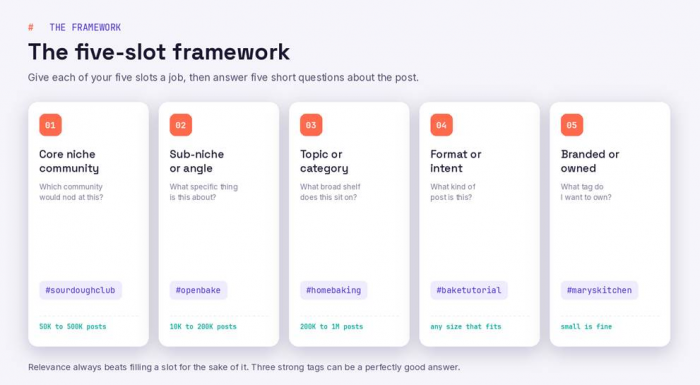
You do not have to fill all five with tags of different sizes every single time. Think of these as roles to consider, not boxes to force. If a post genuinely only needs three strong, relevant tags, three is a perfectly good answer. Relevance always beats filling a slot for the sake of it.
The post-count sweet spot
Every hashtag shows a post count when you search it. That number is your competition gauge. Too big and your post drowns in seconds. Too small and almost no one is looking. The middle is where a normal account can actually surface and stay visible.
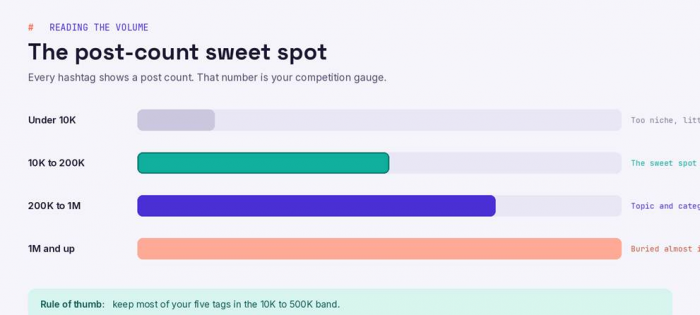
If you take one number from this whole article, make it this. Most of your five tags should sit in the 10K to 500K range. That band gets repeated by tool after tool for a reason. It is big enough to have an engaged audience, and small enough that a good post can climb to the top of the tag instead of vanishing under a million others.
Six steps to actually find them
Frameworks are nice, but you need something you can do in two minutes before you hit publish. This is the routine. It leans on Instagram's own search, which is free and honestly better than most people realize, plus a quick sanity check at the end.
1. List your keywords first. Before opening Instagram, jot down three to five plain words that describe the post: the subject, the niche, the format, the vibe. This is your raw material. Do it away from the share button so you actually think.
2. Mine the search bar. Type each keyword into Instagram search and watch the autocomplete. Every suggestion shows a post count. This is Instagram telling you, in real time, which tags it recognizes and how busy each one is.
3. Study the top posts. Open a few top-performing posts in your niche and note which tags keep showing up across them. Recurring tags on winning content are the ones the algorithm is actively using to classify that space. Borrow the pattern, not the exact copy.
4. Vet each tag by volume. Run your shortlist against the tiers above. Keep the ones in your sweet spot, swap out anything over a million unless it is doing a specific job, and drop anything with barely any posts unless it is your own branded tag.
5. Assign the five slots. Map your survivors onto the framework: one core community, a sub-niche, a topic, a format, and something you own. If a slot has no strong candidate, leave it empty rather than forcing a weak tag in.
6. Save the set, then rotate. Store the finished five in a note, but do not reuse the identical block forever. Build a few sets per content pillar and rotate them. It keeps things fresh and dodges the spammy-repetition flag.
The first time, this takes about ten minutes. Once you have a few saved sets per topic, it drops closer to sixty seconds, because you are choosing from a shortlist instead of starting from scratch every time.
Two quick worked examples
Any post is a big promise, so here it is on two very different accounts. Same framework, completely different tags.

Example A A coffee shop's latte-art Reel
| Community | #coffeecommunity |
| Sub-niche | #latteart |
| Topic | #specialtycoffee |
| Format | #reelscoffee |
| Branded | #brewbarpdx |
Four tags describe the craft and community, one is the shop's own. A local tag like #pdxcoffee could take the format slot if the real goal is nearby foot traffic.

Example B A home-workout follow-along
| Community | #homeworkout |
| Sub-niche | #nogymneeded |
| Topic | #fitnessmotivation |
| Format | #followalongworkout |
| Branded | #trainwithsam |
Notice none of these are just #fitness or #gym. Those mega-tags would bury a growing creator in under a minute.
Different worlds, same five questions. That is the entire point of working in slots instead of lists.
Mistakes that quietly kill reach
Most hashtag damage is not dramatic. It is slow, and it comes from a handful of habits that used to be fine and now are not.
| Common mistake | Do this instead |
|---|---|
| Pasting one identical block on every post | Rotate a few sets built per topic |
| Reaching for #love, #instagood and other mega-tags | Stay mostly in the 10K to 500K band |
| Adding trendy tags that do not fit the post | Only use tags your post would genuinely belong in |
| Hiding every tag in the first comment for room | Put them in the caption; comments do not add slots |
| Never checking if a tag is banned or broken | Search a tag first, skip any showing no recent posts |
| Choosing tags while your thumb hovers over share | Research once, save sets, choose calmly later |
A quick gut check before you publish: would your post honestly belong in the results for each tag you picked? If the answer is no for any of them, that tag is costing you, not helping you.
A few tools worth your time
You genuinely do not need paid software to do this well. But if you post a lot, a couple of tools can save time. Here is an honest, short list, free options first.
| Tool | Best for | Cost |
|---|---|---|
| Instagram search and Explore | Live post counts and what is trending in your niche | Free |
| Instagram Insights | Seeing which of your own tags drove reach and saves | Free |
| Later or Tailwind finders | Contextual tag suggestions inside a scheduler | Free tier |
| A plain notes app | Storing and rotating your saved sets | Free |
My actual stack is embarrassingly simple. Instagram's search bar to research, Insights to see what worked, and a Notes file with a handful of saved sets per topic. That is it. Fancier tools are a convenience, not a requirement.
# SCREENSHOT THIS
The two-minute routine 1 Write three to five keywords for the post 2 Search each in Instagram and read the post counts 3 Keep tags mostly in the 10K to 500K range 4 Fill the five slots: community, sub-niche, topic, format, branded 5 Skip any slot with no strong, relevant tag 6 Save the set and rotate it next time Relevance beats volume, volume beats guessing, and five on purpose beats thirty on autopilot. |
My honest take
Here is where I land after all of it. Hashtags in 2026 are a small lever, not a big one, and anyone selling them as a growth secret is a few years out of date. The heavy lifting is done by the things that were always going to matter: a genuinely good post, a caption written like a human wrote it, a hook that earns the first few seconds, and content people want to save and send to a friend. If your post is weak, no five tags on earth will rescue it.
But a small lever is not the same as no lever. Relevant tags still help Instagram understand who your post is for, and that quiet bit of context is worth the two minutes it costs. Skipping them entirely is like publishing a blog post with no title. It will not sink you, but why hand back a free advantage?
My real view is that the five-tag cap is the best thing to happen to hashtags in years. It killed the copy-paste habit and forced everyone to be deliberate, which is exactly where the value was hiding the whole time. Fewer slots made me a sharper editor of my own content. I now spend those two minutes asking what my post actually is and who it is for, and that thinking pays off far beyond the hashtags.
So if you take one thing from this: stop treating hashtags as a lottery ticket and start treating them as five small, honest labels. Pick them on purpose, keep them relevant, rotate your sets, then go put your real energy where it belongs, into the post itself. Five good tags and a great post will beat thirty tags and a lazy one every single time. That is not a trick. It is just how the platform works now.