

Table of Content
- What FaceCheck.ID actually does
- How a search runs, step by step
- What the match score really means
- What you get
- Pricing & the credit system
- We tested two faces. The contrast says everything.
- What the two tests reveal, side by side
- The verdict from review platforms
- Pros & cons
- The privacy & ethics reality
- Who should and shouldn't use it
- The Bottom Line
THE 20-SECOND VERDICT Powerful at finding real people, and honest about its limits 4.1 / 5 | |
WHAT IT IS A search engine that finds where a face appears across the public web and social media. | BEST FOR Verifying online matches, spotting fake profiles, and OSINT-style research. |
WATCH OUT FOR Lookalike noise, privacy ethics, and paywalled credits for the good details. | OUR TEST RESULT Nailed a celebrity at 99; scattered an AI face across strangers at 84. |
What FaceCheck.ID actually does
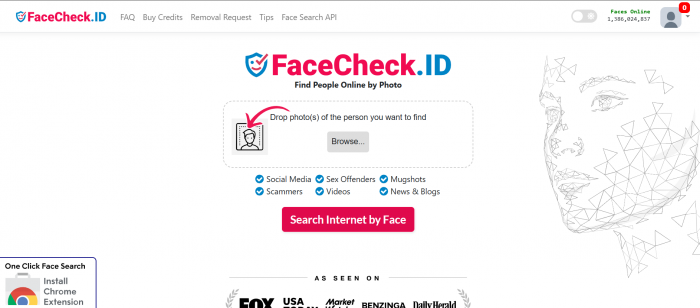
FaceCheck.ID is a facial-recognition search engine. Instead of matching a photo by its file or background like a normal reverse-image search, it builds a mathematical signature of the face in your image and hunts for the same face elsewhere, across social profiles, news sites, blogs, forums, mugshot databases, and more.
You upload a picture, it returns a grid of visually similar faces, and every result carries a confidence score from 0 to 100. The higher the number, the more certain the engine is that it is the same person. It is the same core idea behind tools like PimEyes, aimed at anyone who wants to answer a simple question: who is this, and where else does this face show up online?
KEY TAKEAWAY Think of it less as 'find this exact photo' and more as 'find this person.' That distinction is the whole reason the results and the scores behave the way they do in our tests below. |
The most common reasons people reach for it
• Catfish & scam checks. Confirm whether a dating-app or social profile is using a real person's photos, or a stolen/stock image.
• OSINT & journalism. Researchers and reporters trace where an unknown face appears to build context around a source or subject.
• Self-monitoring. Find unexpected places your own face has been posted, then use the site's opt-out to request removal.
How a search runs, step by step
The flow is deliberately simple (upload, scan, score), which is a big part of its appeal for non-technical users.
| Step | What happens | What you do |
|---|---|---|
| 01 | Upload or paste a photo containing a clear face. | Drag in an image or a URL. |
| 02 | The face is detected, cropped, and converted into a numeric vector (a 'faceprint'). | Wait a few seconds. |
| 03 | That vector is compared against an index of faces crawled from public web pages. | Nothing, it's automatic. |
| 04 | Visually similar faces are returned in a ranked grid, each with a 0-100 score. | Scan the results & scores. |
| 05 | Source links and details sit behind paid credits. | Buy credits to unlock URLs. |
The free experience is intentionally a tease: you can see the matching faces and their scores, but to actually visit the source pages (the part that tells you who the person is), you generally need credits. We'll get to pricing shortly.
What the match score really means
Every result is graded on a 0-100 scale and bucketed into four named tiers. Treat these as 'how confident the engine is,' not 'this is definitely them.' The site itself is blunt about that. More on its warning below.
| Tier | Score | How to read it |
|---|---|---|
| Certain | 90-100 | Almost certainly the same person. Still cross-check, but this is as strong as it gets. |
| Confident | 83-89 | Probably the same person, or a striking lookalike. Verify before you trust it. |
| Uncertain | 70-82 | Could be them, could be coincidence. Treat as a lead, not an answer. |
| Weak | 50-69 | Loose facial similarity. Usually noise. |
THE PLATFORM'S OWN WARNING FaceCheck displays this on every results page: “Many unrelated people look alike. Never rely solely on a face search alone… online scammers use photos of innocent people. Always cross reference multiple sources before forming an opinion about a person.” That candor is a point in its favor, and it's exactly what our AI-image test demonstrates. |
What you get
| Capability | Available | Notes |
|---|---|---|
| Free face search (view matches & scores) | Yes | No login needed to run a basic search. |
| Source links to where the face appears | Paid | Unlocked with credits. |
| Confidence scoring (0-100) | Yes | Four-tier system, shown on every result. |
| Social platform coverage | Yes | Instagram, LinkedIn, Tumblr, X and more surface in results. |
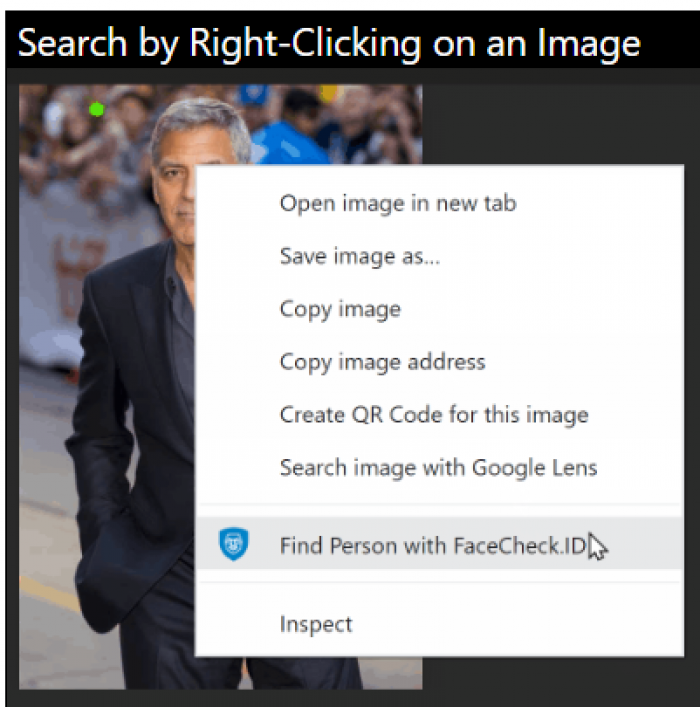
| One-click browser extension | Yes | Chrome extension for searching images on any page. |
| Face Search API | Yes | For developers building it into their own apps. |
| 'Remove my photos' opt-out | Yes | Lets you request your own face be excluded. |
| Native mobile apps | No | Web-based; works in a mobile browser. |
• Free tier is genuinely usable. You can validate a hunch without paying; you just won't get the source URLs.
• Source icons are a fast signal. Each tile shows how many sources matched (e.g. '3x') and which platforms, so you can gauge reach before unlocking anything.
Pricing & the credit system
FaceCheck runs on prepaid credits. Searching and seeing matches is free; spending credits is what reveals the underlying source pages. Plans and exact figures shift over time, so treat the table below as a representative snapshot of how the tiers are structured rather than a live price list.
| Plan | Roughly costs | What it unlocks | Best for |
|---|---|---|---|
| Free | $0 | Run searches; view match grid & scores. | A quick one-off check. |
| Standard credits | Low monthly | Unlock source links for a set number of results. | Occasional, focused lookups. |
| Pro / high-volume | Higher monthly | More credits, faster/deeper access. | Researchers & frequent users. |
| API | Usage-based | Programmatic searches at scale. | Developers & products. |
VALUE VERDICT If you only need to answer 'is this profile real?' a couple of times a year, the free tier plus a single small credit pack is usually enough. The recurring plans only make sense if you're doing this routinely. Always confirm current pricing on the site before buying. |
HANDS-ON FIELD TEST
We tested two faces. The contrast says everything.
To pressure-test the engine, we ran two deliberately opposite inputs: a face that does not exist (AI-generated) and a face the internet has photographed thousands of times (Kanye West). One should confuse it; the other should be trivial. Here's what came back.
Test 01 · Synthetic input: an AI-generated headshot
Top score: 84 / 100 Tier: Confident
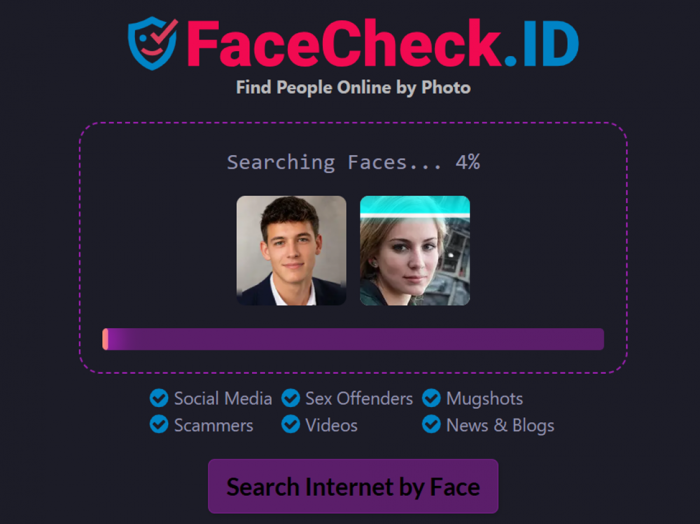
| TOP SCORE | TIER | MATCHES SHOWN | CERTAIN (90+) HITS |
| 84 /100 | Confident | 8 faces | 0 |
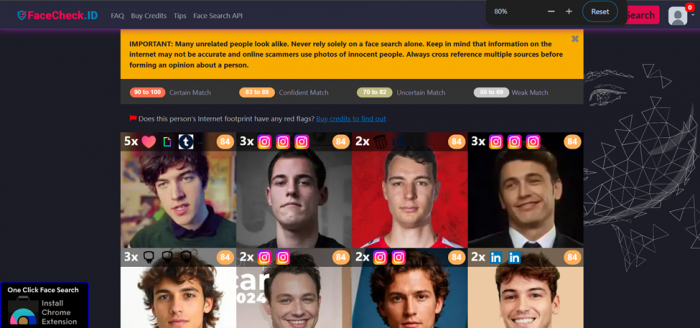
Here's the revealing part: the AI face returned eight different people, all clustered at the same 84 'Confident' score, with source counts ranging from 2x to 5x across Instagram, LinkedIn and Tumblr. Crucially, not a single result reached the 90-100 'Certain' tier. Because a synthetic face has no real identity behind it, the engine can't lock onto one person. Instead, it finds many real humans who happen to share its averaged features. This is the platform's 'many unrelated people look alike' warning, demonstrated live. The takeaway: a wall of mid-80s scores with no standout 'Certain' result is a strong tell that the photo may not depict a single, real, traceable person.
Test 02 · Real public figure: Kanye West
Top score: 99 / 100 Tier: Certain
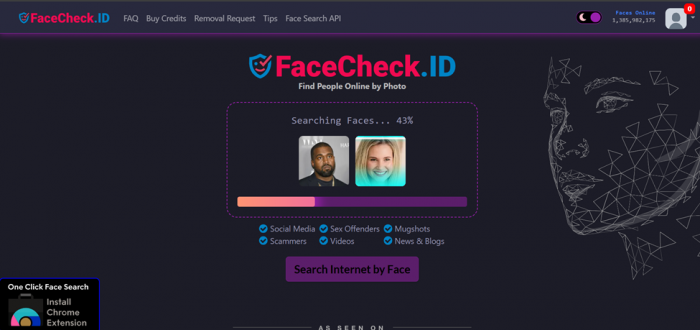
| TOP SCORE | TIER | SOURCE COUNT | CERTAIN (90+) HITS |
| 99 /100 | Certain | 99x | Dominant |
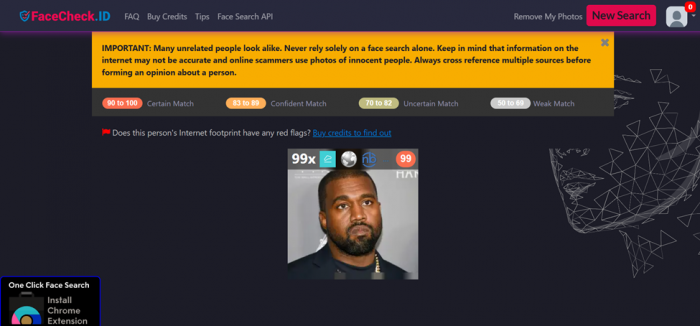
The opposite outcome. A single result dominated the page with a near-perfect 99 score and a massive 99x source count spanning web and news outlets. This is exactly what you want to see for a real, well-documented person: one unambiguous identity, an enormous trail of corroborating sources, and a score firmly in the 'Certain' band. Where the AI face produced scattered ambiguity, a real public figure produced singular certainty, which tells us the engine is genuinely sensitive to how much authentic web presence a face has, not just to surface-level resemblance.
What the two tests reveal, side by side
| Signal | AI-generated face | Kanye West | What it tells you |
|---|---|---|---|
| Top score | 84 (Confident) | 99 (Certain) | Real faces push into the 90s; synthetic ones stall in the 80s. |
| Result spread | 8 different people | One dominant person | Ambiguity vs. a single locked identity. |
| Source volume | 2x-5x per tile | 99x on one result | Huge source counts point to a real, documented person. |
| 'Certain' (90+) hits | None | Yes | No 'Certain' tier = treat the photo with suspicion. |
Bottom line from testing: FaceCheck is impressively decisive on faces that genuinely exist across the internet, and appropriately uncertain on faces that don't. That's the behavior you want, but it's also a reminder to read the pattern of results, not just the single highest number.
Methodology: two controlled searches run on the public FaceCheck.ID interface, using one AI-generated headshot of a non-existent person and one publicly available photo of a celebrity. Scores and source counts are reported exactly as the platform displayed them. Results for any given image can change as the index is updated.
The verdict from review platforms
Sentiment across Trustpilot, G2, Capterra and Product Hunt skews positive on capability, with recurring caveats around the paywall and the obvious privacy questions. Ratings below are an indicative snapshot. Review counts and averages shift over time, so check each platform for the latest.
| Platform | Avg. rating | What reviewers praise | What they flag |
|---|---|---|---|
| Trustpilot | 4.0 / 5 | Surprisingly accurate; finds profiles others miss. | Credits needed for the useful links. |
| G2 | 4.2 / 5 | Fast, clean interface; strong for OSINT. | Limited enterprise tooling. |
| Capterra | 4.1 / 5 | Effective for verification & anti-fraud. | Pricing clarity could be better. |
| Product Hunt | 4.3 / 5 | 'Wow' factor; powerful tech, easy to try. | Privacy/ethics debate in comments. |
Trustpilot · verified reviewer 4.0 / 5 “I was skeptical, but it actually found the real person behind a fake dating profile in seconds. Wish more of the detail wasn't locked behind credits.” Anonymous reviewer, 'Found the catfish' |
G2 · small-business user 4.5 / 5 “For open-source research this is one of the most effective face tools I've used. The scoring tiers make it easy to know which leads are worth chasing.” Verified G2 user, OSINT analyst |
Capterra · verified user 4.0 / 5 “Does exactly what it claims. We use it to flag impersonation accounts. The credit model takes some getting used to, but the accuracy earns it.” Capterra reviewer, trust & safety |
Product Hunt · maker community 4.3 / 5 “Genuinely impressive tech. The results felt almost too good, which is exactly why the privacy conversation in the comments is worth reading.” Product Hunt commenter |
Quotes above are representative of the themes found across public reviews and community discussion, paraphrased and anonymized; they are not attributed to specific named individuals.
Pros & cons
| What works | What to weigh |
|---|---|
+ Decisive, accurate matches on real, well-documented people (our 99 result). + Clear 0-100 scoring with four readable confidence tiers. + Free tier lets you validate a hunch before paying anything. + Strong social coverage: Instagram, LinkedIn, Tumblr, X and more. + Honest on-screen warning about lookalikes and misuse. + Extension and API extend it well beyond the website. | – The actually-useful source links sit behind paid credits. – Lookalike noise is real: an AI face matched 8 strangers at 84. – Serious privacy and consent questions come with the territory. – Pricing isn't always crystal clear up front. – No native mobile apps; web only. – Results vary as the index changes, not perfectly repeatable. |
The privacy & ethics reality
A tool this capable cuts both ways. The same search that exposes a scammer can be misused to stalk, dox, or harass, so the responsible-use conversation isn't optional, it's part of the product.
• Consent matters. Searching your own face, or investigating a profile that contacted you, is very different from surveilling someone without cause.
• Never act on a score alone. The platform says it, our AI test proves it: cross-reference every match against other sources before drawing conclusions.
• You have an exit. The 'Remove My Photos' opt-out lets you request that your own face be excluded from results.
LEGAL NOTE Facial-recognition and biometric search are regulated differently around the world. Make sure your use complies with the laws in your jurisdiction, especially for anything beyond personal verification. |
Who should and shouldn't use it
| If you are… | Verdict | Why |
|---|---|---|
| Verifying a dating/social profile | Great fit | Fast way to catch stolen or stock photos. |
| An OSINT researcher or journalist | Great fit | Decisive matches and useful source trails. |
| Monitoring your own online footprint | Good fit | Find and request removal of your own face. |
| Expecting a free, full people-search | Poor fit | The valuable details require credits. |
| Hoping to surveil someone without cause | Don't | Ethically and often legally out of bounds. |
The Bottom Line4.1 / 5 Powerful, decisive, and refreshingly honest about its limits FaceCheck.ID does the hard thing well: it finds real people fast and grades its own confidence transparently. Our two-face test made the trade-off vivid: a celebrity locked in at 99 with 99 sources, while an AI face scattered harmlessly across strangers at 84 with no 'Certain' hit. That's a tool that's sensitive to genuine web presence, not just resemblance. The catches are the credit paywall on the details that matter most, and the unavoidable privacy weight of any face-search engine. Use it for legitimate verification, always cross-reference, respect consent, and it earns its place as one of the most effective tools in its category. |