

Table of Content
A friend of mine, call her R, met a man on a dating app who said he was an offshore engineer working a rotation in the North Sea. Good photos. Consistent story. He would not do a video call because the rig had "bad signal", which is the sort of thing that sounds reasonable at eleven at night and absurd at nine the next morning.
She did the responsible thing. She found Social Catfish, paid for the trial, uploaded his photo, and waited. What came back was a tidy report about a man with the name he had given her, living in a state he had never mentioned, aged nine years older than his profile. She could not tell if that was him. Neither could the report. The one thing she wanted, proof that the face in the photo belonged to somebody else entirely, was the one thing the tool never gave her.
That is the failure at the centre of this whole category, and it has almost nothing to do with Social Catfish being a bad company. R had an image question. She paid for a records answer. Those are two different products built on two different technologies, and the marketing in this industry works very hard to blur the line between them.
Where most of these searches begin: a profile that feels slightly too smooth. Photo: Santeri Viinamäki, CC BY-SA 4.0 via Wikimedia Commons.
So this guide is organised around your input, not around a leaderboard. If you have a face, two of these tools will help you and two will waste your money. If you have a phone number, the reverse is true. Below are the four alternatives worth your time in 2026, each with a full spec table and an honest pros and cons breakdown, followed by four comparison tables and a workflow you can run in about fifteen minutes.
Quick answer: which one should you use?
| If you have… | Use this | Rough cost |
|---|---|---|
| A photo of a suspicious dating profile | FaceCheck.ID | ~$6, no subscription |
| A photo, and FaceCheck came back empty | PimEyes (one month, then cancel) | ~$30 |
| A photo with a distinctive background | Lenso.ai (place search) | Free tier to ~$30 |
| A phone number, email or name (US subject) | Spokeo | ~$1 trial → ~$25/mo |
| Five spare minutes and zero budget | Google Lens + Yandex + TinEye | Free |
Before any of it: ask for an unscripted live video call. A refusal is the cheapest evidence you will ever collect.
What Social Catfish actually sells
Social Catfish is a people-search company. Its core asset is aggregated public records: names, aliases, phone numbers, email addresses, addresses, relatives. Bolted onto the front of that is an image search feature, which is the thing everybody arrives for and the weakest part of the product.
This matters commercially, because the pricing is structured around the image search that draws traffic while the money sits in the records subscription. Prices below reflect what was publicly advertised in mid 2026 and move around constantly, so treat them as shape rather than gospel and always read the checkout screen before you confirm.
Table 1. Social Catfish pricing structure as advertised mid 2026. Figures are directional and vary by promotion, region and A/B test.
| What you are buying | Advertised cost | The reality check |
|---|---|---|
| Trial | ~$6 for a few days | Auto-renews into a full plan unless cancelled. The single most common complaint about the service is a charge people did not expect. |
| Image search plan | ~$27 to $36 / month | Unlimited image searches. Does not include name, phone, email or username lookups. Those sit on a separate plan. |
| Records plan | ~$27 to $36 / month | Name, email, phone, username, address. The plan most people actually want, and the one they do not buy. |
| Managed investigation | $397 to $3,000 one time | Human-assisted verification and crypto tracing. Aimed at people who have already lost money. |
To be fair to it: as a records tool, Social Catfish is defensible. The interface is friendlier than most, the reports are readable, and the company publishes genuinely useful scam education. If you have a phone number or an email address, buying it is a reasonable decision.
As a face tool, it is outclassed. Its image search leans on general reverse-image matching, which finds copies of your exact picture rather than other pictures of the same person. That distinction is the whole ballgame, and it is worth ten seconds of your attention: reverse image search asks "where else does this file appear?" Face search asks "where else does this person appear?" Scammers steal photos from Instagram accounts belonging to real people. If the stolen photo has never been reposted anywhere, reverse image search returns nothing while face search returns the victim's entire account.
How these four were chosen
There are perhaps forty products in this space and most of them are the same three databases wearing different logos. I filtered on four criteria, in this order:
• Does it solve a distinct problem? Four tools, four jobs. No two entries below are substitutes for each other, which is the entire point.
• Is the pricing legible? Anything that hides the recurring charge behind a one dollar trial was disqualified on principle, however good the tech.
• Does it survive contact with a hard case? A cropped photo, a face at three quarter angle, a person with no public social media. Easy cases prove nothing.
•Is the company still alive? A surprising number of "top ten" lists still recommend tools that stopped working two years ago. (Gramhir is the obvious example: the original Instagram viewer broke when Meta tightened API access, the domain now hosts an unrelated content blog, and the "AI image generator" story attached to it appears to be recycled between review sites with nobody having tested anything.)
Also considered, and why they missed the cut
Cheaterbuster AI scans Tinder specifically and does one thing well, but at roughly $18 per search it is expensive for a single-platform answer, and its advertised 97 to 99 percent accuracy sits well above what independent testers report (closer to 80 to 89 percent). Worth it only if you are certain the person is on Tinder.
BeenVerified and Intelius are competent records aggregators drawing on overlapping data. If Spokeo returns nothing on your subject, these will usually return nothing too. Buying all three is not triangulation, it is paying three times for one dataset.
FaceCheck.ID
Best for one honest answer
Face search / pay per credit / no subscription required
FaceCheck.ID is the tool I would hand to R if I could rewind eighteen months. It does one thing: you give it a face, it searches an index weighted heavily toward the places catfish photos actually surface, and it returns ranked matches with a confidence score and the source URL. Its index deliberately over-samples scam report boards, mugshot archives, news photography and social profiles, which means it is unusually good at the specific case where a stranger has stolen a real person's pictures.
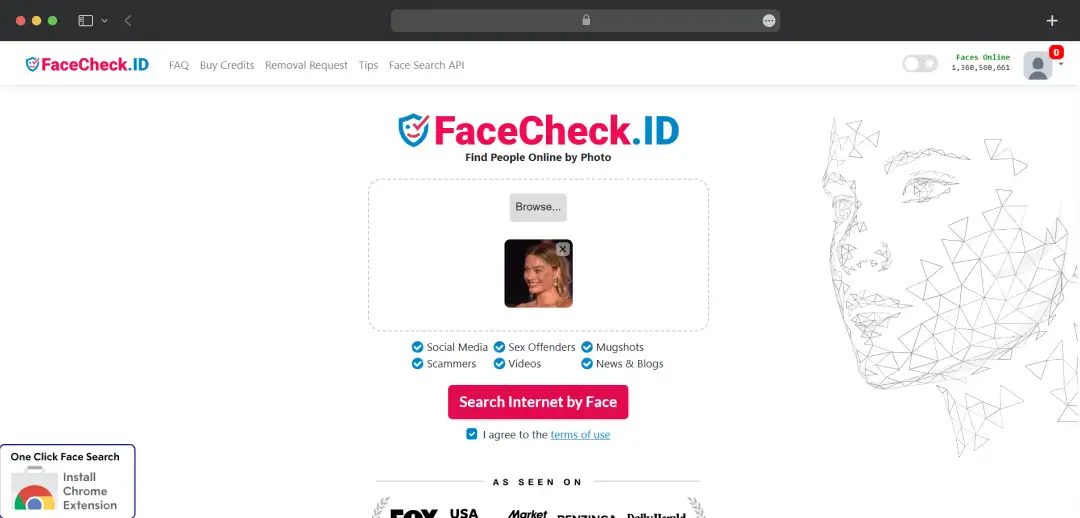
What sold me on it is a small honest design decision: results are blurred until you spend credits, but the count and the confidence bands are visible for free. You can see, before paying, whether there is anything worth paying for. Almost nothing else in this category does that.
Table 2. FaceCheck.ID at a glance. Pricing observed mid 2026, sold as credit packs rather than a monthly plan.
| Attribute | Detail |
|---|---|
| Searches by | Face geometry (not file matching) |
| Ideal input | One clear, front-facing photo, eyes visible, minimal sunglasses or heavy filters |
| Index bias | Scam report sites, mugshots, news media, public social profiles |
| Free tier | Yes. Blurred previews, match counts and confidence scores visible without payment |
| Typical cost | Credit packs from roughly $5. Per-search cost falls sharply on larger packs |
| Subscription | Not required, which is the single best thing about it |
| Speed | Seconds to about a minute per query |
| API | Available but lightly documented. Treat as a bonus, not a foundation |
Table 3. FaceCheck.ID pros and cons.
| Pros | Cons |
|---|---|
| No subscription trap. You buy credits, you use them, nothing renews. | Index is narrower than PimEyes. Fewer total matches on ordinary private people. |
| Free preview shows whether results exist before you spend anything. | Confidence scores are directional, not forensic. Treat 70 percent as "look closer", not "confirmed". |
| Best-in-class on the exact scam case: stolen photos from a real person's account. | Weak on group shots and heavily cropped faces. |
| Returns source URLs, so every claim is checkable by you. | No records data at all. A name will not help you here. |
| Fast, and the interface does not upsell you at every click. | False positives on people with common face types are real. Verify by hand. |
VerdictIf you have a photo and a bad feeling, start here. It is the cheapest way to convert a suspicion into evidence, and the only tool on this list that lets you find out whether the answer exists before it charges you for it.
Face search matches geometry, not pixels, which is why it can find the same person in a photograph you have never seen. Photo: Pete Woodhead, CC BY 2.0 via Wikimedia Commons.
PimEyes
Deepest index, heaviest price
Face search / subscription only / own-face monitoring
PimEyes has the largest and most aggressive face index available to the public. Where FaceCheck.ID is tuned for scam detection, PimEyes is tuned for coverage: it crawls broadly, indexes deeply, and will surface a person in a stranger's holiday photo from six years ago. When it works, it is uncanny. When it charges you, it is uncanny too.
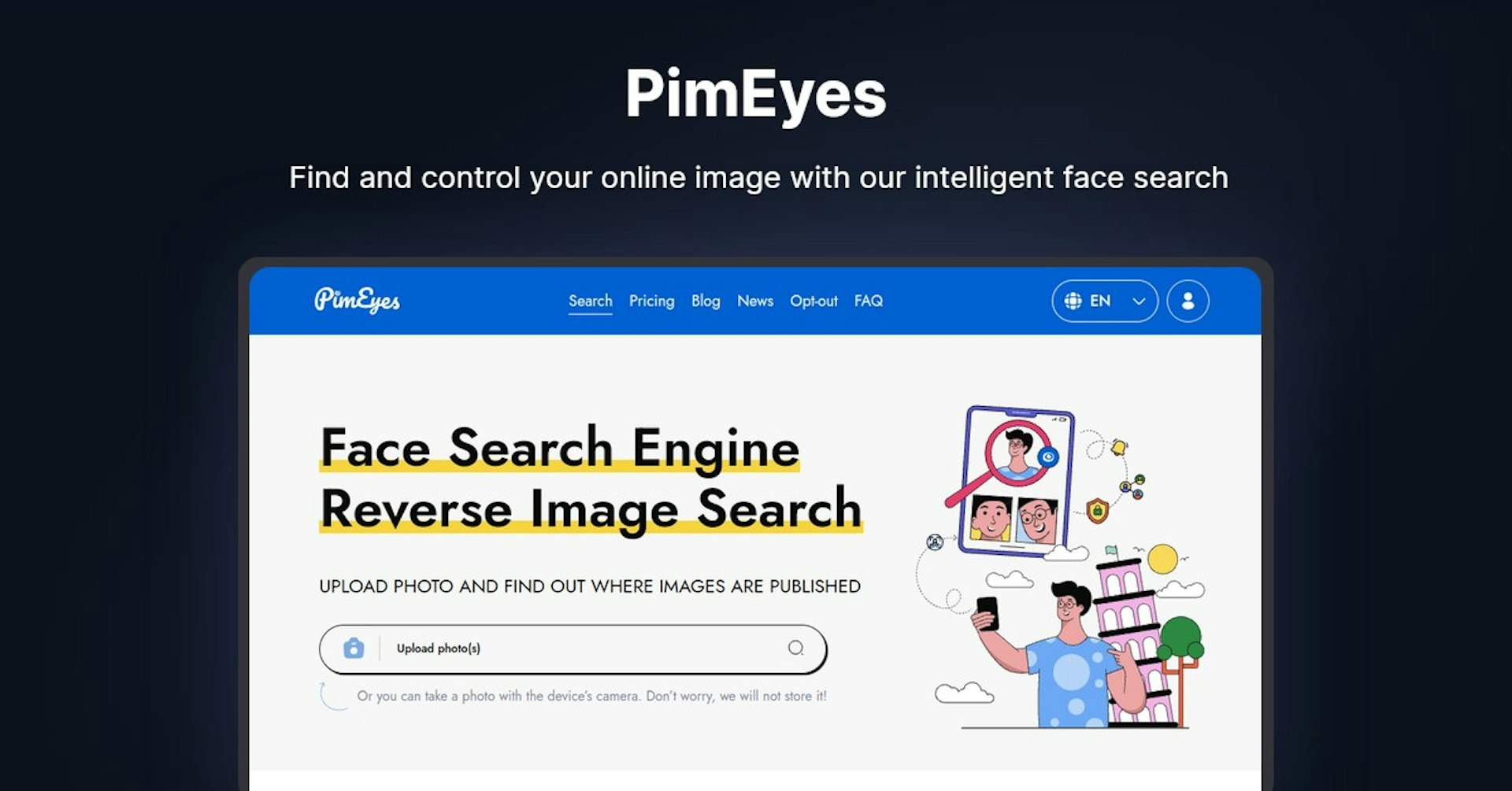
The catch is structural. There is no meaningful pay-per-search option. You subscribe, and the entry tier runs around thirty dollars a month with the deep search and alert features sitting well above that. For a single lookup this is poor value. For someone monitoring their own likeness across the internet, which is officially the only use the company endorses, it is the best product that exists.
That official position is worth taking seriously rather than rolling your eyes at. PimEyes states its service is for searching your own face, requires a consent step, and offers a free opt-out that removes you from results. In practice people use it to search other faces constantly. I am telling you this plainly because a guide that pretends otherwise is not being useful, and because the gap between the stated policy and actual use is exactly where your legal exposure lives. See section 10.
Table 4. PimEyes at a glance. Pricing has changed several times and varies by region and promotion.
| Attribute | Detail |
|---|---|
| Searches by | Face geometry, with the broadest public crawl in the category |
| Ideal input | Any reasonably lit face. Tolerates angles and partial occlusion better than rivals |
| Index bias | Broad open web. Strong on blogs, event photography, forums, archived pages |
| Free tier | Blurred thumbnails only. You cannot see source domains without paying |
| Typical cost | Entry plan around $30 / month. Advanced and monitoring tiers substantially higher |
| Subscription | Required. No credible one-off purchase |
| Standout feature | Alerts when a new photo of you appears, plus a free removal request tool |
| Stated policy | Search your own face only. Consent checkbox on upload |
Table 5. PimEyes pros and cons.
| Pros | Cons |
|---|---|
| Finds matches nothing else finds. Coverage is the product. | Subscription only. Terrible value if you need one answer once. |
| Handles difficult angles, partial faces and older photos well. | Free tier is deliberately useless. You cannot preview whether paying is worthwhile. |
| Genuinely excellent for auditing your own online footprint. | Cancellation friction has been a persistent complaint. Cancel the moment you finish. |
| Free opt-out and takedown request tooling, which competitors do not offer. | Deep search, the tier most people actually need, is behind the expensive plan. |
| Long operating history and a public position on ethics. | Searching a face that is not yours sits against its own stated terms. |
VerdictBuy it for a month if FaceCheck.ID came back empty and the stakes justify thirty dollars. Buy it permanently if you are protecting your own likeness. Do not buy it for a single curiosity search, because you will forget to cancel and the industry knows you will.
Lenso.ai
Best for developers and mixed searches
Face, place, duplicate and related search / documented API
Lenso.ai is the most technically interesting tool on this list, and the one most often left off comparison articles because it does not fit the "catfish" keyword neatly. It splits a single image search into four modes: faces, places, duplicates and related images. That sounds like marketing until you use it on a scam profile, where the answer often is not in the face at all. It is in the background. A hotel lobby, a stretch of coastline, a car number plate. Lenso will tell you the photo was taken in Cebu when the profile says Rotterdam, and that single fact does more work than any face match.

Crucially, it is the only tool here with an API you can build against without a sales call. If you are integrating identity checks into a marketplace, a dating product or a community platform, this is the practical starting point. Pricing is credit and plan based, with a small free allocation that is enough to evaluate quality honestly.
Table 6. Lenso.ai at a glance.
| Attribute | Detail |
|---|---|
| Searches by | Four modes: face, place, duplicate, related |
| Ideal input | Any photo. The background is treated as evidence, not noise |
| Index bias | Broad web, with unusually strong location and landmark recognition |
| Free tier | Yes. A limited number of free searches, results visible |
| Typical cost | Credit packs and monthly plans. Entry pricing broadly comparable to PimEyes |
| API | Documented and self-serve. The only one here you can integrate the same afternoon |
| Standout feature | Place search. Geolocating a photo the subject did not think to check |
| Weakness | Face index shallower than PimEyes, scam coverage thinner than FaceCheck.ID |
Table 7. Lenso.ai pros and cons.
| Pros | Cons |
|---|---|
| Four search modes in one query. Place search regularly cracks cases faces cannot. | Face-only coverage is mid-table. It is not the deepest index. |
| The only self-serve documented API in this comparison. | Aimed partly at creators and researchers, so scam-specific sources are underweighted. |
| Free searches show real results, not blurred teasers. | Free allocation is small. Serious work requires a plan. |
| Duplicate search is excellent for finding where a stolen image spread. | Newer product, shorter public track record than PimEyes. |
| Clean, modern interface with no dark-pattern upsells. | No public records, no phone or email lookup. |
VerdictUse it second, after FaceCheck.ID, when the face search fails and you still have a photograph with a background in it. Use it first if you are a developer, because it is the only option here that will let you ship something this week.
An entire sub-industry now exists to monetise the moment you begin doubting someone. Read the checkout screen carefully. Photo: CC0 via Wikimedia Commons.
Spokeo
The records answer, not the face answer
Public records aggregation / name, phone, email, address
Spokeo is the closest like-for-like replacement for what Social Catfish actually is underneath: an aggregator of public records, court filings, property data, phone listings and social handles. It is on this list because half the people searching for a Social Catfish alternative do not have a photo. They have a phone number that called them at midnight, or an email address on a suspicious invoice.
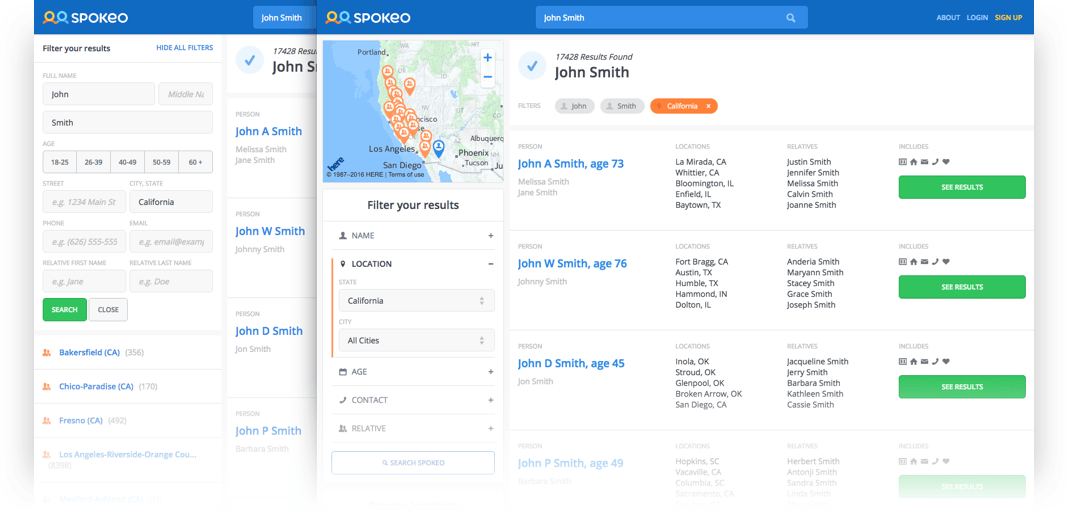
For that job, Spokeo is cheaper and broader than Social Catfish, and its reverse phone lookup in particular is the strongest consumer-grade version available. What it will not do, ever, is tell you whether a photograph shows the person it claims to show. Do not buy it hoping otherwise.
Table 8. Spokeo at a glance. Introductory pricing converts to a recurring plan.
| Attribute | Detail |
|---|---|
| Searches by | Name, phone number, email address, physical address, username |
| Ideal input | A phone number. This is where it is strongest by some distance |
| Data sources | Public records, property and court filings, marketing databases, social handles |
| Free tier | Existence checks only. You are told a record exists, not what it says |
| Typical cost | Around $1 introductory, converting to roughly $25 / month |
| Image search | Effectively none. This is not a face tool |
| Coverage | Strong in the United States. Thin to useless elsewhere |
| Legal status | Not a consumer reporting agency. This limits what you may lawfully do with a report |
Table 9. Spokeo pros and cons.
| Pros | Cons |
|---|---|
| Best consumer reverse phone lookup available. | No meaningful face or image search. Wrong tool for a photograph. |
| Cheaper than Social Catfish for the same underlying job. | The one dollar trial converts to a monthly charge. Set a reminder. |
| Reports are readable and cross-link aliases, relatives and addresses. | Records go stale. Old addresses and defunct numbers appear as current. |
| Broad enough that a null result is genuinely informative for a US subject. | Coverage outside the United States is poor. |
| Long-established, with a clear data-removal process for your own record. | Not FCRA compliant, so it cannot be used for hiring, tenancy or credit decisions. |
VerdictBuy it when your input is a phone number, an email or a name, and when your subject is American. Cancel it the same week. If your input is a photograph, close the tab and go back to section 03.
The free alternatives you should try first
Before spending anything, three free engines catch the easy cases — a photo lifted from a stock library, a news article, or a widely reposted account. They perform file matching rather than true face search, so they'll miss a never-reposted stolen photo, but they take about a minute each.
- Google Lens (lens.google) — the broadest general index. Good at products, places and widely published photos; deliberately conservative on faces.
- Yandex Images — disproportionately good at faces for a free tool, and the one free engine that regularly finds "different photo, same person" matches. Always worth the sixty seconds.
- TinEye — pure file matching with the best "first seen" date data. Useful for proving a photo existed online years before the profile that claims it.
- Bing Visual Search — a weaker fourth option, but occasionally surfaces matches the others miss.
If any of these returns the photo on someone else's long-running account, you're finished, for free. If they return nothing, that means very little which is exactly when the paid tools above earn their money.
The four tools compared
Four tables, each answering a different question. Read the use-case table (Table 12) first if you only read one.
Capability matrix
Table 10. What each tool can and cannot do. Social Catfish is included as the baseline you're replacing.
| Capability | FaceCheck.ID | PimEyes | Lenso.ai | Spokeo | Social Catfish |
|---|---|---|---|---|---|
| True face search | Yes, scam-weighted | Yes, deepest | Yes, mid-depth | No | Barely |
| Reverse image (file match) | Partial | Yes | Yes | No | Yes |
| Location / background search | No | No | Yes | No | No |
| Phone and email lookup | No | No | No | Yes | Yes |
| Public records | No | No | No | Yes | Yes |
| Self-serve API | Limited | No | Yes | Enterprise only | No |
| Own-face monitoring and alerts | No | Yes | No | No | No |
| Usable without a subscription | Yes | No | Yes | No | No |
| Card / PayPal payment | No — crypto only | Yes | Yes | Yes | Yes |
Cost and commitment
Table 11. Pricing shape as verified August 2026. Check at checkout — every figure here has moved at least once in the last year.
| Tool | Free tier is useful? | Entry price | Commitment | Cost of one honest answer |
|---|---|---|---|---|
| FaceCheck.ID | Yes — counts and confidence visible | ~$6 credit pack (crypto only, ~2-day expiry) | None | ~$6 + crypto fees |
| PimEyes | No — blurred, no sources | ~$29.99/mo (Open Plus) | Monthly, cancel manually | ~$30 |
| Lenso.ai | Yes — small free allocation | Credits or monthly plan | Low | $0–~$30 |
| Spokeo | No — existence checks only | ~$1 trial, then ~$25/mo | Auto-renewing | ~$25 if you forget to cancel |
| Social Catfish | No | ~$6 trial, then ~$27+/mo | Auto-renewing | ~$27–$36 |
Use case matrix
Table 12. The table to actually use. Find your situation on the left, start where the second column says, and do not pay for the fourth.
| Your situation | Start here | If that fails, try | Do not bother with |
|---|---|---|---|
| Dating profile photo, no video call offered | FaceCheck.ID | PimEyes for one month | Spokeo, Social Catfish |
| Photo with a distinctive background or location | Lenso.ai place search | FaceCheck.ID | Any records tool |
| A phone number that called you | Spokeo | Free carrier lookup | Every face tool on this list |
| An email address on a suspicious invoice | Spokeo | Free breach-check services | PimEyes, FaceCheck.ID |
| Checking where your own face appears online | PimEyes, then its opt-out tool | FaceCheck.ID as a cross-check | Records tools |
| Building verification into a product | Lenso.ai API | Enterprise vendor conversation | Consumer subscriptions |
| Investment or crypto pitch from a stranger | FaceCheck.ID on their photo | Spokeo on the company name | Paying for a managed investigation before you have tried $5 of search |
| You already sent money | Your bank, then police report | Formal reporting channel in your country | Any recovery service that contacts you first |
Where each tool fails
Table 13. Every tool has a blind spot. Knowing it is the difference between evidence and false confidence.
| Tool | Fails when | Privacy posture |
|---|---|---|
| FaceCheck.ID | The subject has no public photos, or the image is cropped, filtered or a group shot | Uploads not retained for indexing per stated policy. Verify the current terms yourself |
| PimEyes | The subject scrubbed their footprint, or you searched a face you had no right to search | Consent step on upload. Free opt-out and removal request tooling |
| Lenso.ai | The face is common and the background is a plain wall | Standard EU-facing data practices. Read the API terms before storing results |
| Spokeo | The subject is outside the United States, or the records are years out of date | Not a consumer reporting agency. Offers self-service record removal |
The most expensive mistake in this category
A null result is not proof of innocence. It means that index did not match, and every index on this list fails silently on private accounts, cropped faces and people who simply are not photographed much. Write down before you search what result would change your mind. Then honour it. Confirmation bias costs more than subscriptions do.
The fifteen minute workflow
Run these in order. Stop as soon as you have your answer, which is usually at step two.
1. 2 minutes / free
Ask for a live video call
Unscripted, right now, with a request that they touch their nose. This costs nothing, takes two minutes, and resolves the overwhelming majority of cases. Every refusal is data.
2.4 minutes / around $5
Run the clearest photo through FaceCheck.ID
Check the free match count first. If it shows high-confidence hits on scam boards, you are finished. If it shows a real person with a different name and a busy Instagram account, you are also finished, and you should tell that person their photos are being used.
3. 3 minutes / free tier
Put the same photo through Lenso.ai, place mode
Ignore the face for a moment. Where was this taken? A background that contradicts the stated location is stronger evidence than a 68 percent face match.
4. 3 minutes / free
Cross-check with Google Lens, Yandex and TinEye
These are free, they take a minute each, and Yandex remains disproportionately good at faces. They catch the easy case: a photo lifted from a stock library or a public news article.
5. 3 minutes / $0 to $30
Only now consider paying for depth
If steps one to four all came back empty and the stakes are real, buy one month of PimEyes, or one Spokeo lookup if what you hold is a number rather than a face. Then cancel it the same day, before you forget.
The unscripted live video call is still the highest-signal, lowest-cost verification step available to anyone. Photo: Shixart1985, CC BY 2.0 via Wikimedia Commons.
Notes for developers
If you are wiring any of this into a product rather than running it by hand, four things will bite you, and they are not the things the documentation warns you about.
• Lenso.ai is the only realistic starting point. Self-serve keys, documented endpoints, no sales call. FaceCheck.ID has an API but treat it as an accessory. PimEyes has no public API and its terms would not permit the use you have in mind anyway.
• Never store the raw match. Store a hash of the query image, the timestamp, the confidence band and the source URL. The moment you persist biometric templates you have changed what your company is under GDPR and under the EU AI Act, and you will find that out from a lawyer rather than from a linter.
• Design for the dispute, not the happy path. Someone will be wrongly flagged. Build the appeal route, the human review queue and the audit log before you build the scoring. If you cannot explain to a wrongly matched user why they were matched, you do not have a feature, you have a liability.
• Cache aggressively and rate limit yourself. These indexes are expensive to query and the vendors price accordingly. Identical images produce identical results, so a content-addressed cache pays for itself inside a week
If you store biometric match results, you are now a data controller. Design for the dispute, not the happy path. Photo: CC BY-SA 3.0 via Wikimedia Commons.
Limits, law, and the part nobody puts in the sales page
Three constraints apply to everything above, and the companies selling these tools have a commercial reason to be quiet about all three.
• People-search sites are not consumer reporting agencies. Spokeo, Social Catfish and their peers say so explicitly, because saying so keeps them outside the Fair Credit Reporting Act. The consequence is yours: you may not lawfully use these reports to decide on employment, tenancy, credit or insurance. The FTC has been clear that a disclaimer does not by itself remove FCRA obligations, and it has fined companies in this space before.
• Face search is regulated in Europe, and increasingly elsewhere. The EU AI Act restricts biometric categorisation and untargeted scraping of facial images. Illinois BIPA and comparable state laws create private rights of action. Searching a stranger's face is not universally lawful just because a website will let you do it.
• Purpose is what separates safety from stalking. Verifying whether the person courting you is real is self-protection. Monitoring an ex, a colleague or someone who has asked to be left alone is not, and no tool on this list will stop you. Only you will.
Final The call
If I compress everything above into one sentence: match the tool to your input, spend five dollars before you spend thirty, and never let a null result talk you into trusting someone.
For nearly everyone reading this, the answer is FaceCheck.ID, because you have a photograph, you want to know one thing, and you should not have to sign up for a monthly plan to find it out. If it comes back empty and the stakes are high, PimEyes for a single month will take you as deep as the public web goes, and then you cancel it. If your photo has a background worth reading, Lenso.ai will read it. And if you never had a photograph at all, only a number and a bad feeling, Spokeo is the tool and nothing on the face-search side of this article can help you.
R eventually got her answer, and it did not come from a subscription. She asked the man to hold up three fingers on a video call. He blocked her within the hour, which was the entire report she needed. The tools in this guide exist for the cases where that trick does not work, where somebody is patient and prepared and has an answer for every question. Those people exist. They are rarer than the internet suggests, and they are beatable, mostly by the unglamorous work of checking a source URL yourself instead of trusting a percentage.
Trust the evidence you can open in a browser tab. Be suspicious of every number that arrives without one.