


Table of Content
- Your name is the interface
- Why every good name is already taken
- What an AI username generator actually does
- The Instagram playbook
- The TikTok playbook
- The gaming playbook
- The cross-platform strategy
- Turn a shortlist into a claimed name
- Mistakes that sink a good handle
- Claim something better than free
Your username is the shortest, most repeated thing you will ever publish. It rides on every post, comment, leaderboard, and profile link you share. This guide breaks down why good handles have become so scarce, what an AI username generator really does, and exactly how to claim a name that is available, memorable, and consistent across the platforms that matter.
| 3B | ~1.9B | 3.6B |
| people on Instagram every month | monthly TikTok users | gamers worldwide |
Your name is the interface
A handle is a compression problem. You get a couple of dozen characters to signal who you are before anyone sees a single piece of your content. On Instagram, your @name is what people type to tag you, search for you, and remember you by. On TikTok it travels inside every reshare and stitch. In a game lobby it is often the only thing opponents and teammates know about you.
Because it repeats everywhere, a weak handle quietly taxes you forever. It gets misspelled, it gets confused with someone else, and it makes cross-posting harder because the name you own on one platform is already gone on the next. Good handles share a few traits: they are short enough to type from memory, they avoid ambiguous characters that people mishear, and they read the same out loud as they look on screen.
The goal is not clever. The goal is findable.
A name someone can hear once in a video and type correctly on the first try is worth more than a stylish string nobody can reproduce. Everything that follows is about maximizing that one property: how easily a stranger can get from hearing your name to landing on your profile.
Why every good name is already taken
The reason this is hard is arithmetic. Instagram crossed three billion monthly active users in 2025, and more than 60 percent of them are under 35, the exact group most likely to want a short, expressive handle. TikTok sits somewhere between 1.6 and 1.9 billion monthly users depending on how you count, and the platform absorbs roughly 23 million new videos a day, close to 270 every second, each attached to an account that had to pick a name. Gaming is larger still: industry trackers put the global player base above 3.5 billion in 2025, on track to pass 3.7 billion, spread across Xbox, PlayStation, Steam, Discord, and hundreds of individual titles.
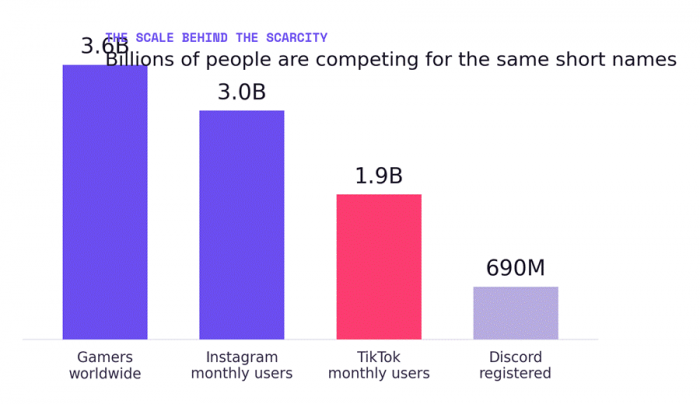
Fig 1. The scale behind the scarcity. Monthly active users and total players, 2025 to 2026 estimates.
Now layer the character limits on top. Xbox caps modern gamertags at 12 characters. X allows only 15. TikTok gives you 24. When you multiply billions of users against a small pool of short, pronounceable letter combinations, the common words go first. Single dictionary words like shadow, ghost, or wolf were claimed years ago on every major platform.
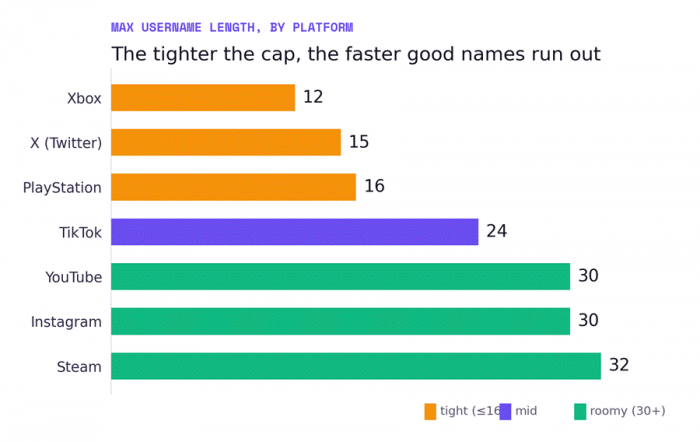
Fig 2. Maximum username length by platform. Xbox is the tightest of the majors at just 12 characters.
This is why a name that feels obvious to you returns a red X the moment you type it, and why brainstorming alternatives by hand turns into an hour of trial and error against an availability checker. The math is not on your side, so the strategy has to be smarter than reaching for the obvious.
What an AI username generator actually does
An AI username generator is not a random string machine, or at least the good ones are not. The useful tools do three jobs at once. First, they expand a seed: you give it a word, a vibe, or your niche, and it produces variations built from blends, prefixes and suffixes, sound-alike spellings, and compound pairings. Second, they filter for platform rules, so the suggestions already fit the character limit and use only permitted characters, which saves you from names that look perfect and then fail at signup. Third, the better ones check availability, so instead of a list of ideas you get a list of names you can actually claim.
The quality difference comes from the combination logic. Pairing two unrelated but pronounceable words, FrostVex rather than DarkWolf, is far more likely to be open, because the space of two-word combinations is enormous while single words are exhausted. Sound-preserving swaps (frames to framez, nova to n0va) open new ground without hurting how the name reads aloud.
A generator that understands these patterns hands you dozens of viable options in the time it takes to think of one. That is the entire point: it turns a scarcity problem into a filtering problem, and filtering is something software is very good at.
The Instagram playbook
Instagram is one of the more forgiving platforms for handles, which is both good and bad. You get up to 30 characters and can use letters, numbers, periods, and underscores, so there is room to be descriptive. The catch is that this generosity has been fully exploited by three billion accounts, so the descriptive names are largely gone too.
Two rules trip people up. A username cannot start or end with a period, and it cannot contain two periods in a row. Casing does not create a new name either, so @NovaFrames and @novaframes are the same handle. You can display capitals for readability, but you cannot claim a variant just by changing case.
The practical move on Instagram is to separate your username from your display name. The @handle should be short and clean; the display name, which allows spaces, emoji, and keywords and can be changed freely, is where you put searchable terms like your real name or your niche. If your ideal handle is taken, resist the string of random numbers at the end. A relevant added word almost always beats nova12938, which reads as spam and is impossible to recall.
| Length | 1 to 30 characters |
| Allowed | a-z 0-9 . _ |
| Case sensitive | no |
| Watch out for | no leading / trailing / double period |
| Change frequency | anytime |
The TikTok playbook
TikTok is tighter and stricter. Usernames run from 2 to 24 characters using letters, numbers, underscores, and periods, with no spaces and no hyphens. Periods and underscores are allowed in the middle but not at the very start or end, and TikTok enforces this at a level that creates a confusing side effect: it will often tell you a name is unavailable when the real problem is an illegal character position, not another user. If a name you are sure is free keeps getting rejected, check whether it begins or ends with a symbol.
Two more things matter here. TikTok reserves words that imply authority, terms like official, admin, support, and tiktok, for verified accounts and partners, so building a handle around them will fail. And you can only change a TikTok username once every 30 days, which makes the first choice more consequential than on platforms with free, frequent renaming.
Because so much of TikTok's distribution runs through reshares and stitches that carry your @name into other feeds, a handle that is easy to read at a glance and easy to say in a voiceover pays off directly in how findable you are after a video travels. On TikTok more than anywhere, sayable beats stylish.
| Length | 2 to 24 characters |
| Allowed | a-z 0-9 . _ |
| Not allowed | spaces hyphens |
| Watch out for | no leading / trailing symbol |
| Change frequency | once / 30 days |
The gaming playbook
Gaming is where the character math gets brutal, because the limits are the shortest and the player pools are the biggest. Xbox is the tightest of the majors: modern gamertags are capped at 12 characters, must start with a letter, and allow letters and numbers only, no symbols. If the name you want is taken, Xbox does not simply reject it; it appends a hash and a number (FrostBlade#1234) so multiple people can share the visible name with a hidden discriminator behind it. You get one free change, then Microsoft charges for the next.
PlayStation is a little roomier at 16 characters and permits hyphens and underscores alongside letters and numbers. Sony allows online ID changes now, but older games sometimes still display your previous ID, so treat the name as semi-permanent. Steam is the outlier: your account has a permanent underlying ID, but your public display name can be up to 32 characters, can include spaces and punctuation, and can be changed as often as you like. Discord, the connective tissue for most gaming communities, pairs a lowercase handle with a separate, freely changeable display name.
The cross-platform reality drives the strategy: design your gamertag to fit Xbox's 12 characters first, because a name that works there will work almost everywhere else. Avoid standalone common words, which are gone; combine two short words that do not normally sit together, or mix letters with numbers in a pronounceable way (N3XT, K7VR) to find open ground. And never encode real information, your legal name, birth year, or town, into a public gaming handle. It is an unnecessary privacy leak in an environment full of strangers.
| Platform | Max | Key rule |
|---|---|---|
| Xbox | 12 | Letters + numbers, starts with a letter. Adds #1234 if the name is taken. |
| PlayStation | 16 | Allows hyphens and underscores. Changeable, but old games may show the old ID. |
| Steam | 32 | Display name only. Very flexible, spaces allowed, unlimited changes. |
| Discord | n/a | Lowercase handle plus a separate display name you can edit anytime. |
The cross-platform strategy
If you care about being found, the highest-value move is owning the same handle everywhere. It compounds: someone who spots you on TikTok can find you on Instagram and in a Discord without guessing, and every mention on one platform quietly reinforces your presence on the others. The obstacle is that each platform has different rules, so the trick is to design for the strictest common denominator and work up from there.
The safe zone that clears almost every major platform is a handle of roughly 4 to 15 characters, using only lowercase letters and numbers, starting with a letter, with no trailing periods. That set survives Instagram, TikTok, X's 15-character ceiling, Xbox's 12-character cap, YouTube's letter-first rule, and Discord's lowercase system all at once.
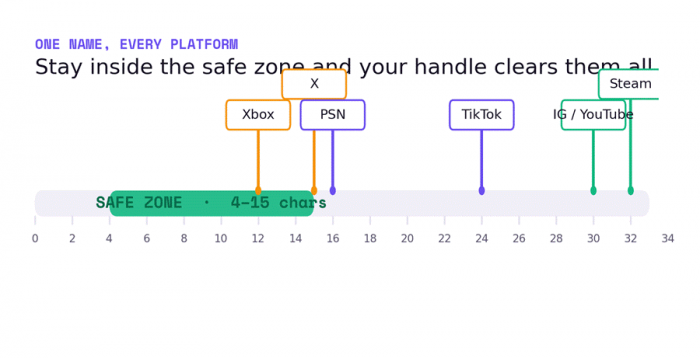
Fig 3. The cross-platform safe zone. A 4 to 15 character handle clears every major platform at once.
Separators are the usual failure point. Hyphens are rejected by Instagram, TikTok, and X; underscores fail on a handful of platforms; periods behave inconsistently everywhere. If you can avoid separators entirely, do it. A single clean word or blend travels furthest. And always check the name on your tightest platform before you commit anywhere, because claiming it on the easy platforms first and then discovering it is gone on the hard one is the single most common way people end up with mismatched handles they regret.
Turn a shortlist into a claimed name
Getting from ideas to a locked-in handle is a short, repeatable process. Run it in order and you avoid almost every naming regret.
1. Start from a seed. Feed a generator your niche, a favorite word, or two words you want blended, and ask for options that fit your target platform's limit.
2. Shortlist for sound. Keep only the names you can say out loud and spell on the first try. If it needs explaining, cut it.
3. Test the strictest platform first. Check availability where the limit is smallest and the crowd is largest, usually Xbox for gamers or TikTok for creators.
4. Sweep the rest. Confirm the survivor is open on every platform you plan to use, ideally in one pass with a multi-platform checker rather than 20 separate tabs.
5. Claim in order. Register on the hardest platform first so nobody grabs it mid-signup, then secure the rest right away, even the ones you are not active on yet.
Keep two or three backups ready before you start, because popular combinations get claimed while you deliberate.
Mistakes that sink a good handle
A few habits sabotage otherwise strong names. Trailing numbers like jordan99432 signal a throwaway account and are nearly impossible to remember; a meaningful word beats a random suffix every time. Leaning on the year or a birthdate ages your handle instantly and quietly discloses personal information you did not mean to share.
Copying a verified brand or creator with slightly altered characters can get you force-renamed on platforms like TikTok that actively police impersonation. Overusing separators, especially stacking a period and an underscore, makes a handle harder to dictate and easy to typo. And picking a name tied to a fleeting meme guarantees it feels dated within a year; unusual but timeless word pairings hold up far better than whatever phrase is trending this month.
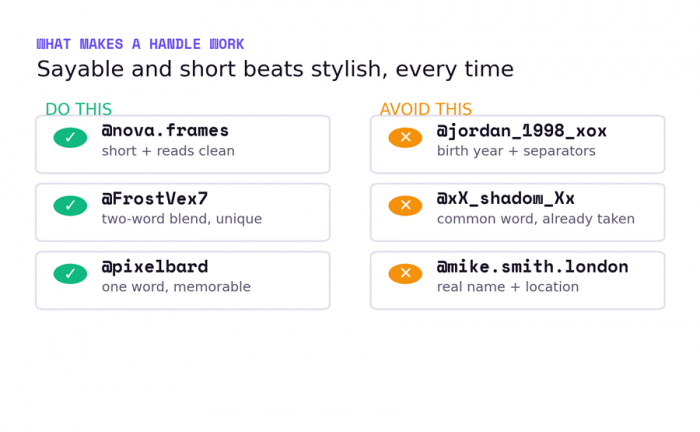
Fig 4. Strong handles read the same as they sound. Weak ones lean on years, separators, or personal details.
The through-line is simple. Optimize for a stranger hearing the name once and typing it correctly, not for how it looks to you while you are staring at the signup screen. Almost every naming mistake is a case of choosing what impresses you now over what a new listener can reproduce later.
Claim something better than free
The scarcity is real, but it is not a dead end. Billions of accounts have claimed the obvious names, which is precisely why the winning strategy is to stop reaching for obvious names. Use an AI generator to explore the enormous space of blends and pairings that people have not exhausted, filter hard for the rules and limits of your platforms, design to the strictest common denominator so one name can travel everywhere, and check availability before you commit rather than after.
Do that and you end up with something better than a name that was merely available: a handle that is short, sayable, consistent, and unmistakably yours. Your username is the one piece of your profile that appears literally everywhere you go. It is worth the ten extra minutes to get it right.
The 60-second handle checklist ✓ 4 to 15 characters, letters and numbers, starts with a letter ✓ Reads the same as it sounds, no ambiguous characters ✓ No real name, birth year, or location ✓ Available on your strictest platform first ✓ Two backups ready before you start claiming |