


Table of Content
The AI character chat space has gotten loud, and PolyBuzz wants to be the platform that out-shouts the rest. Formerly known as Poly.AI before its rebrand, the app now markets itself as the largest character library on the market, claiming over 20 million AI personas across anime, fantasy, celebrities, originals, and almost any niche a user might want. After spending roughly a week using it across the web app and the iOS version, here is an honest breakdown of what works, what feels engineered to drain wallets, and where it actually sits next to its loudest competitors.

Quick Facts at a Glance
| Product | PolyBuzz AI (formerly Poly.AI) |
| Developer | Cloud Whale Interactive Technology LLC |
| Category | AI Character Chat / Roleplay Companion |
| Platforms | Web, iOS, Android |
| Free Tier | Yes, with ads and coin-gated features |
| Pricing | From $9.90/month (Standard) up to $29.90/month (Ultimate) |
| Age Rating | 18+ (mature roleplay permitted in private chats) |
| Best For | Casual roleplay, character browsing, voice chat enthusiasts |
| Rating | ★ ★ ★ ☆ ☆ 3.0 / 5 |
What PolyBuzz Is Trying to Be
PolyBuzz is an AI roleplay and companion platform built by Cloud Whale Interactive Technology LLC. It targets the 18-to-25 demographic with a freemium model that includes unlimited basic chats, optional voice generation, image creation it calls “Live Photos,” and a long-term memory feature locked behind premium tiers. The platform sits in the same broad category as Character.AI, Janitor AI, Talkie, and SpicyChat, but its identity hinges on two claims:
•Catalog scale: the biggest character roster of any platform in the category, at over 20 million personas.
•Permissive privacy: private chats allow mature roleplay behind closed doors while public content is moderated.
The rebrand from Poly.AI happened recently and was, by the company's framing, meant to communicate a wider feature set and a more immersive direction. Whether that direction actually serves users or just serves the monetization engine is one of the questions worth answering.
First Impressions and Onboarding
Signing up was painless. The web app does not technically require an account to start browsing characters and even firing off a few messages, which lowers the barrier for anyone curious but commitment-averse. Registration takes seconds with an email, and the onboarding flow nudges users toward picking interest tags so the discovery feed populates with relevant personas.

The home screen is busy. Categories stack tightly, recommended characters scroll endlessly, and the interface clearly draws inspiration from infinite-feed social apps. For someone who knows what they want, the search bar works fine. For someone browsing, it can feel overwhelming in the same way a TikTok feed feels overwhelming on a fresh install. That is not necessarily a flaw, but it sets the tone for the entire experience: PolyBuzz is built to keep users scrolling.

TESTER NOTE The onboarding clearly optimizes for the discovery loop. Within ten minutes of signup, the interest-based feed had surfaced more than 200 characters that matched the selected tags. Whether that depth is signal or noise depends on how much filtering effort a user is willing to put in. |
Putting the Chat Engine to Work
The real test of any character chat platform is how the actual dialogue holds up. PolyBuzz blends several large language models under the hood, with company materials referencing the use of multiple foundation models depending on context and feature. The platform does not publicly clarify which model powers any specific chat, which means consistency across characters is hit-or-miss.
Across a week of testing, three things stood out about the chat experience:
•Strong openings. The opening exchanges with any new character felt sharp. Personalities came through, dialogue carried tone, and characters generally stayed in role for the first 20 to 30 messages.
•Mid-chat drift. Past the 30-message mark, characters would occasionally lose track of established details, drift in tone, or repeat phrasing patterns. The memory system performs better on premium tiers but still has visible limits.
•Hard message cap. The 500-character message limit per interaction becomes a real creative bottleneck for narrative-heavy roleplay that competitor platforms do not impose as aggressively.
A custom detective character built in five minutes responded with the genre-appropriate clipped speech and noir framing the persona prompt suggested. An anime-style character pulled from the public library leaned into the expected mannerisms without much prompting. Long-arc roleplay, the kind that builds across hundreds of messages, runs into the same context-window problems that plague every platform in this category.
Voice chat works and sounds decent, though anything beyond a handful of voice exchanges burns through coins, which brings up the part of the experience that genuinely changed how it felt to use the app.
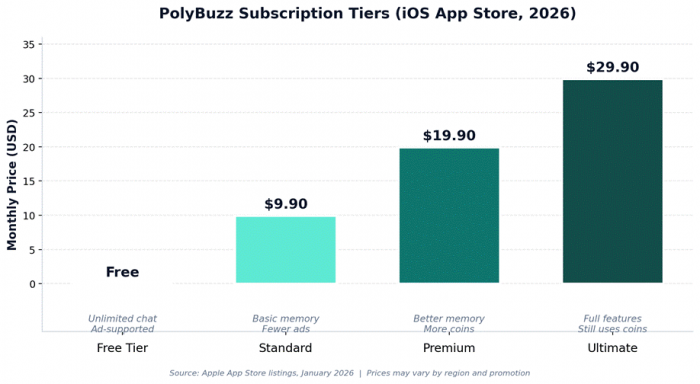
Figure 1: PolyBuzz subscription tier pricing as listed on the iOS App Store (January 2026)
The Coin Economy and Why It Reshapes Everything
PolyBuzz operates on a dual monetization stack: subscriptions plus a coin currency. According to current iOS App Store listings, the monthly subscription tiers are Poly Standard at $9.90, Poly Premium at $19.90, and Poly Ultimate at $29.90. Coin bundles run from $2.49 for 1,000 coins to $19.90 for 20,000.
Subscription Tier Breakdown
| Feature | Free Tier | Standard $9.90/mo | Premium $19.90/mo | Ultimate $29.90/mo |
|---|---|---|---|---|
| Unlimited basic chat | Yes | Yes | Yes | Yes |
| Character library access | Full (20M+) | Full | Full | Full |
| Ad-free experience | No | Partial | Yes | Yes |
| Long-term memory | Limited | Basic | Enhanced | Top tier |
| Voice chat duration | Coin-gated | Coin-gated | Extended | Extended |
| Live Photos generation | Coin-cost | Coin-cost | Discounted | Most generous |
| Response regeneration | Coins | Coins | Coins | Still coins |
| Monthly coin allowance | Earn-only | Small | Medium | Large |
Coin Bundle Pricing
| Coin Bundle | Price (USD) | Cost per 1K coins | Value Tier |
|---|---|---|---|
| 1,000 coins | $2.49 | $2.49 | Starter |
| 3,000 coins | $5.99 | $2.00 | Casual |
| 6,000 coins | $9.99 | $1.67 | Regular |
| 12,000 coins | $14.99 | $1.25 | Heavy use |
| 20,000 coins | $19.90 | $1.00 | Best value |
Coins gate a long list of things that other platforms either include free or simply do not charge for separately:
•Regenerating a response costs coins
•Extending voice chat duration costs coins
•Generating Live Photos costs coins
•Accessing inspiration replies costs coins
•Even on the highest-tier Ultimate subscription, response regeneration still consumes coins
The platform offers ways to earn coins through daily check-ins and engagement tasks, but the loop is clearly built to convert casual users into either subscribers or coin buyers. After three days of moderate use without buying coins, basic actions like regenerating an unsatisfying reply started feeling rationed. The free tier is genuine, but the coin clock is always ticking against the user.
WORTH FLAGGING Long-time users on Google Play have reported in reviews that promised bonus coins after the rebrand never arrived, and that aggressive in-app pricing notifications began appearing more frequently after the Poly.AI to PolyBuzz transition. Independent reviews from outlets including Scribe and Skywork have documented this pattern. It does not invalidate the product, but it does color how the "free and unrestricted" branding lands in practice. |
Live Photos, Voice, and the Multimodal Layer
The visual generation feature is one of PolyBuzz's bigger differentiators. Live Photos take a chat moment and render a static image that reflects the character's expression, setting, or implied action. The output quality is mid-tier:
•Faces sometimes drift from established character looks
•Image consistency across multiple generations is unreliable
•Compared to dedicated companion apps like Candy AI that have built sharper visual pipelines, PolyBuzz's Live Photos feel like a feature checkbox rather than a polished offering
Voice generation, on the other hand, surprised on the upside. The voice options are varied, the lip-sync on animated character interactions is reasonable, and the emotional inflection in voice replies is better than the bare-bones text-to-speech most competitors deploy. The catch is the duration cost. Anything longer than a short reply burns coins, which makes sustained voice roleplay expensive.
Character Creation Tools
The character builder is one of the unambiguously strong parts of the platform. Users can define:
•Personality and behavioral traits
•Backstory and lore
•Voice and dialogue style
•Avatar and visual appearance
•JSON character cards imported from platforms like Character.AI, Pygmalion, TavernAI, and others
For creators migrating from other ecosystems, the import flow is genuinely useful. Private characters stay private, public ones get moderated before being added to the discoverable library. This is also where PolyBuzz earns its 20-million-character claim. The vast majority of that catalog is user-generated, which means quality varies wildly. Some characters are richly written. Others are five-line summaries someone published at 2 a.m. The discovery algorithm does a decent job of surfacing the better ones, but anyone browsing should expect to filter aggressively.
The Honest Scorecard
Stripping away marketing language and pricing pages, here is how PolyBuzz actually performs across testing:
| STRENGTHS | WEAKNESSES |
|---|---|
▸Largest character library on the market at 20M+ personas ▸Mobile app is smooth and syncs cleanly across devices ▸Character creator supports JSON imports from rival platforms ▸Voice generation quality is genuinely above category average ▸Private chat policy is permissive without being chaotic ▸Public content moderation is transparent in policy ▸Web version requires no signup to start browsing | ▸ Coin economy gates features even on top-tier subscription ▸ 500-character message cap limits narrative-heavy roleplay ▸ Memory degrades visibly past 30 messages on free tier ▸ Live Photos are inconsistent and oversold by marketing ▸ Post-rebrand reviews report unfulfilled bonus coin promises ▸ Pricing structure only fully visible inside the app ▸ Underlying LLM model is not disclosed per chat session |
How PolyBuzz Stacks Against the Competition
Three competitors are worth examining closely, because each represents a different design philosophy in the same category.
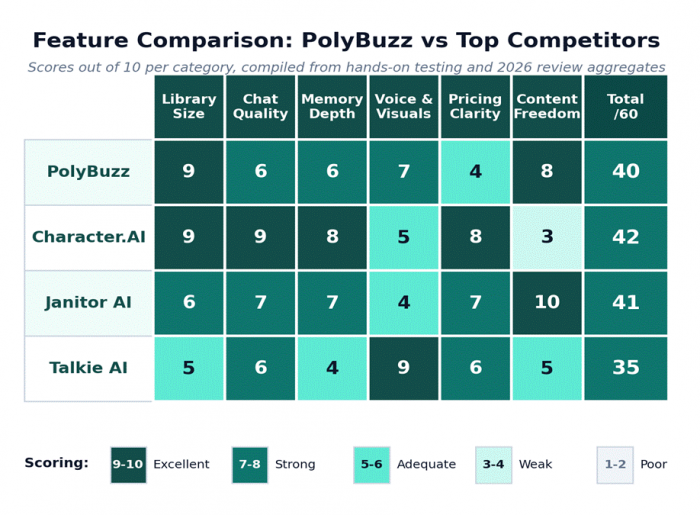
Figure 2: Feature comparison across PolyBuzz and three primary competitors (scored out of 10)
Character.AI
Character.AI is the dominant force in this space. Launched in 2021 by former Google engineers Noam Shazeer and Daniel De Freitas, the platform reported 233 million users in April 2026 and roughly 15 million mobile monthly active users according to industry analyses. Its catalog of user-created characters is in the same scale league as PolyBuzz, though the exact count claims are harder to verify directly.
The major trade-off is strict content moderation. Character.AI maintains tight filters across both public and private chats, which makes it the safer pick for general roleplay but a non-starter for anyone wanting permissive private interactions. Character consistency and emotional tone in dialogue are widely regarded as best-in-class, and the free tier is substantial enough that most users never need to pay. For mainstream, structured roleplay with mature moderation, Character.AI is still the default.
Janitor AI

Janitor AI takes the opposite approach. It is a bring-your-own-key platform that supports connections to external models like GPT-4 and Claude, which means quality depends entirely on what model the user wires up. The platform draws over 117 million monthly visits according to WeavAI's 2026 analysis and offers character customization with extensive token allowances, plus a fully uncensored mode.
The catch is setup complexity. New users have to navigate API keys, model selection, and configuration steps that PolyBuzz hides behind a one-tap experience. For technically comfortable users who want maximum customization and the best underlying models, Janitor AI delivers. For everyone else, the learning curve is steep.
Talkie AI

Talkie sits closer to PolyBuzz in design philosophy. It leans heavily into voice-first interaction and offers a Mini-Theater Mode that animates chats as small visual scenes, which is genuinely unique in this segment. The character library is smaller than both PolyBuzz and Character.AI, but the production value on individual characters is higher.
Talkie's biggest weakness is memory stability across longer chats, where it lags behind both Character.AI and PolyBuzz according to user community discussions documented across Reddit and Discord. For users who care most about voice and visual immersion in short to medium sessions, Talkie is a credible alternative.
Side-by-Side Comparison
| Criteria | PolyBuzz | Character.AI | Janitor AI | Talkie AI |
|---|---|---|---|---|
| Character library | 20M+ | 10M+ | ~32K | ~100K |
| Reported users (2026) | Millions | 233M total | 117M visits/mo | Mid-tier |
| Free tier quality | Good | Excellent | Free w/ own API | Good |
| Starting paid plan | $9.90/mo | $9.99/mo | BYO API costs | $8-15/mo |
| Content moderation | Permissive | Strict | Uncensored | Moderate |
| Voice chat | Yes (coin) | Limited | External | Yes (strength) |
| Memory consistency | Tier-locked | Strong | API-dependent | Weakest |
| Setup complexity | One-tap | One-tap | API setup | One-tap |
| Best for | Browsing | Mainstream RP | Power users | Voice & visuals |
Who Should Try PolyBuzz
The honest answer is that PolyBuzz fits a specific user. Anyone who matches these criteria will get value here:
•Wants the largest possible character library to browse
•Prefers a mobile-first experience that works cross-device
•Values permissive private chat policies over strict moderation
•Is comfortable paying piecemeal through coins or a subscription
•Enjoys voice features and accepts some visual inconsistency on Live Photos
Anyone in these categories should look elsewhere:
•Long-arc narrative roleplay where memory consistency is critical (try Character.AI)
•Predictable pricing without coin friction (Character.AI or Candy AI)
•Maximum control over the underlying model quality (Janitor AI with paid API)
•Polished visual generation for image-driven roleplay (dedicated companion apps)
•Under-18 users (PolyBuzz is rated 18+ for its private-chat policy)
Final Verdict
PolyBuzz earns a measured recommendation. The free tier is genuine enough to test, the character library delivers on its scale promise, and the voice and creation tools are competent. The coin-based monetization, mid-tier visual generation, and message-length restrictions are real friction points that users should weigh before committing money.
FINAL RATING ★ ★ ★ ☆ ☆ 3.0 / 5 A flexible, mobile-friendly roleplay app with one of the largest catalogs on the market. The experience comes with a meter running in the background, and whether that meter feels worth feeding depends on how much a user values catalog size over the cleaner economics offered by its competitors. |
For curious newcomers, the price of entry is zero and a weekend of testing is enough to know whether the platform fits. For anyone planning to invest serious time or money, the alternatives deserve equal evaluation before a subscription button gets pressed.