


Table of Content
- Overview of the Platform
- How the Tool Is Meant to Work
- Is pvstory.com the Official InstaPV Website?
- Hands-On Testing: What Held Up and What Did Not
- Features Catalogue and What Each One Claims
- Site Sections, Navigation, and the Surrounding Pages
- Pricing, Limits, and Access
- Pros and Cons in Summary
- Why Is Insta PV Story Not Working? Fixes to Try
- Verdict and Rating
Quick Verdict: ★★★☆☆ 3/5 — Insta PV Story (pvstory.com) is a free, no-login viewer for public Instagram stories, posts, highlights, and follower lists. In our hands-on testing the anonymity claim held up and the chronological followers view worked, but one of the site's two search sections returned a server error, and the about page discloses nothing about who runs the service. Fine for casual, ethical public-profile lookups. Keep an ad blocker on and never enter your Instagram credentials on this or any similar tool.
This review tests the platform as a regular user would encounter it today, covering the homepage workflow, search behavior, login and OTP flow, features page, contact section, blog, and how the tool performs when an Instagram profile link is dropped into it.
Overview of the Platform
Insta PV Story is a web-based tool that lets a visitor enter an Instagram username or paste a profile link, after which it attempts to surface that account's public stories, highlights, posts, follower and following lists, and profile metadata. The pitch is straightforward: browse public Instagram content without logging in, without installing anything, and without registering an Instagram view against the target account.
The current homepage carries an acknowledgement that reads “The issue has been fixed, we are back!” alongside the standard search bar. This is the first signal that the service has been through recent disruption, and the messaging matches what tools in this category routinely experience when Instagram tightens API access or rotates rate limits.
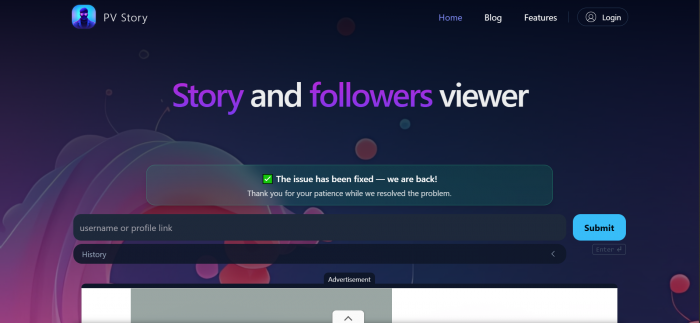
Figure 1. Insta PV Story homepage at pvstory.com showing the recovery notice and search bar.
Key Site Information
| Attribute | Detail |
|---|---|
| Official domain | pvstory.com |
| Former brand name | InstaPV |
| Domain change announcement | February 11, 2026 |
| Account required | No |
| Login present | Yes, with email OTP verification |
| Cost | Free, ad-supported |
| Supported platform | Instagram public accounts only |
| Mobile support | Yes, browser-based |
| Support channel | Email and contact form |
| Stated affiliation with Instagram | None, per footer disclosure |
How the Tool Is Meant to Work
Insta PV Story describes a three-step flow on its homepage. The first step is to enter a username or paste a profile link into the search field and submit. The second step is to navigate the rendered profile to view stories, tagged accounts, posts, and other public artifacts. The third step is to tap the follower or following count to surface the most recent additions in chronological order, with the option to copy individual usernames or the full list.
The chronological follower and following view is the feature the tool has historically marketed as its differentiator. As noted in Serlig's review, the official Instagram app does not order follower or following lists by date added, so an external tool that exposes that order has a clear functional reason to exist beyond simple anonymous viewing.
StartupHub.ai's technical breakdown explains how this category of tool generally operates. Instagram registers a story view only when an authenticated session opens the story. Since pvstory.com fetches public content server-side without ever attaching an Instagram session to the request, no viewer record is created on the target account. Independent multi-day testing by AIListingTool.com further confirmed the anonymity claim in practice, with views routed through the platform consistently failing to appear in the target account's viewer list across repeated attempts on different days and accounts.
Is pvstory.com the Official InstaPV Website?
pvstory.com announced on February 11, 2026 that it is the new home of the tool formerly branded InstaPV, and its homepage warns visitors that copycat sites have appeared. The picture from the outside is messier than that notice suggests. At least one other domain, instapv.works, operates under near-identical branding, claims to be the original service, and labels pvstory.com the imitation. Each site calls the other the fake, and because neither discloses an operating company, a team, or a jurisdiction, there is no independent way for a visitor to verify either claim.
For practical purposes, the dispute matters less than it appears to. Whichever domain a visitor lands on, the safety rules for this category are identical: never enter Instagram credentials anywhere, treat any version that requests a login to Instagram, a payment, or a human verification survey as a red flag, and assume the tool only surfaces public data. This review tested pvstory.com specifically, and all findings below apply to that domain
Hands-On Testing: What Held Up and What Did Not
Direct testing of the platform produced a mixed picture. Before the section-by-section narrative, here is the headline summary of what testing surfaced.
Testing snapshot:
•Login flow works cleanly, with email-based OTP delivered and validated on first attempt
•Homepage search section accepts input and displays the recovery notice as intended
•A second search section on the same domain returned a server connection error for the same input
•Downstream pages such as followers, post likes, and story previews depend on a successful search and could only be reached via the homepage path
•Contact, blog, and about sections are reachable and stable, though thin on tool-specific content
The good news first: the login flow works as expected. A login button sits in the top navigation, an email field opens an OTP step, and the one-time password arrives and validates without retries or stuck states.
The core search experience told a different story. The main homepage section, carrying the “issue has been fixed, we are back” message, accepts a profile link or username and acknowledges receipt of the input. However, a second part of the site that exposes the same search functionality returned “unable to connect to the server” for the same input. Two adjacent sections on the same domain therefore reported contradictory states of service health, which is a quality assurance concern regardless of the underlying cause. The likely explanation, consistent with how IGDetective and Vents Magazine describe these tools, is that the platform has multiple data fetch paths and only one was operational during testing. Presenting a “fixed and back” notice while a sibling component reports a server connection failure is an inconsistency the operators should reconcile.
The downstream feature pages, including the listings of followers, profile insights, post likes, and story previews, depend on the search succeeding in the first place. With one search section reporting a server failure, those downstream features could not be exercised end to end in that path, and only the homepage path produced any data at all during testing.
Features Catalogue and What Each One Claims
The features page at pvstory.com/features lists six tools the platform offers, alongside a public form for users to suggest new features. The table below maps each feature to its purpose and its current behavior based on observed testing and on the descriptions documented across StartupHub.ai's and Postunreel's coverage.
| Feature | What It Targets | Account Required | Observed Reliability |
|---|---|---|---|
| Story Viewer | Active stories from a public account | No | Functional via homepage search path |
| Post Viewer | Captions, likes, comments on public posts | No | Dependent on search success |
| Highlights Viewer | Saved highlight reels on public profiles | No | Dependent on search success |
| Profile Viewer | Bio, photo, post count, follower count | No | Dependent on search success |
| Followers and Following Tracker | Recent follows in chronological order | No | Marketed as the tool's signature feature |
| Story Downloader | One-click download of stories and posts | No | HD MP4 or JPG per StartupHub.ai testing |
| Post Likes Viewer | Accounts that liked a public post, in order | No | Newest addition per the site's update note |
The Post Likes Viewer was the most recent addition called out in the homepage update notes, and it offers chronological ordering of likes on a public post. Chronological ordering of likers is uncommon in the category, even among tools that handle stories and highlights well. Worth noting alongside this addition: StartupHub.ai's 2026 reviews flag that the platform still has no dedicated reel viewer, a real feature gap given that reels are now where much of public engagement on Instagram lives.
In StartupHub.ai's 2026 ranked roundup, Insta PV Story was positioned as the category's strongest bulk downloader, with the caveats that its interface is less clean than competitors and its uptime has been inconsistent through the year. The uptime observation lines up with what testing surfaced firsthand.
Site Sections, Navigation, and the Surrounding Pages
The supporting pages around the core search follow the small-utility SaaS template. Findings on each follow.
Login and Authentication
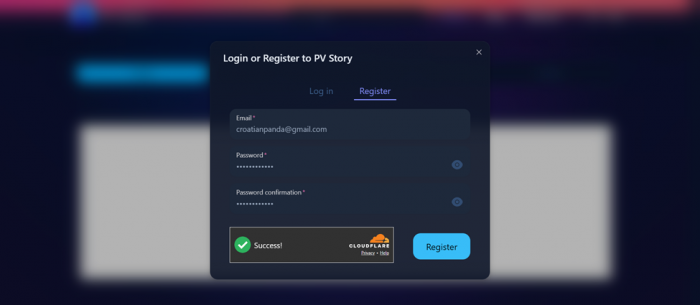
The login system uses an email plus OTP flow and works reliably. What is not clear is why it exists at all for an anonymous viewer, or what additional access the logged-in state unlocks compared to the anonymous experience. The site does not document this, and that gap deserves to be closed.
Contact Page
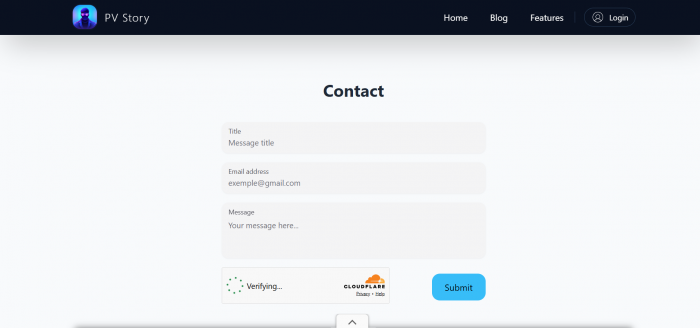
The contact page at pvstory.com/contact is minimal: a title field, an email field, a message field, a submit button, and a support email in the footer. No phone, live chat, ticket tracker, or published response window is offered. For a tool that recently changed its domain, a fuller transparency footprint, including a stated response time and a privacy posture for submitted messages, would help inspire confidence.
Blog Section
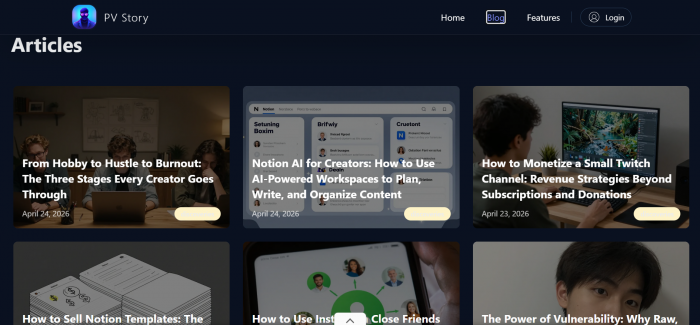
The blog at pvstory.com/blog is active and updated on a near-daily cadence, with over one hundred articles indexed at the time of review, dating back to mid-February 2026. The recurring topic categories include creator economy, monetization, AI tooling, platform algorithms, and creator wellbeing. What the blog does not contain, however, is any content directly relevant to the tool itself. There is no changelog post, no domain migration explainer post that goes beyond the on-homepage notice, no feature deep dive on the Story Viewer or Followers Tracker, and no guidance article on how to interpret the chronological follower and following data. For a product blog attached to a utility, that absence is conspicuous. The blog reads as a separate content engine optimized for adjacent search traffic rather than as documentation or community programming for the tool's own users.
About Page
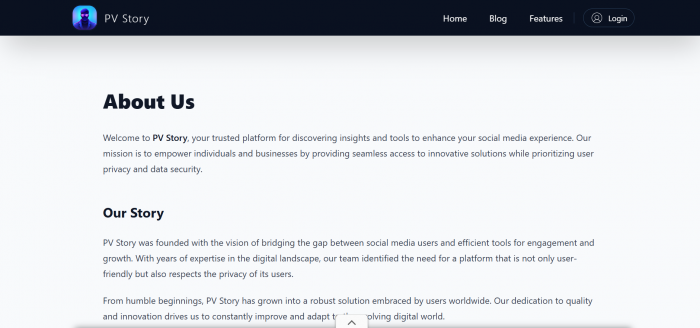
The about page positions Insta PV Story as a privacy-first social media tool with stated values of innovation, integrity, privacy, and excellence. It does not name a parent company, founding team, headquarters, or registration jurisdiction. For a service that handles Instagram profile lookups on a visitor's behalf, that lack of disclosure is a gap.
Pricing, Limits, and Access
| Plan or Access Mode | Cost | Account Needed | Limits |
|---|---|---|---|
| Anonymous browser use | Free | None | No published quota, subject to fetch path availability |
| Logged-in mode | Free | Email plus OTP | Stated benefits not documented on site |
| Mobile use | Free | None | Standard browser, no app install |
| Story downloads | Free | None | HD output, MP4 or JPG per StartupHub.ai testing |
| Premium tier | Not offered | Not applicable | Revenue model is advertising |
The site carries Google AdSense, identified by the publisher ID in the page metadata, which makes the revenue model explicit. Visitors pay with attention to ads rather than a subscription, a tradeoff standard for the category per IGDetective and StartupHub.ai.
Pros and Cons in Summary
| Strengths | Weaknesses |
|---|---|
| No account needed for the core anonymous viewing flow | Server connection failure observed in one search section while another reports recovery |
| Login flow with email OTP works without issues | The benefit of logging in is not documented on the site |
| Chronological followers and following ordering, which the official app does not expose | Private accounts cannot be accessed, by technical necessity |
| Story downloads in HD as MP4 or JPG, per third-party testing | Reliability of fetch paths is tied to Instagram's API state, which changes |
| Active blog updated almost daily | Blog has no content about the tool itself, including no migration or changelog explainer |
| Domain change communicated openly on the homepage | No company name, jurisdiction, or team disclosure on the about page |
| Multiple feature surfaces including stories, posts, highlights, likes, and followers | Contact section is bare, with only an email and a generic form |
Is Insta PV Story Safe and Legal to Use?
The short answer: Insta PV Story is safe in the narrow sense that matters most, because it never asks for your Instagram username or password, so there are no credentials to lose. Legitimacy is murkier. The viewer worked through one search path during our testing, but the operators are unnamed, the domain is young, and independent trust checkers score it with caution rather than confidence.
Trust Signals at a Glance
| Signal | What We Found |
|---|---|
| Credentials requested | None. No field on the site asks for an Instagram login |
| Domain age | Registered February 2026, per Gridinsoft's public scan |
| Gridinsoft trust score | 59/100, rated as warranting caution rather than a scam flag |
| Scam Detector score | Low, flagged as controversial |
| Operator disclosure | No company name, team, or jurisdiction anywhere on the site |
| Revenue model | Advertising via Google AdSense, no payments requested |
| Anonymity claim | Held up in AIListingTool.com's independent multi-day testing |
Why Is Insta PV Story Not Working? Fixes to Try
Outages are a fact of life in this category because every anonymous viewer depends on data fetch paths that Instagram regularly disrupts. Our own testing hit this directly: the homepage search returned data while a second search section on the same domain reported it was unable to connect to the server. If pvstory.com is not working for you, run through these steps in order.
- Use the homepage search bar specifically. It was the only path that returned data during our testing, so start there rather than any other search surface on the site.
- Check the username. Paste the full profile URL instead of typing the handle, and confirm the spelling against the real account.
- Confirm the account is public. Private accounts return nothing by design, and no setting on the tool changes that.
- Wait and retry. Fetch-path outages in this category tend to be temporary. If the tool posted a recovery notice recently, capacity may still be uneven.
- Switch browsers or open an incognito window. This rules out a cached error state on your side.
- Check the address bar. Confirm you are on pvstory.com and not one of the look-alike domains circulating under the same branding.
If errors persist across several days, the pattern across sibling tools suggests Instagram changed something upstream, and nothing on the visitor's side will fix it until the operators adapt.
Who the Platform Suits
The site lists six audience personas, and each maps to a real use case the tool can serve within the limits of public data:
•Marketers and agencies: The followers and following timeline view exposes competitor growth patterns that the official app hides, useful for tracking who a competitor is courting or losing
•Journalists and researchers: A way to gather public material discreetly during early-stage investigations without alerting the source account
•Parents: A view into the public content children are exposed to, without minting yet another logged-in trail tied to a personal account
•Content creators: A way to study what works in a niche by reviewing competing accounts without inflating their view counts
•Privacy-conscious users: A bridge to public posts from friends and brands for people who refuse to maintain a social account at all
•Curious users: Casual public-profile browsing without ceremony, ads aside
Verdict and Rating
Insta PV Story does most of what it claims to do, and it does so without asking for an Instagram login, which is the single most important safety attribute for anything in this category. The core anonymity claim holds up against third-party testing, the chronological follower view is a genuinely useful exposure of data the official app hides, and the recent Post Likes Viewer addition extends the platform into territory that most competitors do not cover.
The platform is held back by inconsistent surface quality. One search section announces recovery while a parallel one returns a server connection error, the login flow is offered without a stated benefit, the contact surface is bare, the about page omits any information about who runs the service, and the blog contains nothing about the tool itself. None of these are fatal, but together they make the experience feel less polished than the underlying technology actually is.
For a free, no-account tool that survived a forced domain migration earlier this year and continues to ship new features, it earns a qualified recommendation. Use it for casual, ethical, public-data lookups, with an ad blocker active, with no credentials ever entered, and with realistic expectations about uptime.
| Category | Rating |
|---|---|
| Anonymity | ★★★★★ 5 / 5 |
| Feature Breadth | ★★★★☆ 4 / 5 |
| Reliability | ★★★☆☆ 3 / 5 |
| Transparency | ★★☆☆☆ 2 / 5 |
| Support and Contact | ★★☆☆☆ 2 / 5 |
| Overall | ★★★☆☆ 3 / 5 |
The score reflects a working tool with real utility and a few avoidable rough edges. Closing the gap between the recovery notice and the server connection error in the next section would lift reliability by a full star on its own. A tool-focused changelog post on the blog and a named operating entity on the about page would lift transparency in the same way. The underlying product is closer to a four-star tool than the surrounding presentation currently suggests.