

Table of Content
The rapid growth of AI study tools has created a new category of educational software designed to answer questions instantly. Among these tools, Gauth AI has developed a noticeable presence, especially among high school and college students who want help solving homework problems quickly.
Unlike many purely automated learning assistants, Gauth combines two different systems. One layer uses artificial intelligence to interpret and solve problems. The second layer relies on a network of human tutors who step in when automated systems fail to resolve more complicated tasks.
Understanding how this hybrid system works requires looking beyond the app interface and examining how the platform evolved, how its technology operates, and where it succeeds or struggles as a learning tool.
From Gauthmath to Gauth AI
The platform originally launched in 2019 under the name Gauthmath, focusing almost entirely on mathematics problem solving. Its initial appeal came from a simple concept: students could photograph a math question with their phone and receive a step by step solution within seconds.
The project was created by Higgz Academia Technology Pte Ltd, a company founded by entrepreneur Joey Sun. The idea emerged while Sun was studying engineering at Tsinghua University in Beijing. Early development focused on connecting students with tutors who could manually solve difficult problems that AI systems struggled with.
As the user base expanded internationally, the company relocated its corporate structure to Singapore in order to reach Western markets more effectively. By the early 2020s, the application had accumulated millions of downloads and attracted venture capital investment.
In early 2024, the company rebranded the product as Gauth AI. The new name reflected a broader goal. Instead of solving only math questions, the system began supporting multiple academic subjects and incorporated generative AI models to produce explanations and learning guidance.
What the App Actually Does
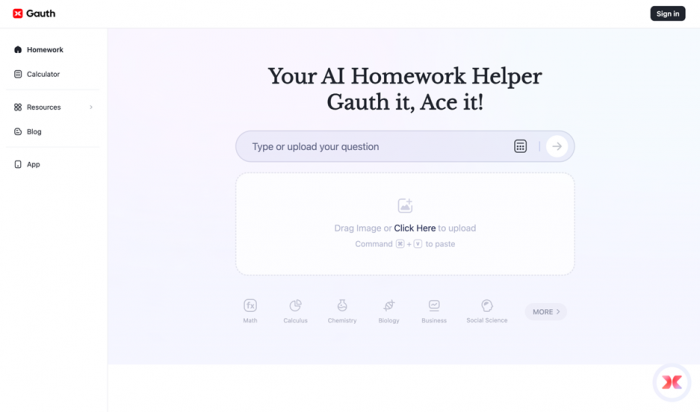
At its most basic level, Gauth AI functions as a homework assistant. Students interact with it by typing a question or uploading a photograph of a problem taken from textbooks, worksheets, or handwritten notes.
Once the system receives a question, several processes occur behind the scenes.
First, optical character recognition scans the image to identify numbers, formulas, and text. The problem is then converted into structured data that the AI system can interpret.
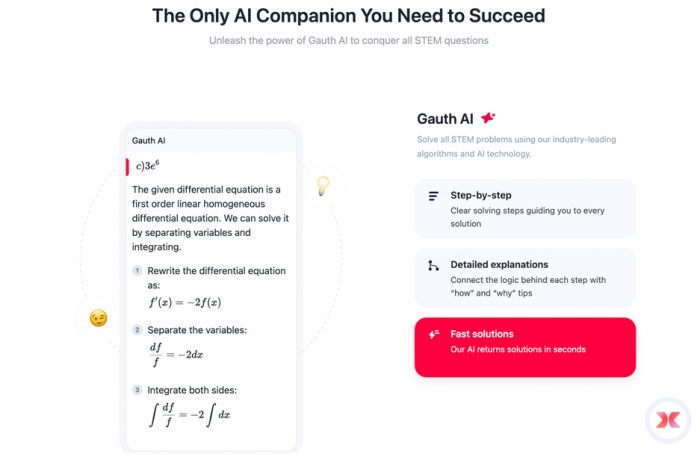
Second, the platform analyzes the question using its internal language model, often described as Gauth GPT, which generates a solution and explanation. The system attempts to show intermediate reasoning steps rather than only presenting a final answer.
Finally, if the AI cannot confidently resolve the task, the platform may route the question to a human tutor within its support network.
This layered structure allows the platform to handle routine homework quickly while still providing assistance for more complicated questions.
Core Capabilities in Daily Use
Students typically use Gauth AI for three main tasks.
Problem Solving Through Images
The most recognizable feature is the ability to photograph a problem directly from paper. The system scans the image and converts it into a digital question that can be solved automatically.
This approach is especially useful for mathematical equations or physics problems that are difficult to type on a phone keyboard.
Step by Step Explanations
Rather than displaying only a numerical answer, the system attempts to explain the reasoning process behind each step. The explanations are written in simple language designed for students who may not fully understand the concept yet.
Multi Subject Coverage
Although the application started with mathematics, it now supports a broader set of academic subjects. These include:
| Subject Area | Typical Tasks |
| Mathematics | Algebra, calculus, statistics |
| Physics | Motion problems, formulas, conceptual questions |
| Chemistry | Reactions, balancing equations |
| Biology | Concept explanations and diagrams |
| Economics and social science | Short answer explanations |
| Writing and literature | Essay outlines and analysis |
The expansion into non mathematical topics reflects the broader trend of AI tools moving from single subject applications toward general academic assistants.
The Human Tutor Layer

One element that distinguishes Gauth from many competing tools is its human tutor network.
According to company statements, the platform employs tens of thousands of tutors located in regions such as the United States, India, and the Philippines. These tutors handle the small percentage of problems that automated systems cannot solve reliably.
When the AI encounters an unfamiliar question or produces uncertain output, the system can escalate the task to a tutor. Responses from tutors typically arrive within several minutes rather than instantly.
This hybrid model allows the platform to offer faster responses than traditional tutoring services while still maintaining human oversight for difficult tasks.
Pricing Model and Access
Gauth AI uses a freemium structure that allows limited access without payment. The free version restricts the number of questions a student can ask each day and includes advertisements within the interface.
Students who require regular assistance can subscribe to the Gauth Plus plan, which removes daily limits and unlocks additional features such as tutor access and advanced explanations.
| Plan | Monthly Cost | Key Limits |
| Free Plan | Free | About 11 questions per day |
| Gauth Plus | $11.99 per month | Unlimited questions and tutor access |
Subscription pricing varies by region and sometimes appears lower in markets outside the United States.
Areas Where the Tool Performs Well
For everyday homework tasks, Gauth AI generally performs best when the questions follow predictable academic patterns. Problems that rely on standard formulas or structured steps are usually handled quickly and with reasonable accuracy.
Basic algebra equations are a good example. When students upload a typical equation such as solving for a variable or simplifying expressions, the system can usually identify the structure of the problem and produce a step by step explanation within seconds. Geometry questions involving angles, triangles, or coordinate calculations also tend to work well because the mathematical logic behind them is relatively consistent across textbooks.
Physics questions that rely on well known formulas also fall into this category. When the problem clearly references formulas related to motion, velocity, or acceleration, the AI often provides both the calculation and the reasoning behind each step.
Another area where the platform performs well is usability. The camera based input system allows students to upload questions directly from worksheets or textbooks. This feature reduces the need to manually type complex equations or symbols on a phone keyboard, which can otherwise slow down the process.
The hybrid tutor system also adds a practical advantage. While many AI homework tools rely entirely on automated responses, Gauth includes a network of human tutors who can review questions that the AI struggles to solve. Although this process takes longer than automated responses, it provides a secondary layer of support that many competing apps do not offer.
Limitations That Appear in Practice
Despite its strengths with standard homework questions, Gauth AI becomes less reliable when dealing with more advanced or unconventional problems.
Higher level mathematics is one area where limitations become noticeable. Complex calculus problems or multi step derivations can sometimes produce incomplete explanations or incorrect intermediate steps. In these situations, the AI may appear confident in its reasoning even when the final answer is wrong, which can make it difficult for students to identify mistakes.
Scientific problems that require contextual interpretation can also challenge the system. For example, questions that combine multiple physics concepts or require interpreting diagrams may not always translate accurately through the image recognition process.
The quality of the uploaded image also plays a major role in the system's performance. Optical character recognition works best when the question is clearly printed and well lit. If the image contains handwritten notes, unusual formatting, or low resolution text, the AI may misread symbols or miss parts of the problem entirely.
Some users also mention issues related to the platform's credit based features. Certain capabilities such as tutor assistance may require credits depending on the subscription tier. In some cases, unused credits expire or reset with each billing cycle, which can limit flexibility for students who only use the service occasionally.
These limitations do not necessarily make the tool unusable, but they highlight the importance of reviewing the generated explanations carefully rather than relying on them blindly.
Academic Concerns Around AI Homework Tools
The rise of automated homework assistants has sparked debate among educators.
Some teachers argue that tools like Gauth AI can help students understand difficult concepts by presenting explanations in simple language. Others believe the technology encourages students to skip the learning process entirely by copying answers.
Because of this concern, several schools have implemented policies restricting AI homework tools during assignments or exams. Some regions have also examined data privacy practices related to educational apps that collect student information.
These debates highlight a broader challenge facing AI in education. Tools designed to support learning can easily become shortcuts if used without guidance.
Position Among Competing Study Tools
Gauth AI is part of a crowded ecosystem of AI powered learning assistants.
Some competing platforms focus strictly on mathematics problem solving, while others operate as general AI chatbots capable of answering academic questions.
The following comparison highlights where Gauth sits relative to several well known alternatives.
| Platform | Focus | Human Tutors |
| Gauth AI | Multi subject homework help | Yes |
| Photomath | Math problem solving | No |
| Wolfram Alpha | Advanced computational math | No |
| ChatGPT or Gemini | General AI assistance | No |
The inclusion of human tutors remains the most distinctive feature separating Gauth from many AI based study tools.
Where the Platform May Go Next
Educational AI systems continue to evolve quickly, and Gauth is expanding its capabilities through features such as conversational tutoring and interactive explanations.
However, long term success will depend on addressing several challenges. Accuracy improvements for advanced subjects, clearer policies around data privacy, and responsible use within academic settings will likely shape how these tools develop in the coming years.
Final Thoughts
Gauth AI represents a hybrid approach to digital learning assistance. By combining automated problem solving with a large network of tutors, the platform attempts to balance speed and human support.
For routine homework and basic concept explanations, the system works efficiently and can help students review difficult topics. At the same time, its accuracy decreases with highly advanced questions, and the broader debate around AI assisted homework continues to influence how schools respond to tools like this.
Rather than replacing traditional learning methods, applications such as Gauth AI function best when treated as supplementary study tools that explain concepts rather than shortcuts that complete assignments automatically.