

Table of Content
I did not want to write another AI tool review that reads like a brochure. So I set one rule: every claim must trace back to something I can show. A screenshot. A credit balance. A character counter. A timestamp.
In practice: one fresh account, fifteen free credits, and two deliberately demanding briefs written the way a real marketing team writes them, a 30-second cinematic brand film and a text-heavy Instagram launch image. I pasted the prompts, watched the counters, and logged every credit.
By the end of the afternoon I had one credit left, one pretty 6-second clip that ignored most of my brief, two images with typos the AI invented, and a much clearer picture of what Clipfly is for. Here is all of it.
| START 15 → −10 · text to video → 5 → −4 · two images → END 1 |
How I tested it
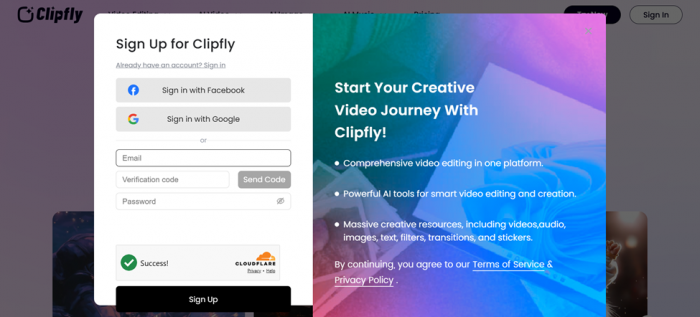
• Fresh account, real signup flow. I registered via Facebook login, which asked only for name and profile picture; Google and email also work.
• 15 free credits, no card required. My entire budget: almost exactly one video job plus one image job.
• Two tests. Text to Video on Lumen (10 credits), then Text to Image on Fluxon 2.0 (4 credits for two 1K images).
• Same day, same conditions. Desktop web, July 20, 2026; both prompts appear in full below.
Clipfly AI Explained.
Clipfly pitches itself as an everyday AI video and image toolkit: one browser tab for generating video from text or images, making pictures, composing music, and assembling longer "AI movies" on the Pro tier. Its Android app is published under Everimaging, the company behind Fotor: an established operation, not a weekend project.
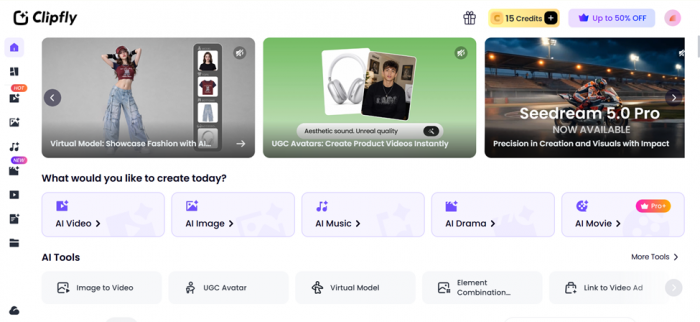
Text to Video Image to Video UGC Avatar Virtual Model Motion Control First & Last Frame Video Enhance Text to Image Background Remove Image Expand AI Music AI Drama AI Movie (Pro)
Under the hood it is a model marketplace: the video picker alone listed Lumen, Lumen 2.3, Seedance 2.0, and HappyHorse 1.1, each with credit price, resolution, and clip length on a small spec chip. Remember those chips.
Pricing: what a credit really buys
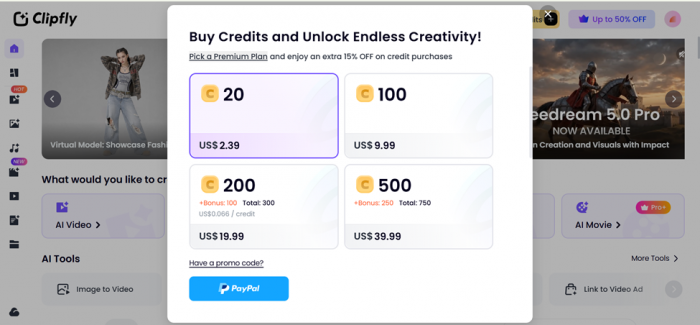
Clipfly runs on credits topped up through PayPal. Here is the pricing I saw, converted into what it buys on Lumen at 10 credits per clip:
| Pack | Price | Bonus | Per credit | Buys (Lumen clips) |
|---|---|---|---|---|
| 20 credits | $2.39 | None | $0.120 | 2 clips |
| 100 credits | $9.99 | None | $0.100 | 10 clips |
| 200 credits | $19.99 | +100 (300 total) | $0.066 | 30 clips |
| 500 credits | $39.99 | +250 (750 total) | $0.053 | 75 clips |
A Premium plan adds an extra 15% off credit purchases; a promo code field sits at checkout.
Three things before buying. Costs swing hard by model: my Lumen clip was 10 credits, Seedance 2.0 wanted 30, my two-image run cost 4. Credits are spent whether or not the output matches your prompt. And one long-term Trustpilot reviewer reported per-video costs climbing over time, so treat these numbers as a snapshot.
Test 01 · Text to Video: the 30-second brand film
LEDGER CHECK
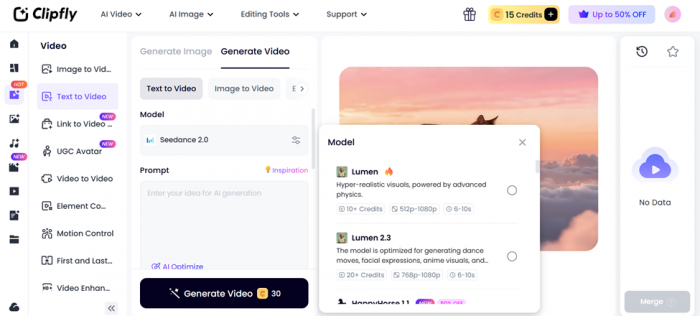
| 15 → −10 · Lumen, one generation → 5 |
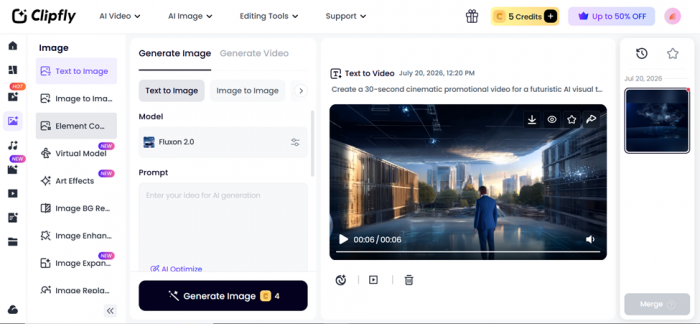
I picked Lumen, the model Clipfly was promoting hardest. Its tagline reads "Hyper-realistic visuals, powered by advanced physics," so I did something mischievous and made that exact line the brand concept of my brief. The model was effectively asked to advertise itself. If it could not nail this, what could it?
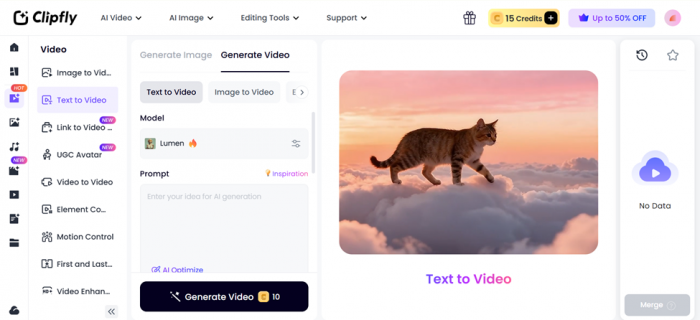
The complete brief, exactly as pasted:
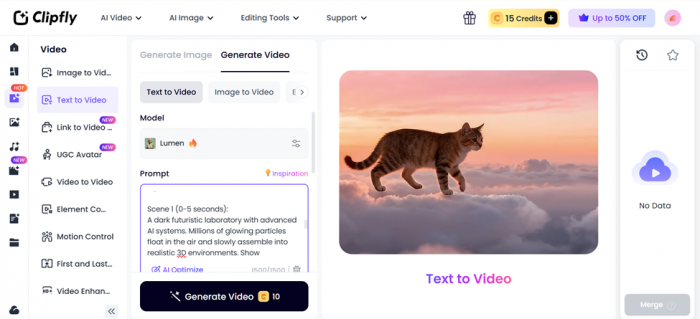
The brief · Text to Video · Lumen · Field maxed at 1,500 / 1,500 chars Create a 30-second cinematic promotional video for a futuristic AI visual technology brand. Brand concept: “Hyper-realistic visuals, powered by advanced physics.” The video should showcase how artificial intelligence can recreate reality through physics-based simulations, realistic environments, and next-generation visual generation. Style: - Ultra-realistic cinematic quality - Futuristic technology aesthetic - Premium AI startup branding - Hollywood-level visual effects - Physically accurate lighting and materials - Realistic motion and simulations - High-end commercial advertisement style Scene 1 (0-5 seconds): A dark futuristic laboratory with advanced AI systems. Millions of glowing particles float in the air and slowly assemble into realistic 3D environments. Show advanced computing, neural networks, and digital simulations. Cinematic camera movement, slow dolly-in shot, dramatic lighting. Scene 2 (5-12 seconds): Show AI reconstructing realistic natural elements: - Water flowing with accurate physics - Glass reflections and refractions - Smoke and particles moving naturally - Metallic surfaces reflecting light realistically - Detailed textures and materials Use macro cinematic shots, slow motion, realistic physics simulation, ray-traced lighting. Scene 3 (12-20 seconds): A creative professional enters an AI-generated virtual world. Show a futuristic city with realistic buildings, realistic weather, natural sunlight, and immersive environments. The person interacts with the digital world seamlessly. Camera: Smooth cinematic tracking shot, shallow depth of field, realistic human details. Scene 4 (20-27 seconds): Show creators, filmmakers, designers, and businesses using AI tools to create realistic videos and digital experiences. Display futuristic creative workflows and collaboration. Scene 5 (27-30 seconds): End with a premium brand reveal. Visual: A glowing logo formed from particles and digital energy. Text on screen: "Hyper-realistic visuals." “Powered by advanced physics.” Mood: Innovative, futuristic, intelligent, premium. Color palette: Black, deep blue, silver, neon blue highlights. Video quality: 8K cinematic look, realistic textures, professional advertisement style. |
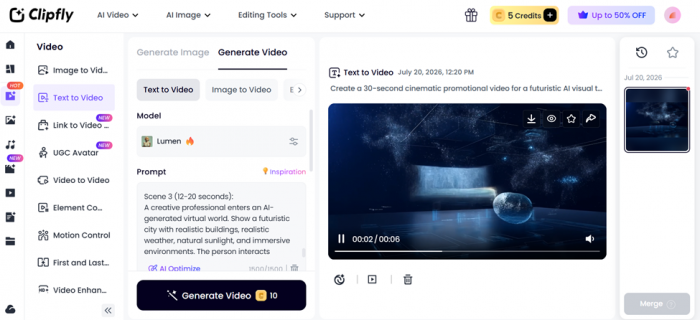
Asked vs. delivered
| What the brief asked for | What Lumen delivered |
|---|---|
| 30-second runtime across 5 scripted scenes | One clip, 6 seconds (00:06 in the player) |
| Lab, physics closeups, city, creators, logo reveal | A single dark cosmic scene with a glowing sphere and drifting particles |
| Two lines of on-screen text | No text at all |
| Logo formed from particles | No logo |
| Black, deep blue, silver, neon highlights | Nailed it. The palette was exactly as briefed |
What actually happened
1. Silent truncation. The field caps at 1,500 characters and my brief was longer. Clipfly trimmed it without warning, so scenes four and five, the overlays, and the logo reveal likely never reached the model.
2. The length was never possible. Lumen's own spec chip lists output at 6 to 10 seconds, so a 30-second request was out of range from the start. The Generate button took my 10 credits anyway, no flag, no warning.
3. One scene out of five. The result is a moody fragment of Scene 1: a luminous orb in blue-black space. No lab, no water physics, no city, no people, no ending. To its credit, it rendered fast and the grading looked genuinely cinematic.
4. The real path to my film. Building the actual 30-second ad means five generations at 10 credits each, stitched with the Merge tool: 50 credits, roughly $2.70 to $6.00 depending on your pack, plus retries.
MY HONEST REACTION As a mood clip it is honestly pretty, and it is still in my downloads folder. As the advertisement I briefed? It was not right. If a freelancer delivered this, we would be having a direct conversation about the invoice. |
Test 02 · Text to Image: the BioGPT launch visual
LEDGER CHECK
| 5 → −4 · Fluxon 2.0, two images, 1K → END 1 |
Round two moved to stills, where AI traditionally behaves better. I switched to Fluxon 2.0, requested two 1K images, and pasted a detailed brief for a fictional biotech brand, BioGPT, including three exact lines of overlay text. This field caps at 2,000 characters, and mine hit the ceiling again.
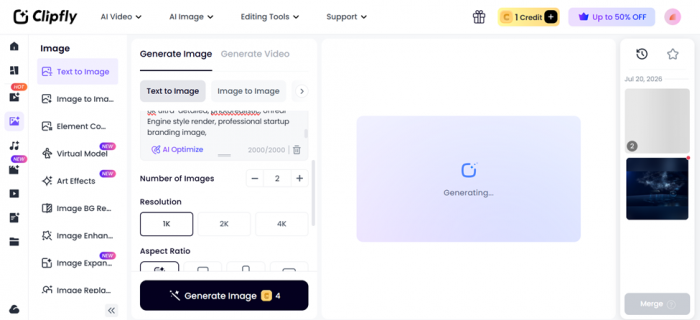
The brief · Text to Image · Fluxon 2.0 · Field maxed at 2,000 / 2,000 chars Create a premium futuristic Instagram promotional image for BioGPT, an advanced AI biotechnology brand that combines artificial intelligence, biology, and scientific innovation. The visual concept should represent the idea: “Where artificial intelligence meets the future of life.” Create an ultra-realistic cinematic scene featuring a futuristic biotechnology laboratory with a glowing AI-powered DNA structure at the center. The DNA helix should merge naturally with advanced neural network patterns, digital circuits, and holographic scientific data. Show microscopic biological elements, realistic cells, molecular structures, and AI-generated simulations floating around the environment. Include futuristic laboratory equipment, transparent glass interfaces, holographic displays, and scientists analyzing complex biological data through artificial intelligence systems. The environment should feel like a next-generation research facility focused on discovering breakthroughs in medicine, genetics, and life sciences. Visual style: Hyper-realistic, cinematic, premium technology branding, luxury scientific advertisement, Hollywood-level rendering, realistic physics, advanced lighting, detailed textures, professional biotech campaign aesthetic. Camera: Professional commercial photography style, shallow depth of field, cinematic perspective, balanced composition, sharp focus on the DNA and AI interaction. Lighting: Dark futuristic background with elegant blue, purple, and cyan glowing lights. Add realistic reflections, volumetric lighting, soft shadows, and high contrast to create a premium innovation feel. Design: Minimal, clean, modern, suitable for Instagram branding. Leave space for elegant typography. Text overlay: "BioGPT" "AI Meets Biology" “Engineering The Future Of Life” Mood: Intelligent, trustworthy, innovative, scientific, futuristic, revolutionary. Quality: 8K ultra-detailed, photorealistic, Unreal Engine style render, professional startup branding image, perfect for an Instagram launch campaign. |
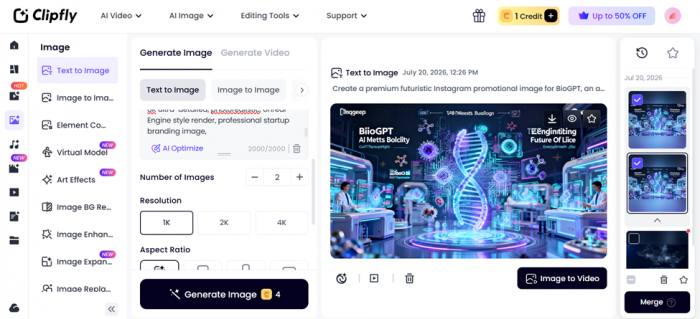
WHAT FLUXON GOT RIGHT • A glowing DNA helix front and center, fused with circuit-like neural patterns • A believable next-gen lab: glass panels, holographic dashboards, scientists at work • The exact blue, purple, and cyan palette, with volumetric glow • Lighting that reads as an expensive campaign photograph | WHERE IT FELL APART • The text. I asked for "BioGPT," "AI Meets Biology," and "Engineering The Future Of Life." I received "BiioGPT," "AI Metts Boldity," and "TEEngintiting Fusure Of Lice" • Extra gibberish scattered across the frame, including a phantom "Inqgeep" mark I never asked for • "Minimal, clean, leave space for typography" was ignored. Every corner is busy • Neither of the two images was postable as delivered |
This is not just my luck. On Trustpilot, one reviewer described images ignoring prompt details while still consuming coins. Clipfly's team publicly replied that accuracy fixes and retry options are in the works. My results say they still are.
MY HONEST REACTION Staring at "Engineering The Fusure Of Lice," I honestly could not tell whether the model understood my brief or just decorated around it. With the text stripped and rebuilt in Canva, usable as a background plate. As the finished Instagram asset? Not even close. |
How Clipfly scores across review platforms
My afternoon is one data point, so here are Clipfly's public ratings with caveats.
| Platform | Score | Volume | What to know |
|---|---|---|---|
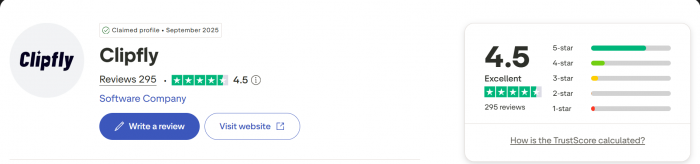
| Trustpilot | 4.5 / 5 | 295+ reviews | Overwhelmingly positive but shallow: a March 2026 independent audit of 100 reviews found none verified and roughly 75% under five words. |
| Google Play | ≈4.1 / 5 | 600+ ratings | Healthy average; recent complaints cluster on billing and renewals, not output quality. |
| AIapps.com | 3.7 / 5 | 6 ratings | Tiny sample, more measured take: praise for speed, flags on limited control. |
| Gridinsoft trust check | 95 / 100 | Site scan | Measures legitimacy, not quality. Clipfly passes comfortably: real company, secure payments, established domain. |
| This review | 3.2 / 5 | 1 thorough afternoon | Hands-on, prompts published, every credit accounted for. |
The pattern: the highest scores sit on the thinnest feedback; detailed evaluations, including this one, land nearer the middle.
What people are actually saying
These cards paraphrase recurring themes from real user reviews.
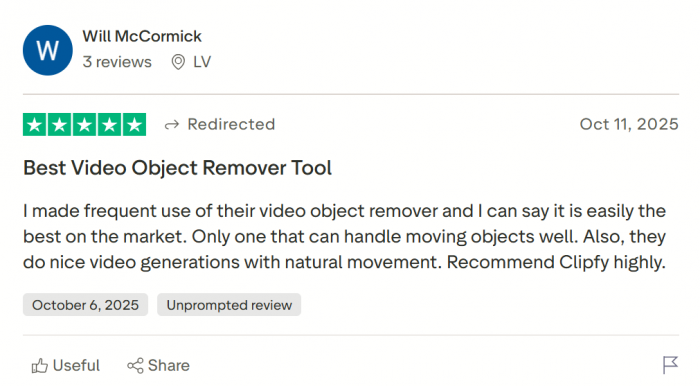
■ TRUSTPILOT · POSITIVE The video object remover gets singled out repeatedly. One heavy user called it the best they had tried, and the only one handling moving subjects well. |
■ TRUSTPILOT · POSITIVE A self-described AI beginner rated Clipfly the best mix of price, quality, and simplicity they had found; a small budget stretches far. |
■ TRUSTPILOT · MIXED Photo-to-video fans say it shines when subjects face the camera, but admit they often rerun generations before landing a keeper. |
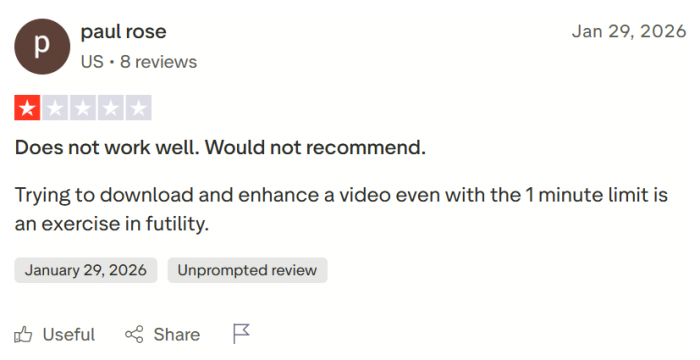
■ TRUSTPILOT · NEGATIVE A recurring gripe mirrors my test: outputs that ignore the prompt still burn coins, with no free retry offered. |
■ TRUSTPILOT · NEGATIVE Several users note the free tier realistically covers one video; others reported per-clip costs jumping from around 30 coins to 80 or more. |
■ GOOGLE PLAY · NEGATIVE Mobile complaints center on billing: one plan quietly switched from monthly to weekly renewal; another user gave up fighting export limits. |
Pros and cons at a glance
PROS • Facebook signup asked only name and photo; first render landed in minutes • 13 tools in one tab, from UGC Avatar to AI Music to Video Enhance • 15 free credits covered one Lumen clip plus a two-image Fluxon run • Spec chips print each model's credit cost, resolution, and clip length up front • The 6-second clip rendered fast, with grading that genuinely looked cinematic • Bulk credits fall to $0.066 each on the $19.99 pack | CONS • Both fields truncated my briefs silently at 1,500 and 2,000 characters • Lumen caps clips at 6 to 10 seconds yet accepted my 30-second brief • Four of five scripted scenes, plus every overlay, never reached the screen • Paid generations invented "BiioGPT" and "Fusure Of Lice" as on-image text • All 14 credits charged despite both misses, with no free retry • The 4.5 Trustpilot score rests on reviews an audit found 0% verified |
Five rules I would follow next time
1. Count your characters. Stay under 1,500 for video, 2,000 for images, or the tail of your brief silently vanishes.
2. Brief one scene per generation, then assemble with Merge; multi-scene scripts in one prompt are wasted credits.
3. Never ask for on-image text. Generate the visual, then add typography in a proper editor.
4. Read the spec chip before you spend. Length, resolution, and cost are printed right there; the interface will not stop you from exceeding them.
5. Trial paid models with the $2.39 starter pack before buying a bigger bundle.
Final verdict: the scorecard
I sat with this overnight, because Clipfly is two products in one interface. Judged as what it wants to be, a friendly sandbox for short AI media, it earns its Trustpilot affection. Judged as what its marketing implies, a production tool, it stumbled twice in one afternoon and charged me both times.
| Category | Score | Why |
|---|---|---|
| Ease of use | 4.5 / 5 █████████░ | Signup to first render in minutes, no manual |
| Speed | 4.0 / 5 ████████░░ | Both jobs finished fast with clear progress states |
| Visual polish | 3.5 / 5 ███████░░░ | Lighting, palette, and atmosphere consistently look premium |
| Pricing and value | 3.5 / 5 ███████░░░ | Cheap at bulk rates, but paying for misses stings |
| Transparency | 2.5 / 5 █████░░░░░ | Silent truncation and missing warnings cost me credits |
| Prompt adherence | 2.0 / 5 ████░░░░░░ | Duration, scene structure, and text instructions largely ignored |
| Text in images | 1.5 / 5 ███░░░░░░░ | Invented words on both outputs, unusable without edits |
| Overall | 3.2 / 5 ██████░░░░ | Real utility, fairly priced, undermined by silent limits |
So here is where I land. The film came back at 6 seconds with four scenes missing; the image arrived promoting "BiioGPT." Both failures were predictable from limits Clipfly knew and I did not, and a product this pleasant deserves equally honest guardrails.
So, 3.2 out of 5. Use Clipfly for fragments, not films. Bring your own typography. Keep your briefs short and your expectations shorter. And watch that credit counter, because Clipfly certainly does.