


Table of Content
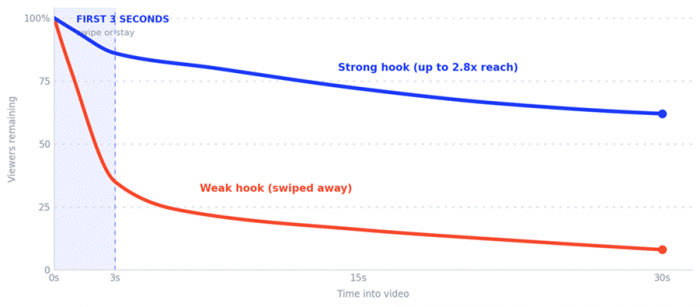
The opening seconds decide everything. A strong hook keeps viewers past the decision window and earns multiplied reach; a weak one loses the majority before the content even begins.
The three-second economy
Most content does not fail because it is bad. It fails because almost no one stays long enough to find out.
When someone opens TikTok, Reels, or YouTube Shorts, their thumb is already moving. They travel through videos roughly every one to three seconds, deciding in real time whether each one is worth interrupting the scroll for. Your video is not really competing with other videos. It is competing with the swipe itself.
The numbers are blunt. The most widely cited estimate is that around two thirds of short-form viewers are gone inside the first three seconds. The window is so tight that TikTok’s distribution system can often read a video’s viral potential within the opening six seconds, and Instagram and YouTube both weight those first moments far more heavily than the rest of the runtime.
The payoff for getting the opening right is not linear, and this is the part that should change how you work. One 2026 analysis of TikTok performance found that the stronger your three-second retention, the more the algorithm multiplies your reach.
| THREE-SECOND RETENTION | WHAT IT SIGNALS TO THE ALGORITHM | REACH VS. BASELINE |
|---|---|---|
| Above 85% | Exceptional. Pushed widely to new audiences. | ~2.8x the views |
| 70% to 85% | Strong. Clear algorithmic favor. | ~2.2x the views |
| 60% to 70% | Average. Moderate visibility. | ~1.6x the views |
| Below 60% | Weak. Minimal distribution. | baseline |
Source: 2026 analysis of TikTok retention bands. Treat the exact multipliers as directional, but the pattern holds across platforms.
A mediocre video with a great hook will out-travel a great video with a weak one, almost every time. The hook is the single highest-leverage decision in anything you publish.
What a hook actually does
A hook is not a clever line. It is a promise and an open question delivered in the same breath. It tells the viewer this is for you while quietly refusing to give away the ending.

That refusal is the engine. In the 1920s, the psychologist Bluma Zeigarnik observed that people remember unfinished tasks far more vividly than finished ones, by some accounts around 90% better. The brain files an open loop as an active goal and keeps spending attention on it until the loop is closed. A good hook opens one of those loops on purpose and holds the resolution just out of reach.
Modern neuroscience backs the feeling with biology. Brain imaging shows that when an information gap opens, the dopamine-linked reward circuitry activates, so curiosity runs on the same pathway as the anticipation of a reward. A Carnegie Mellon study found that unresolved questions raise dopamine activity and make the answer feel more rewarding once it finally arrives. The itch is not a metaphor. Your viewer is mildly uncomfortable until they find out what happens next, and watching is the relief.
THE ONE RULE THAT PROTECTS YOUR REACH A genuine curiosity gap and cheap clickbait pull the same trigger, but they end differently. Clickbait opens a loop it never satisfyingly closes, and audiences have fast, ruthless instincts for the difference. Worse, platforms read early drop-off and “not interested” taps as a quality signal, so a hook that over-promises does not just disappoint. It actively suppresses your reach. So open a loop you fully intend to close, then close it well. |
What every working hook is doing
Strip away the formulas and every strong hook is doing three things at once.

• Immediate stimulation. Something moving, said, or shown in the first frame that signals something is happening here. On muted feeds, this is usually bold on-screen text rather than sound.
• An open loop. A question, gap, or tension the viewer can resolve only by staying.
• Relevance. An instant signal that this is for them, not for everyone.
Three more qualities separate a hook that travels from one that is forgotten.
• Specificity. “I changed one thing and doubled my income” is forgettable. “I cut one habit and my freelance income doubled in 90 days” is sticky. Concrete numbers, timeframes, and nouns give the brain something to hold.
• A clear promise. Within the first second, the viewer should sense exactly what they get for staying.
• Tension. Lead with the friction, not the throat-clearing. “Here is why your videos are not growing” beats “Today I want to share some growth tips.”
If your opening could be swapped onto a thousand other pieces of content without anyone noticing, it is not a hook. It is a warm-up.
Seven formulas you can steal
These are reliable starting points, not rigid scripts. Notice that each one opens a loop a different way. Treat the examples as templates and fill them with your own specifics.
| FORMULA | WHAT IT DOES | EXAMPLE YOU CAN ADAPT |
|---|---|---|
| Contrarian | Challenges a common assumption | “Everything you have been told about morning routines is backwards.” |
| Curiosity gap | Reveals a detail, withholds the context | “I deleted 90% of my content last month. My views went up.” |
| Specific number | Leads with a concrete, surprising figure | “I tested 47 thumbnails so you do not have to. Three rules won.” |
| Pattern interrupt | Opens mid-surprise, visually or verbally | “Do not water this plant. Put the cup down.” |
| Direct callout | Names the exact viewer you want | “If you have rewritten the same email five times, this is for you.” |
| Social proof | Borrows credibility or scale up front | “The script behind 4 million views started with one boring line.” |
| In media res | Begins inside the action, skips the setup | “…and that was the moment I realized the whole plan was wrong.” |
You will start spotting these everywhere. Save the ones that stop your own scroll. That is the beginning of your personal swipe file.
How to actually write one
Strong hooks are rewritten, not born. A repeatable process beats waiting for inspiration.
1. Write the payoff first. Know exactly what reward you are promising. You cannot tease what you have not defined.
2. Draft ten openers, fast. Let them be bad. The point is to get past your first idea, which is almost always the weakest.
3. Cut to the conflict. Delete every word before the interesting part. If the hook still works without a line, that line was setup.
4. Tighten the language. Present tense, active verbs, plain words. For on-screen text, keep it to roughly four to seven words so it reads mid-scroll.
5. Check the promise. Reread it as a skeptical stranger. If the question can be answered instantly in the viewer’s head, there is no reason to stay.
6. Say it out loud. Hooks live in rhythm. If it is a mouthful to speak, it is a mouthful to watch.
Two minutes per opener, ten openers, one ruthless edit. That is a better hook than most creators ever write, and it is entirely a process, not a talent.
Mistakes that quietly kill views
Most creators know hooks matter and still trip on the same handful of patterns.
| THE MISTAKE | WHY IT COSTS YOU VIEWS | THE FIX |
|---|---|---|
| “Hey guys, in today’s video…” | Burns your most valuable second on logistics and signals low energy | Lead with the content, not the introduction |
| Context before conflict | Assumes a patience the viewer simply does not have | Start at the friction, then backfill |
| Vague bait | Hollow intrigue reads as a trick, and viewers punish it fast | Make the promise specific and real |
| An answerable question | The viewer resolves it instantly and scrolls on | Ask something they cannot answer without you |
| Over-promising | Triggers a sharp drop the algorithm reads as low quality | Promise only what the content delivers |
| Crowding the frame | Too many words or cuts overwhelm rather than engage | Choose one clear idea for the opening |
If your platform shows a swiped-away or three-second drop-off rate above roughly 40%, the opening is failing, and nothing later in the video gets a chance to make up for it.
When the view is a click: hooks for written content
Everything above translates to headlines, subject lines, and post openers, the written hooks that decide whether anyone reads on.
The most quoted rule in copywriting comes from the advertising legend David Ogilvy: on average, about 8 out of 10 people read the headline, but only 2 out of 10 read the rest. That ratio grew out of an adman’s experience rather than a controlled study, so hold the exact number loosely. The principle still holds, and it matches how people behave online, where most skim rather than read in full. Your headline is not part of the work. It is most of the work’s audience.
| LEVER | WHAT THE DATA SUGGESTS |
|---|---|
| Length | Headlines of roughly 6 to 13 words tend to pull the most consistent traffic, with about six words often cited as a sweet spot |
| Write to one person | “You” and “your” lift engagement, and personalized calls to action have been measured as more than twice as effective as generic ones |
| Open the same loops | The curiosity gap, the specific number, and the contrarian claim all work just as well in text |
| Front-load the value | Since most readers scan, the first line and the subheads carry the weight, so make the payoff visible early |
The grammar of attention is the same on the page as in the feed. Stop the scroll, open a loop, promise something real, and deliver.
Test, measure, then write the next one
Here is the shift that separates creators who plateau from those who compound: treat your hook as a variable to test, not a one-time creative decision. The feedback is already sitting in your analytics.
• Read the first three seconds of the retention curve. A sharp cliff there means the hook is not earning attention, so rewrite the first line and first frame before you touch anything else.
• Use rough benchmarks. Three-second retention above about 70% suggests a strong hook; below about 50% means it needs a rewrite. These shift by niche, format, and length, so treat them as orientation, not gospel.
• Mind the average view. For short videos under five minutes, a healthy average percentage viewed often lands around 50% to 70%. Consistently under 50% usually points right back to the opening.
Then build a system around it.
• Keep a swipe file. Whenever a hook stops your own scroll, save it and note why it worked.
• Test one variable at a time. Same content, two openers, and let the retention data pick the winner, not your taste.
• Build your own playbook. Over time you learn which hook types your audience rewards, and that private dataset is worth more than any generic list, including this one.
Before You PublishThe 30-second hook check ☐ Does something happen in the first second: motion, bold text, or a strong opening line? ☐ Is there an open loop the viewer can close only by staying? ☐ Is it specific: a real number, name, or claim, not a vague tease? ☐ Is the promise honest: can the content actually deliver it? ☐ Did you cut the setup and start at the interesting part? ☐ Could this opener be swapped onto anyone else’s content? If yes, keep working. |
The Bottom Line
A hook is a promise you make in the first moment and keep by the end.
Make it specific. Make it honest. Open a loop your viewer cannot ignore, then earn the attention you borrowed by closing it well. Do that consistently and you stop fighting the scroll, because the algorithm and the human on the other side of it are both quietly rooting for content worth staying for.
Now go write ten bad openers. Your best hook is somewhere in the rewrite.