

Table of Content
YouTube pulls in 2.83 billion monthly users and over a billion hours of daily watch time, according to early 2026 figures from GlobalMediaInsight and DataReportal. Large parts of that audience still hit walls. School networks filter the domain, office firewalls flag bandwidth-heavy streaming, and several governments block the platform outright. What follows covers why those blocks exist, where they sit, and which methods actually restore access.
Why networks block the platform in the first place
Three categories cover almost every YouTube block in existence: institutional filtering, national censorship, and content-licensing restrictions. The reasoning and the technical mechanism differ in each case.
Institutional blocks dominate by sheer numbers. A 2023 EdTech Magazine survey found that more than 60 percent of K-12 schools in the United States restrict YouTube, often citing the Children's Internet Protection Act and concerns about violent or sexual content. Workplaces apply similar filtering through DNS and category rules from Cisco Umbrella, Zscaler, or Fortinet. Bandwidth cost, not YouTube itself, is the real driver. BBC coverage in 2024 captured the trend when Glasgow City Council blocked YouTube on 43,000 primary school iPads after reports of pupils accessing violent content on managed devices.
National-level censorship is rarer but more entrenched. Wikitubia tracking puts five countries under a full block as of 2024: China, Eritrea, Iran, North Korea, and Turkmenistan. Video-level restrictions affect a smaller slice. Around 3.6 percent of YouTube videos carry country-level limits according to unblockvideos.com data, climbing to roughly 13 percent for videos with more than one million views, driven mostly by music licensing and regional broadcast rights.
| Context | Primary reason | Block method |
|---|---|---|
| K-12 schools | CIPA compliance, distraction control | DNS filtering, category firewalls |
| Universities | Bandwidth, focus during class | Domain blacklists, scheduled filtering |
| Workplaces | Productivity, bandwidth costs | Network firewall, DNS rules |
| National (full ban) | Government censorship | ISP-level blocks, DNS poisoning |
| Specific videos | Music licensing, copyright | Geo-IP detection by YouTube |
Table 1: Why YouTube ends up blocked in different contexts.
Where YouTube remains restricted today
The list of countries with full bans has narrowed over the past decade. Pakistan lifted its three-year ban in 2016. Turkey ended its repeated blocks. Brazil restored access following a 2007 court order. What remains is small but durable. China has blocked YouTube since 2009 with Bilibili, Youku, and iQIYI filling the gap. Iran has done the same since 2009. North Korea, Eritrea, and Turkmenistan complete the list documented by Wikitubia and the Open Net Initiative.
Russia is a different case. The platform technically remains accessible, but Cybernews and BusinessStats reporting confirms heavy throttling since 2024 that has pushed users toward VK Video and Rutube. Institutional blocks reach a far larger population. Edpuzzle and Lightspeed Systems estimate that a majority of school networks across the United States, the United Kingdom, and Australia apply some form of YouTube filtering.

| Country | Status | In effect since |
|---|---|---|
| China | Full block | 2009 |
| Iran | Full block | 2009 |
| North Korea | Full block | Platform launch era |
| Eritrea | Full block | Reported in early 2010s |
| Turkmenistan | Full block | Mid 2010s |
| Russia | Heavy throttling | 2024 |
Table 2: Countries currently blocking or heavily throttling YouTube.
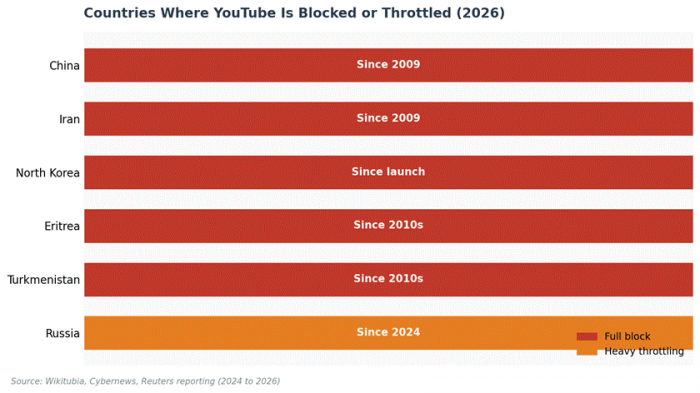
Figure 1: National-level restrictions on YouTube access, current as of 2026.
VPN services worth considering
A virtual private network remains the most reliable method for restoring access, whether the block sits at a school router or a national ISP. Traffic moves through an encrypted tunnel to a server in another location, so the connection looks like it originates from that server rather than the restricted network.
Three providers consistently top independent testing from Tom's Guide, Cybernews, Security.org, and SafetyDetectives in late 2025 and early 2026: NordVPN, ExpressVPN, and Surfshark. NordVPN carries the largest server footprint at 9,300 servers across 137 countries and bundles ad blocking through its Threat Protection feature. ExpressVPN holds the strongest reputation for hostile environments, with SafetyDetectives placing it first for unblocking in Russia and Iran thanks to its Lightway protocol and built-in obfuscation. Surfshark sits at the lowest entry price, allows unlimited device connections, and uses its NoBorders mode to bypass school and workplace filters.
Free VPN services warrant a separate note. Most operate as data-harvesting businesses, and several have surfaced in security disclosures for leaking IP addresses or selling browsing data. Proton VPN and Windscribe are the most credible free tiers, but data caps and limited server choices restrict them to light, occasional use.
| Service | Server footprint | Entry plan | YouTube test result | Best for |
|---|---|---|---|---|
| NordVPN | 9,300+ servers, 137 countries | Around $3.39 a month | Consistent unblock across tests | Daily use, in-app ad blocking |
| ExpressVPN | 3,000+ servers, 105 countries | Around $4.99 a month | Strongest in restrictive regions | Iran, China, Russia conditions |
| Surfshark | 3,200+ servers, 100 countries | Around $1.99 a month | NoBorders bypasses school nets | School and workplace blocks |
| Private Internet Access | 35,000+ servers, 90 countries | Around $2.03 a month | Stable streaming speeds | Budget-conscious viewers |
| Proton VPN free tier | 100+ servers in 3 free locations | Free | Slow but functional | Light, occasional use |
Table 3: VPN comparison for YouTube unblocking. Pricing reflects long-term plan rates published in May 2026.
Alternative methods beyond the VPN route
Several non-VPN approaches restore access depending on the block, with real tradeoffs in each case.
Smart DNS reroutes only the queries needed to reach a specific platform and skips the encryption overhead, which makes it the fastest option. The catch, as Multilogin and Top10VPN document, is that it does nothing to hide the underlying IP, so network administrators can still see traffic heading to YouTube. It works for home broadband geo-licensing blocks and rarely for school networks.
Tor delivers strong anonymity but routes traffic through multiple volunteer nodes. Multilogin testing notes that Google blocks most exit nodes and the layered routing kills streaming speed, leaving Tor useful only for hostile countries where any access matters more than playback quality. Web proxies install nothing but tend to inject ads, fail on HD playback, and get caught by most school filters. Mobile hotspots are the simplest workaround: switching to cellular data bypasses the filter layer entirely, with battery life and data caps as the only constraint.
A few observations on browser-based extensions and unblocker mirror sites are worth keeping in mind:
•Free browser VPN extensions frequently route traffic through other users' devices, which exposes both parties to security risk.
•Many YouTube unblocked mirror sites carry malware, scam ads, or aggressive tracking payloads that hide behind a familiar interface.
•Browser extensions built by VPN companies that already operate paid apps tend to be safer than standalone free VPN browser tools.
Comparing approaches at a glance
The right method depends on what is being bypassed and which tradeoffs are acceptable. The summary below reflects independent testing rather than provider claims.
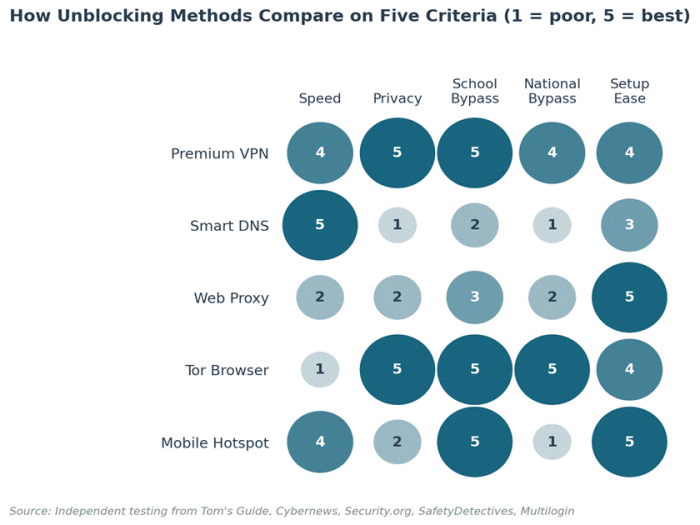
Figure 2: How the main unblocking methods stack up across five practical criteria.
| Method | Speed | Privacy | Setup | School blocks | National blocks |
|---|---|---|---|---|---|
| Premium VPN | Fast | Strong | Low | Yes | Usually yes |
| Smart DNS | Fastest | None | Medium | Rarely | No |
| Web proxy | Slow | Weak | Lowest | Sometimes | Sometimes |
| Tor browser | Very slow | Strongest | Low | Yes | Yes, but unwatchable |
| Mobile hotspot | Depends on signal | Carrier sees activity | Lowest | Yes | No, same country |
Table 4: Quick comparison of unblocking methods on the metrics that matter for everyday use.
Legal status and safety to think about
VPN use is legal in most jurisdictions, including the United States, the European Union, the United Kingdom, Canada, Australia, India, and most of Latin America. Restrictions or bans on non-government-approved VPNs apply in China, Russia, Belarus, North Korea, Iran, and Turkmenistan. Tor faces similar limits in the same group.
Using a VPN to access YouTube does not violate the platform's terms in most cases, but YouTube has tightened enforcement against using a VPN to claim Premium at lower regional prices. ExpressVPN itself notes that suspected location-spoofing accounts may face cancellation. Bypassing a school or workplace network is rarely illegal but almost always violates the acceptable use policy, with consequences ranging from loss of network privileges to disciplinary action.
A few red flags are worth treating as deal-breakers when picking any unblocking tool:
•A service that does not publish a privacy policy or a country of incorporation.
•Mobile apps that request permissions unrelated to networking, such as contacts, camera, or SMS access.
•Free services with no clear revenue model, since the business model is usually data resale.
Final verdict on picking a method
For most situations, a paid VPN from an established provider remains the cleanest solution. NordVPN and Surfshark cover the value end of the range. ExpressVPN covers the harder cases in restrictive countries. Smart DNS makes sense for home users dealing only with regional licensing on smart TVs. Web proxies and Tor serve narrow cases and should not be the default. With more than a billion hours of YouTube watched daily and 2.83 billion monthly active users, restrictions of some form touch nearly every viewer at some point. Matching the method to the block is the difference between a five-minute fix and a frustrating afternoon.