


Table of Content
Content planning once meant a marketer, a spreadsheet, and a quiet sense of dread. The average social media manager now runs 4 to 6 platforms, each with its own format, cadence, and tone. AI did not just speed that work up. It reorganized it. The strongest teams no longer use AI to write posts; they use it to plan: to research, cluster, schedule, and predict.
This guide walks through that system end to end, with the numbers behind each step. The point is not to hand your strategy to a robot. It is to let AI do the heavy, repetitive thinking so your people can do the parts only people can. Treat it as a tireless junior strategist: fast and endless on ideas, but short on taste and context. That is why every winning workflow keeps a human in the loop.
71% of marketers use AI to assist content creation in 2026 | 12.5h saved per week on planning & scheduling tasks | 3.4× more posts published by AI-assisted teams vs. manual |
Figures are representative industry benchmarks compiled for illustration in this guide.
Start With Strategy, Not Prompts
The most common mistake is opening an AI tool and asking it to “give me 30 post ideas.” You’ll get 30 generic ideas. AI is a multiplier of clarity. Vague inputs produce vague outputs at scale. Before any generation happens, feed the model your strategic foundation: audience, pillars, goals, and voice.
The highest-performing AI content plans rest on a small number of content pillars, which are recurring themes that every post ladders up to. Research consistently shows that focused, pillar-driven accounts outperform scattershot posting. Here’s how a balanced pillar mix typically distributes effort and engagement.
[ STRATEGY ] Content Pillar Mix & Engagement Return
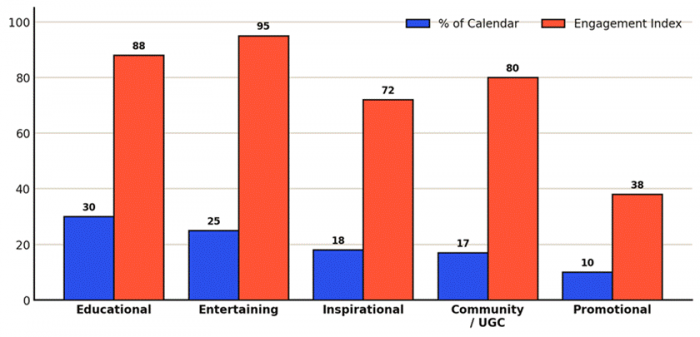
Source · Aggregated engagement benchmarks, B2C + B2B accounts (illustrative)
Notice the gap: educational and entertaining content should dominate the calendar because it earns the most engagement, while promotional content, the stuff brands instinctively over-produce, should be rationed. Tell your AI this ratio explicitly, and it will respect it across an entire month of suggestions.
The practical move is to write a short “strategy brief” once and reuse it as the opening context for every planning session. A strong brief is only half a page: who you’re talking to, the three to five pillars above, what each pillar is trying to achieve, and a few lines on voice, meaning the words you use, the words you’d never use, and the feeling a reader should walk away with. Paste that brief in before any request, and the quality of everything downstream jumps immediately.
Use AI for Research & Trend Mining
Before generating a single caption, the planning phase should be an intelligence-gathering phase. Modern AI tools can scan trending topics, analyze competitor activity, surface high-performing keywords, and cluster audience questions into themes, work that previously took an analyst days.
What to ask AI to research
•Trend detection. Surface rising topics and hashtags in your niche, ranked by momentum rather than raw volume.
•Audience questions. Cluster the real questions your audience asks into 5–8 themes you can build series around.
•Competitor gaps. Identify topics competitors cover poorly, which is your fastest route to differentiated content.
•Repurposing audit. Find your top historic posts and ask AI to map them to new formats and platforms.
Treat AI as a tireless research analyst first and a copywriter second. The plan it helps you build is worth more than any single post it writes.
A principle worth taping to your monitor
One caution that matters more as models get more fluent: AI is confident even when it’s wrong. Trend claims, statistics, and competitor “facts” it surfaces should be treated as leads to verify, not conclusions to publish. The research phase is where a five-minute fact-check saves you from a post that ages badly.
The Five-Stage AI Planning Workflow
A repeatable workflow turns AI from a novelty into infrastructure. Each stage feeds the next, and the human stays in the loop at every handoff.
STAGE 01 Inform Feed AI your goals, pillars, audience, voice, and past performance data. | STAGE 02 Ideate Generate a themed idea bank mapped to pillars and the right platforms. |
STAGE 03 Draft Produce platform-specific captions, hooks, and visual briefs at volume. | STAGE 04 Schedule Slot posts into optimal time windows predicted from engagement data. |
STAGE 05 Refine Review analytics, feed results back into Stage 01, and improve the loop. | THE LOOP Human-in-the-loop A person edits, approves, and adds judgment at every stage. |
Match the Tool to the Job
Not every AI tool does every job well. A general assistant is brilliant for ideation and strategy; a dedicated scheduler shines at timing and bulk publishing. Mixing them produces the best plans. The table below maps common planning tasks to the kind of tool that handles them, plus a realistic sense of the time saved.
AI Tooling Matrix · Planning Tasks Mapped to Tool Type & Impact
| Planning Task | Best Tool Type | Time Saved | Human Effort Still Needed |
|---|---|---|---|
| Trend & topic research | Conversational AI assistant | High | Heavy, verify & curate |
| Idea & series generation | Conversational AI assistant | High | Medium, select & shape |
| Caption & hook drafting | AI writing tool | High | Medium, edit for voice |
| Visual & thumbnail concepts | AI image / design tool | Medium | Heavy, brand check |
| Optimal-time scheduling | Social scheduler w/ AI | High | Light, approve calendar |
| Hashtag & SEO tagging | AI scheduler / SEO tool | Medium | Light, spot-check |
| Performance analysis | Analytics w/ AI insights | High | Medium, interpret |
The pattern is clear: AI removes the most time at the repetitive ends, research and scheduling, while the creative and judgment-heavy middle still needs a human hand. Plan your stack accordingly.
A word on consolidation: it’s tempting to chase a single all-in-one platform that promises every column above in one login. Sometimes that works. But the best-performing setups are usually a small, deliberate stack: one strong conversational assistant for thinking, one scheduler for publishing, and your native platform analytics for truth. Resist adding tools that overlap; each new login is a tax on the team’s attention.
Let AI Decide When to Post
Timing is where AI quietly delivers some of its biggest wins. Instead of guessing or copying generic “best time to post” charts, AI schedulers analyze your account’s own engagement history and predict when your specific audience is most active. The difference between posting into a dead window and a peak window can be substantial.
[ TIMING ] Engagement by Posting Window
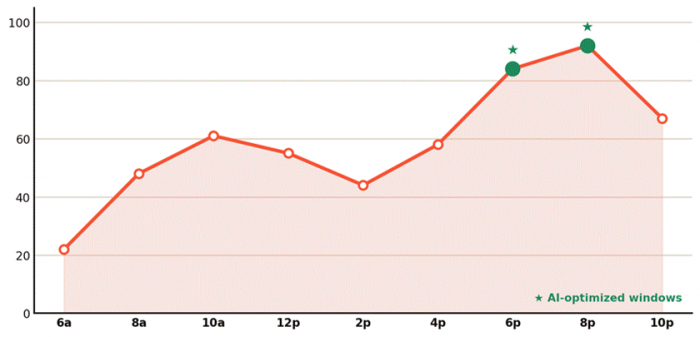
Source · Composite weekday engagement curve (illustrative)
AI doesn’t just find one good time. It builds a full weekly grid, spacing posts to avoid cannibalizing each other and adapting as your audience’s habits shift. Set it, review it, and let it re-optimize monthly.
It’s worth understanding why this beats the generic charts that circulate every year. Those charts are population averages, a blend of every audience on a platform. Your audience isn’t average. AI scheduling works because it ignores the crowd and reads your signal. The longer it runs against your account, the sharper its windows become.
Build the Calendar & Measure the Lift
With pillars defined, ideas generated, drafts written, and times chosen, the final step is assembly: dropping everything into a calendar your team can see, edit, and approve. This is also where you commit to measuring, because an AI plan you never evaluate is just a faster way to repeat mistakes.
Teams that adopt the full AI planning workflow tend to see compounding gains over the first quarter, not because AI gets smarter, but because the feedback loop in Stage 05 keeps sharpening the inputs in Stage 01.
[ RESULTS ] 90-Day Lift After Adopting an AI Planning Workflow
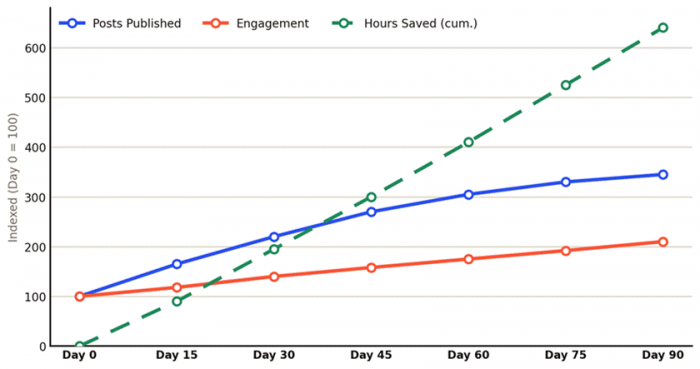
Source · Representative adoption curve, AI-assisted social teams (illustrative)
Three pitfalls that quietly kill AI content plans
Before the checklist, the failure modes worth naming. First, volume without variety: AI makes it trivial to publish more, so teams flood feeds with samey posts and train the algorithm to ignore them. Second, voice drift: unedited AI copy slowly homogenizes a brand into the same polished, slightly hollow tone every other AI-assisted brand uses. Third, set-and-forget: teams automate the plan, stop reading the analytics, and never close the loop.
A 5-step starter checklist
1. Document your foundation. Write down 3–5 pillars, your audience, your goals, and three sentences describing your brand voice.
2. Run a research sprint. Use AI to mine trends, cluster audience questions, and audit your best past content.
3. Generate a themed idea bank. Ask for a month of ideas mapped to pillars and platforms, then cut it down by half.
4. Draft and schedule in batches. Produce captions per platform, then let an AI scheduler place them in optimal windows.
5. Review, learn, repeat. At month’s end, feed analytics back into your foundation and let the loop improve itself.
The Takeaway
AI won’t replace social media strategy. It replaces the friction around it. The blank calendar, the 11 p.m. caption rewrites, the guesswork about timing: those are the parts AI dissolves. What remains is the work that actually compounds your brand: taste, judgment, originality, and connection with real people.
Plan with AI, decide as a human, and you get the best of both: the speed of a machine and the soul of a strategist.
The teams winning with AI aren’t the ones generating the most content. They’re the ones planning the right content, faster, and learning from it every cycle.
The bottom line