


Table of Content
Your bio is a landing page, not a caption
The single biggest mindset shift: stop writing your bio based on mood, and start treating it like a conversion asset you measure and test.
Instagram now hosts roughly three billion monthly active users, and around two in three consumers maintain a profile there. That scale is the opportunity and the problem in the same breath. For every person who could discover you, there are thousands of accounts competing for the same glance. When someone finally taps through to your profile, you have a few seconds and one small box to convince them you’re worth a follow, a click, or a purchase. Most people squander it.
Part of the reason the bio matters more than it used to is that Instagram’s algorithm has quietly reweighted what counts. Intent-driven actions (profile visits, saves, link clicks, DM replies) now carry more weight than passive likes. If users click through, save your posts, or message you, distribution expands. The bio sits right at the center of that high-intent moment: the visitor has already shown curiosity, and the bio decides whether that curiosity converts into action or evaporates.
The data backs the stakes. Across 2024–2025 performance audits, profiles under 50,000 followers but with optimized conversion paths earned up to 3.2× more revenue per follower than larger accounts that chased engagement alone. Meanwhile creators who rebuilt their content and bios around solving one clear problem saw up to a 41% lift in link clicks within 60 days, even while posting less often. Size isn’t the lever. Clarity is. A small, sharply positioned account routinely out-earns a big, blurry one.
Instagram converts better than its peers
Source: Zebracat / DataReportal 2025 marketing benchmarks
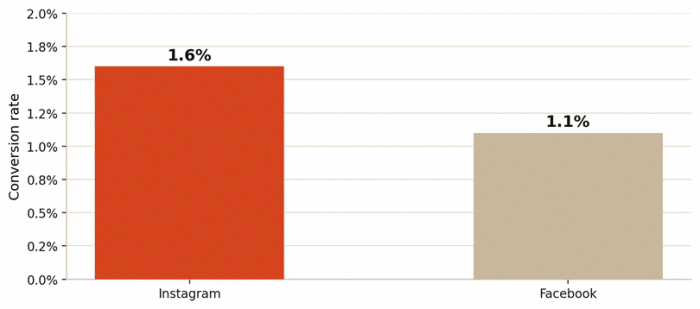
Instagram’s average conversion rate of 1.6% edges out Facebook’s 1.1%, and 73% of marketers say Instagram delivers the highest ROI of any social channel they use. None of that ROI materializes if your profile leaks visitors. The bio is the seam where attention either becomes a measurable outcome or simply leaks away, which is exactly why it deserves the same scrutiny you’d give a paid landing page.
The seven parts of a high-performing bio
Every bio that converts is quietly doing the same handful of jobs. The order matters, because attention decays line by line: the first thing a visitor reads should be the most important thing you have to say. Here’s the structure, top to bottom, in the order the eye actually travels.
| # | ELEMENT | WHAT IT DOES |
|---|---|---|
| 1 | Name field (the searchable one) | Put a keyword here, not a repeat of your handle. “Mara · Vegan Meal Prep” beats “@marasmith.” The name field is indexed by Instagram search, so this is free discoverability most people waste. |
| 2 | The first line / hook | Who you help and what you do, in plain words. This is the line most people actually read. Be blunt. Across testing, the bluntest bios consistently beat the cleverest ones. |
| 3 | A proof point | Social proof removes doubt fast: “Featured in Vogue,” “12k students,” “Trusted by 200 brands.” One line, real numbers. Vague superlatives don’t count. |
| 4 | Personality / point of view | One human detail or a distinct voice so you’re not interchangeable with every competitor in your niche. This is what makes a follow feel like joining something. |
| 5 | A single, clear CTA | Tell people exactly what to do next: “Shop the drop ↓”, “Free guide below,” or “DM the word START.” One instruction, not three. |
| 6 | The link (treated like a button) | One destination that matches the CTA. Don’t send curiosity-clicks to a generic homepage; match the promise the bio just made, or the click dies on arrival. |
| 7 | A tracking handle | A UTM tag or unique promo code so you can actually attribute what the bio drives. You can’t improve what you don’t measure, and most accounts measure nothing. |
THE ONE-LINK RULE Instagram gives every profile exactly one clickable bio link. Whether you point it at a single product page or a link-in-bio hub with a few curated choices, the principle is the same: don’t overwhelm. The strongest link strategies offer a focused set of next steps that build a genuine experience, not a chaotic wall of options. |
Notice that five of the seven elements are about reducing friction and doubt, not adding flair. A bio doesn’t fail because it lacks personality; it fails because the visitor can’t quickly answer three questions: What is this? Is it for me? What do I do next? Answer those clearly and the rest is polish.
Three bio archetypes: match yours to the goal
There is no universal template, and chasing one is the most common reason bios underperform. A contractor hunting for quote requests should not copy a coach selling a digital course. The structure has to follow the one action you want most. Broadly, a bio does one of three jobs: growth builds curiosity, sales removes friction, and DM bios start a conversation fast. Pick one as primary; the others can be secondary at best.
| ARCHETYPE | LEADS WITH | CTA POINTS TO | TRACK |
|---|---|---|---|
| GROWTH | Your niche + a clear point of view | A follow, free resource, or “best-of” hub | Followers, saves, profile→follow rate |
| SALES | The offer + the outcome you deliver | A product page, booking page, or offer | Link CTR, order value, code uses |
| DM / LEAD | The problem + an invitation to talk | A keyword message (“DM START”) | New messages, keyword hits, booked calls |
To make it concrete, here’s how the same hypothetical creator, a personal trainer, would write each archetype within the same ~150-character limit:
GROWTH BIO Strength coach for busy parents 💪 No-equipment workouts in 20 min/day Free starter plan ↓ |
SALES BIO Get visibly stronger in 8 weeks 🏋 1,200+ clients · results guaranteed Join the spring cohort ↓ (20% off) |
DM / LEAD BIO Tired of starting over every January? I build plans you’ll actually keep. DM the word READY to start → |
What actually moves people to click & buy
Source: Zebracat 2025 IG marketing statistics (CTA, social proof & shopping effects)
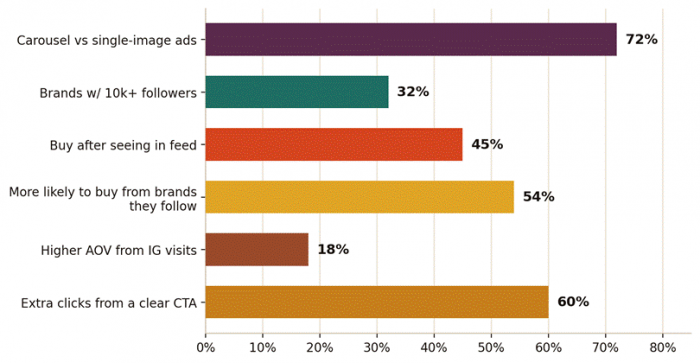
The chart above shows why these archetypes work. Carousel formats convert 72% better than single images, accounts past 10,000 followers see a 32% conversion bump, and 45% of users buy after seeing a product in their feed. Crucially, 54% of shoppers say they’re more likely to buy from a brand they already follow, which means a growth bio that earns the follow today is quietly building the sales conversion you’ll capture next month. The archetypes aren’t isolated; they’re stages of the same funnel.
Five proven conversion levers
Not all bio tweaks are equal. Some are cosmetic; these five show up again and again in the data as the things that genuinely move the needle. If you only have time to fix a handful of things, fix these.
→A clear call-to-action. Photo content with an explicit CTA earns roughly 1.6× more clicks than content without one. Spell out the next step instead of hoping people infer it.
→Visible social proof. 54% of shoppers are more likely to buy from brands they already follow, so a proof line in the bio shortcuts that trust for first-time visitors who don’t yet have the history.
→A promo code or incentive. A bio coupon (e.g. “10% off your first order”) is a proven conversion driver, and a unique code doubles as a tracking mechanism so you can attribute sales straight back to the bio.
→Keywords for search. Treat the bio and name field like SEO: keyworded bios, alt text, and captions increasingly surface in Instagram’s search-driven discovery, where intent is highest.
→Match the link to the promise. Profiles visited from Instagram generate around 18% higher average order values; don’t waste that high-intent traffic on a mismatched or generic landing page.
What ties these together is specificity. A vague bio asks the visitor to do the work of figuring out whether you’re relevant; a specific one does that work for them. “Helping people live better” is noise. “Helping small brands turn Instagram traffic into sales” is a magnet for exactly the right person and a repellent for the wrong one, which is precisely what you want.
Using AI to draft and iterate
The hardest part of a bio is cramming a clear hook, a proof point, personality, and a CTA into roughly 150 characters. That’s a brutally tight constraint, and staring at the empty box rarely produces your best work. This is exactly the kind of problem AI tools handle well, generating a dozen distinct variations in seconds so you have raw material to react to and test, instead of agonizing over a blank field. A free Instagram Bio Generator is a quick way to spin up those first drafts: feed it your niche, your primary goal, and a proof point, and it returns ready-to-paste variants tuned to the character limit.
A practical workflow looks like this: generate eight to ten candidates, immediately discard anything vague or cute, then keep the three that lead with the bluntest, clearest first line. From there, run them live one at a time and let the data, not which one sounds cleverest in your head, pick the winner. The same approach travels across platforms; the bio constraints just shift in flavor, whether you’re writing a TikTok hook, a Twitter one-liner, or a Facebook page intro.
DON’T SKIP THE HUMAN PASS AI gives you raw material fast, but the line that converts is almost always the most specific one: a real number, a real outcome, a real voice. Edit the generated draft until it sounds like a person who knows exactly who they’re talking to. The machine drafts; you make it true. |
How to test like a landing page
The cardinal rule: change one variable at a time. When you swap the CTA, the first line, and the link all at once, you learn almost nothing about which change actually worked.
A clean testing cycle is simple: keep each version live long enough to gather a real signal, compare it against a similar posting period, and judge the result by outcomes rather than by whether the wording feels smart. Many businesses rewrite their bio on a whim, based on mood. The disciplined ones treat it like a series of small experiments and keep only the winners. Test in this order, CTA first, then the first line, then the link destination, then the proof point, so each change is isolated and measurable.
| TEST ORDER | WHAT YOU CHANGE | WATCH THIS METRIC |
|---|---|---|
| 1 | The CTA wording | Link click-through rate |
| 2 | The first line / hook | Profile-visit → follow rate |
| 3 | The link destination | On-site conversions (GA4) |
| 4 | The proof point | DMs & saves |
A 2025 MEASUREMENT NOTE As of January 2025, Instagram deprecated profile-visit and website-click data from its API, so third-party tools can no longer auto-pull those numbers. Use native Instagram Insights for profile actions, and pair it with UTM-tagged links plus GA4 for the off-platform side. For DM or call-driven goals, a tool like ManyChat or CallRail closes the attribution loop. |
One more discipline worth adopting: track micro-conversions, not just the final sale. Profile visits, link clicks, keyword DMs, and saves are all leading indicators that tell you which way a test is trending before the revenue shows up. Brands that monitor these weekly adjust faster and compound small wins into large ones over a quarter.
Common mistakes that quietly kill bios
Most underperforming bios aren’t broken in dramatic ways; they fail through small, fixable habits. Here are the ones that show up most often.
→ Being too vague or generic. “lifestyle | dreamer | coffee” tells a visitor nothing about what they’ll actually get from following you.
→ No call-to-action, so high-intent visitors arrive ready to act and then bounce because there’s nowhere obvious to go.
→ Sending the one precious link to a generic homepage instead of the specific thing the bio just promised.
→ Rewriting on a whim instead of testing, judging the bio by vibes and gut feel rather than by profile actions and link clicks.
→ Wasting the name field on a duplicate of your handle instead of a searchable keyword that helps people find you.
→ Cramming three competing CTAs into one box, which forces a decision and usually produces no decision at all.
The whole playbook in one breath
Pick one goal. Lead with a blunt, keyworded first line. Add one proof point and one clear CTA. Point your single link at exactly what you promised. Tag it so you can measure it. Then change one thing at a time and keep the winners.
The perfect bio isn’t the cleverest arrangement of words; it’s the one your data says works for the specific person you’re trying to reach. The accounts that win this aren’t the biggest; they’re the clearest and the most disciplined about measurement. Draft fast, edit ruthlessly for specificity, ship it, and let the numbers decide the rest. The same playbook carries to every channel you write for. A TikTok Bio Generator, a Twitter Bio Generator, a Facebook Bio Generator, or even a WhatsApp Status Generator all reward the same clarity. Your bio is the highest-intent zone on your entire profile. Treat it that way, and the small box starts paying for itself.