


Table of Content
Picture this. It is late on a Sunday, the phone gallery is bursting with weekend photos, and there is no way of picking just one. The waterfall shot. The messy plate of food. The friend mid-laugh. The sunset that turned out better than expected. Years ago, Instagram forced that brutal choice on everyone. One photo per post. Pick the favourite or split everything across five posts and annoy followers into hiding the account.
That problem is mostly gone now, and the number that solved it has quietly changed more than once. The current limit is higher than most casual users realise, and the history of that limit tells a small story about how Instagram thinks about feed content, how user behaviour shifted, and why “photo dump” went from inside joke to default format.
What follows is everything worth knowing about Instagram's photo cap as of May 2026: the exact number per post, the format-by-format breakdown, the timeline of how the cap changed over the years, and the small details that catch people off guard even when they think they know the rules.
The quick answer for 2026
Instagram allows up to 20 photos or videos in a single carousel post as of May 2026. The minimum for a carousel is 2 slides. A single image is a regular post, not a carousel.
That cap is confirmed by Meta's own help article titled “Share a post with multiple photos or videos on Instagram,” which states the limit explicitly. The 20-slide figure has been the standard since August 2024, and it remains stable in the latest app version.
| The headline number: 20 slides per carousel. The same 20 slots cover any mix of photos and videos. There is no separate cap for photos and videos within one post. |
| Specification | Limit |
|---|---|
| Maximum slides per carousel | 20 |
| Minimum slides per carousel | 2 |
| Maximum file size per photo | 30 MB |
| Maximum file size per video | 4 GB |
| Maximum length per video slide | 60 seconds |
| Photo-Reel total runtime | 90 seconds |
| Photos per Story segment | 1 (unlimited segments per 24 hours) |
| Photos per direct message | No published cap |
Sources: Meta Help Center; Carouselli (March 2026); PostEverywhere (April 2026).
A timeline of Instagram's photo limits
The 20-slide cap is recent enough that many older guides still quote the previous number. Here is the actual progression from launch to present, with the year each limit became effective.
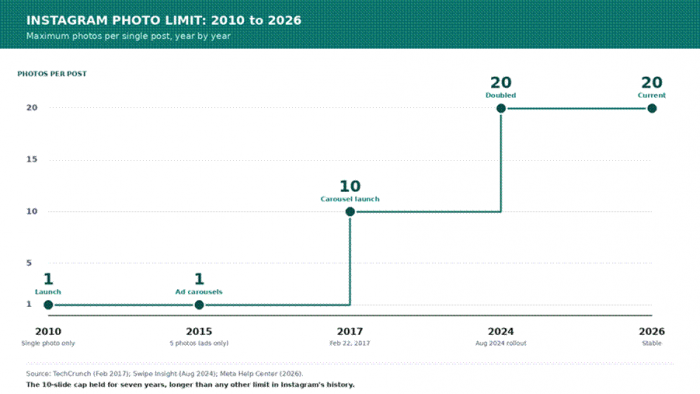
Figure 1. Instagram's photo cap over 16 years. The 10-slide limit lasted longer than any other cap in the platform's history.
| Year | Photo limit per post | What changed |
|---|---|---|
| 2010 | 1 | Instagram launches on iOS. Single-photo posts only. No multi-image option exists. |
| 2015 | 1 (5 for ads) | Instagram introduces carousel ads for businesses with up to 5 photos. Regular user posts still capped at 1. |
| 2016 | 1 (10 for ads) | Carousel ads expand to include video and stretch to 10 slides. Personal accounts still post one photo at a time. |
| 2017 | 10 | February 22, 2017: Instagram launches multi-photo posts for all users, up to 10 photos or videos per carousel. |
| 2018 to 2023 | 10 | The 10-slide cap remains stable for six years. Carousels become the dominant format for educational content, photo dumps, and product showcases. |
| 2024 | 15, then 20 | Mid-2024: Instagram tests 15-slide carousels with select accounts. August 2024: the cap doubles to 20 in a global rollout. |
| 2025 to 2026 | 20 | The 20-slide cap is now the standard. Some older accounts still report seeing 10 due to phased rollout. |
Sources: TechCrunch (Feb 22, 2017); Swipe Insight (Aug 2024); Pixelscan (Jan 2026).
Two observations from this timeline are worth keeping in mind. First, the 10-slide cap lasted seven years, longer than any other limit in Instagram's history. That stretch shaped a generation of Instagram habits. Second, the jump to 20 closely tracks TikTok's photo-post format, which supports up to 35 photos per post. Competitive pressure mattered as much as user behaviour.
Breaking down every post format
The 20-photo number is for feed carousels specifically. Other Instagram formats have their own rules, and confusing them is the most common reason a post fails to upload or behaves unexpectedly.
| Post format | Photo capacity | Notes |
|---|---|---|
| Feed carousel | Up to 20 | Photos, videos, or any mix. Same 20 slots for both media types. |
| Photo Reel | Up to 20 photos | Auto-generated video format with music sync. Total runtime capped at 90 seconds regardless of slide count. |
| Story | 1 per segment | No cap on number of segments per 24-hour window. |
| Direct message | No published cap | Multiple photos attach to a single message. Practical limit is device upload speed. |
| Live broadcast | Not applicable | Live video format only. No photo posting during a broadcast. |
| Profile grid | Limited by posts published | The grid simply mirrors published feed content. |
The photo-Reel format deserves its own note. Introduced in 2024 and still active in 2026, it converts a photo carousel into a video-style Reel with auto-cycling slides and licensed music. The 20-slide cap applies, but the 90-second total runtime is a separate constraint that bites harder on longer carousels. A 20-photo Reel gives each slide about 4.5 seconds, which is fine for casual photo dumps and too fast for anything that asks the viewer to read.
Why ten became twenty
The cap doubled in 2024 for several converging reasons.
First, photo-dump culture had already won. Younger users were posting carousels of casual, unedited photos to capture a trip or a weekend, and 10 slides was the practical ceiling. Lia Haberman, who tracks Instagram product changes for an industry newsletter, called the change a direct accommodation of how Gen Z was already using the platform.
Second, TikTok's photo carousel supports 35 photos per post. Instagram had been losing photo-first creators to TikTok for over a year, and matching the format without copying the number was a competitive move that did not require Instagram to admit it was reacting.
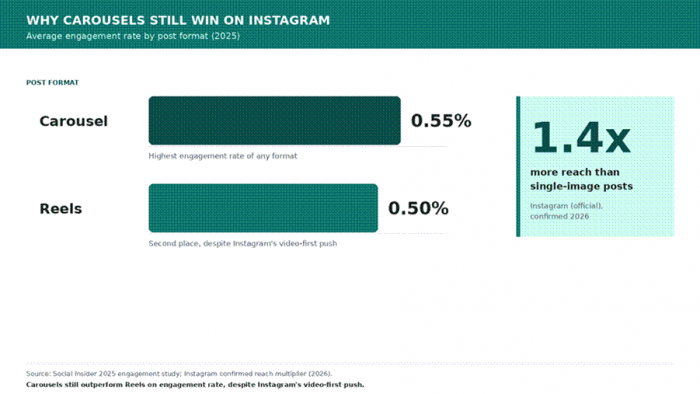
Third, longer carousels favour Instagram's own algorithm. Carousel posts already deliver 1.4x more reach than single-image posts according to data Instagram has confirmed, and 3.1x more engagement than regular posts according to ContentStudio's analysis of carousel performance. More slides means more swipes, more dwell time, and more signals that the algorithm weights heavily in feed ranking.
“The expanded limit changed how creators can package content. It did not change the basic rule that every slide has to earn its place.” Attribution: ClipCreator, 2026.
The rollout was deliberately slow. Some accounts saw 20 in August 2024. Others still see 10 in early 2026, particularly older accounts and certain business account types, with availability depending on app version, region, and device compatibility.
How many slides actually work best
The cap is 20. The optimal number is much lower, and the gap between “what is allowed” and “what performs” is where most creators leave engagement on the table.
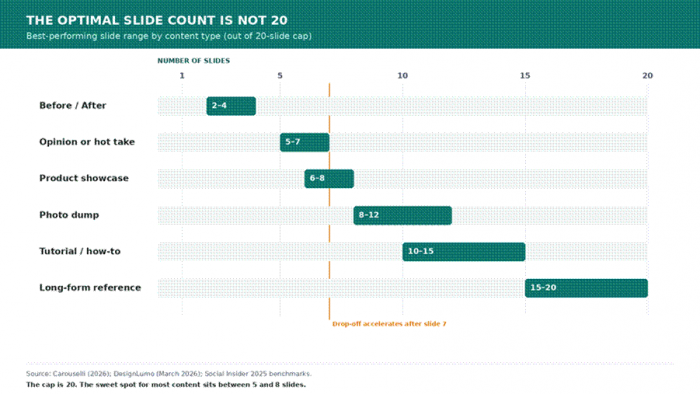
Figure 3. Optimal slide-count ranges by content type. Drop-off accelerates past slide 7 for most formats.
| Content type | Optimal slide count | Why this range works |
|---|---|---|
| Photo dump | 8 to 12 | Enough variety for a story arc, not so many that pacing slows to a crawl. |
| Tutorial or how-to | 10 to 15 | One action per slide keeps each step digestible. |
| Product showcase | 6 to 8 | Enough angles for a buying decision without burying the call to action. |
| Opinion or hot take | 5 to 7 | Value lands fast or viewers swipe away. Carousels are not the place for slow builds. |
| Before and after | 2 to 4 | Comparison is the whole point. Extra slides dilute the impact. |
| Long-form reference | 15 to 20 | Only justified when the content genuinely needs the length, such as a detailed guide. |
Sources: Carouselli (2026); DesignLumo (March 2026); Social Insider 2025 engagement benchmarks.
The mechanical reason for these ranges is straightforward. Drop-off increases sharply after slide 7 for most content types. Slides 1 through 3 determine swipe-through rate. If those three slides do not earn the next swipe, slide 12 will not save the post regardless of how strong it is.
Social Insider's 2025 research put the average engagement rate for carousels at 0.55%, compared with 0.50% for Reels. Carousels remain the highest-engagement format on Instagram. Hitting the 20-slide cap does not unlock that engagement on its own. Tight pacing does.
Quirks most people run into
A few specifics that catch even experienced users off guard.
Photos and videos share the same 20 slots
There is no “10 photos plus 10 videos” arrangement. A carousel can be 20 photos, 20 videos, or any mix totalling 20.
Third-party schedulers are often behind
Tools that use the Instagram Graph API still enforced the 10-slide limit through much of 2025, because the API lagged the consumer app. Native posting through the Instagram app is the only guaranteed way to access the full 20-slide cap. Buffer, Later, Hootsuite, and most other schedulers caught up at different speeds.
Auto-compression is the real quality killer
The 30 MB per-image cap is generous, but Instagram compresses everything on upload. Pre-sizing each slide to the correct aspect ratio (1080 by 1080 pixels for square, 1080 by 1350 for portrait) is the single most important step for maintaining quality across all 20 slides. Skipping this step is why carousels often look softer than the source files.
Older accounts may still see 10
The rollout is gradual and not strictly tied to account age, app version, or region. Some users on the latest app version still report a 10-slide cap. The workaround is to update the app, restart, and check again. There is no setting to toggle and no support ticket that will speed it up.
What changed in early 2026
Instagram added the ability to reorder slides on already-published carousels in March 2026. The control lives under Edit Post and lets users drag slides into a new order without losing the engagement metrics on the post. Deleting individual slides became possible in the same update.
What still cannot be changed after publishing:
| Action | Possible after publishing? |
|---|---|
| Reorder existing slides | Yes (added March 2026) |
| Delete individual slides | Yes (added March 2026) |
| Add new slides to a published carousel | No |
| Replace an existing slide with new content | No |
| Change the slide count upward | No |
The practical effect: cover-slide mistakes are now fixable without losing the post's engagement history. Content mistakes still require a full delete and re-upload, which resets all likes, comments, and shares to zero.
Instagram is also testing per-slide engagement insights in 2026. Creators will eventually see which specific slide earned a like and which slide lost viewers. Metricool confirmed Instagram is actively testing this feature as of January 2026, though it has not rolled out broadly yet.
Numbers worth remembering
| Metric | Value | Source |
|---|---|---|
| Maximum carousel slides | 20 | Meta Help Center, 2026 |
| Optimal slide range | 5 to 8 | Carouselli, 2026 |
| Average carousel engagement rate | 0.55% | Social Insider, 2025 |
| Average Reels engagement rate | 0.50% | Social Insider, 2025 |
| Carousel reach vs single post | 1.4x | Instagram (official), 2026 |
| Carousel engagement vs single post | 3.1x | ContentStudio analysis |
| Maximum file size per photo | 30 MB | Meta Help Center |
| Maximum file size per video | 4 GB | Meta Help Center |
| Drop-off acceleration point | After slide 7 | DesignLumo, March 2026 |
| TikTok's comparable photo cap | 35 | Swipe Insight, 2024 |
These numbers shift slowly. The 20-slide cap has held since August 2024 and looks stable through late 2026. The next likely change is on the API side, where third-party tools are still catching up to the consumer app's capabilities. A further increase to match TikTok's 35-slide cap is plausible but not currently signalled by anything Instagram has shipped.
Closing thoughts
So the short answer is 20 photos. The honest answer is more nuanced than that, and worth holding in mind the next time the gallery is overflowing on a Sunday night.
You can post 20. You probably should not, most of the time. The cap doubled because Instagram's algorithm rewards longer dwell time and because TikTok forced the move, not because 20 is the magic number for any single post. The optimal range still sits between 5 and 8 slides for most content types, with carousels rewarding tight, purposeful sequences over padded ones.
The history is worth keeping in mind too. Seven years at 10 slides shaped a generation of Instagram habits, and the doubling to 20 in 2024 quietly reshaped what feels normal on the feed. Photo dumps got longer. Tutorials got deeper. The platform leaned into long-form image content at exactly the moment everyone else assumed short video had won.
Whatever the next change brings, the working principle stays the same. Every slide should earn its place. The cap is just permission to keep going. The decision to stop earlier is usually the one that gets the post saved, shared, and remembered.