

Table of Content
- Does a right to publish include AI training rights?
- Peel the archive into layers
- Look at the work around the content
- Can AI-generated content go into a licensed archive?
- Watch for personal and confidential context
- Where a company assessment fits
- What should a marketing operator do first?
- About the founder
Pull up your brand's best-performing post from last year. The caption came from your copywriter. The image came from a stock library. The audio was a licensed track. The star of the video was a happy customer who signed a release for a campaign.
That's one post with at least four permissions to check. Copyright, stock and music licenses, contractor agreements and a customer's release are different kinds of rights; they do not necessarily mean four different owners.
For most marketing work, that's fine. You had the rights you needed to publish. But the moment someone asks whether the company could license its content archive for AI training, those layers suddenly matter a great deal.
THE SHORT VERSION
- A finished post can combine company-owned work with stock, music, contractor and customer inputs, each under different terms.
- A right to publish an asset doesn't automatically include a right to grant AI training uses to another party.
- The most useful records may be the work around the content: briefs, revisions and decisions.
Does a right to publish include AI training rights?
Permission to publish an asset does not automatically establish permission to grant AI training rights over it.
Stock licenses, music agreements, freelancer contracts and customer releases can define different channels, purposes and onward rights. A new use, especially granting rights to an outside party, needs a fresh look at each one. Your scheduling dashboard can open everything; that settles nothing about external licensing.
Peel the archive into layers
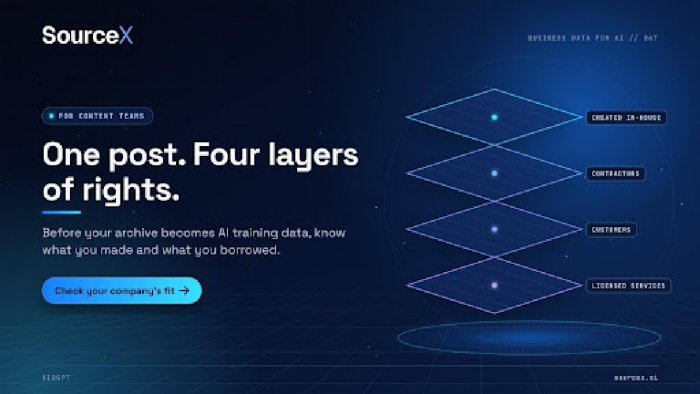
Start by sorting content into four buckets:
- Created in-house: copy, designs and strategy your team produced
- Supplied by contractors: check what the contract assigned or licensed
- Provided by customers: testimonials, user content, case stories
- Licensed from services: stock imagery, fonts, music, templates
Then check the agreements for the proposed use. The answer can differ by media type. Text you wrote may be clear. The video it sits inside may not be.
An illustrative example: a product video shot in-house, scored with a track licensed for social advertising, featuring a customer under a campaign release. The company may own the footage if its employment or contractor arrangements establish that. The music license and customer release still need checking for the proposed AI use; permission for a campaign does not settle the new use.
Some material will need excluding, and that's normal. The asset that performed best in a campaign may still be the least straightforward one to license.
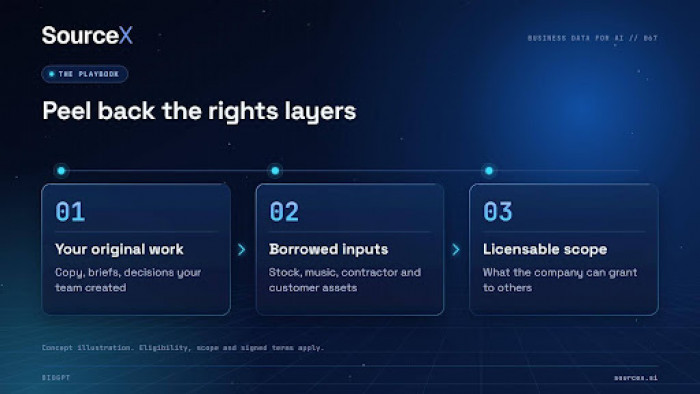
Peel back the rights layers: Your original work, Borrowed inputs, Licensable scope. Concept illustration, not measured performance or a completed transaction.
Look at the work around the content
Here's what many marketers miss. The finished posts may be the least distinctive part of the archive.
The surrounding business record can be richer: approved briefs, revision rounds, documented decisions about tone or targeting, and the performance discussions that shaped the next campaign. Those records show how a team works, provided they're suitable and authorized for the proposed use.
Keep them separate from third-party audience profiles or platform analytics, which often carry their own reuse restrictions. A good first description states which activity the records explain and what context and outcome evidence exist.
Can AI-generated content go into a licensed archive?
Not as a stand-in for real history. An AI-written caption can do its marketing job perfectly well. It shouldn't be represented as years of original human operating records.
SourceX's current supplier terms include a confirmation that data was not created or altered with AI for the sale. That requirement concerns the provenance of the offered records, not the appearance of the finished marketing asset. Using invented examples to learn a format or test a template is one thing. Generating material to inflate a commercial collection is something else entirely. Keep those purposes apart, and preserve the true provenance of what already exists.
Watch for personal and confidential context
Customer stories, campaign debriefs and internal approvals can contain information that was never meant for another use. Get the relevant review before anything is extracted.
And remember that removing names doesn't make a distinctive campaign unrecognizable. A launch that only one brand ever ran can identify itself. Preparation should account for context and document its limits.
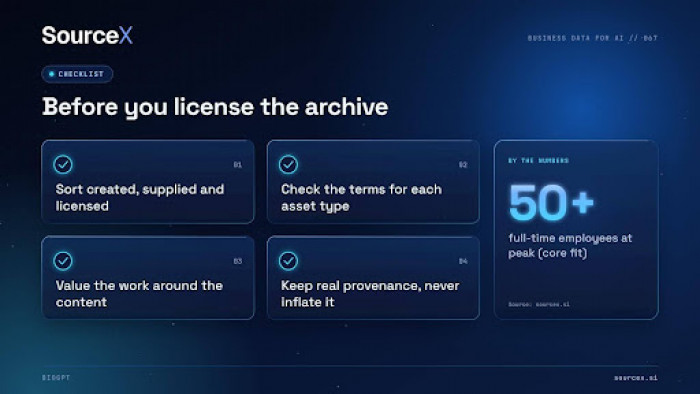
Before you license the archive. Four takeaways from the article; the text supplies the full context and conditions.
Where a company assessment fits
If the archive is part of a larger operating history, a structured assessment can help. SourceX licenses approved business data directly from companies for AI training and evaluation. The company signs with SourceX, which manages the agreement, preparation and payout under signed terms. It is not a blanket purchase of social posts.
It's built for companies with 50+ full-time employees at peak and several years of operating history, and the first fit check needs no uploads. SourceX advertises payouts of up to $4 million, an upper bound that applies only to the largest enterprise datasets and is not a typical or guaranteed amount.
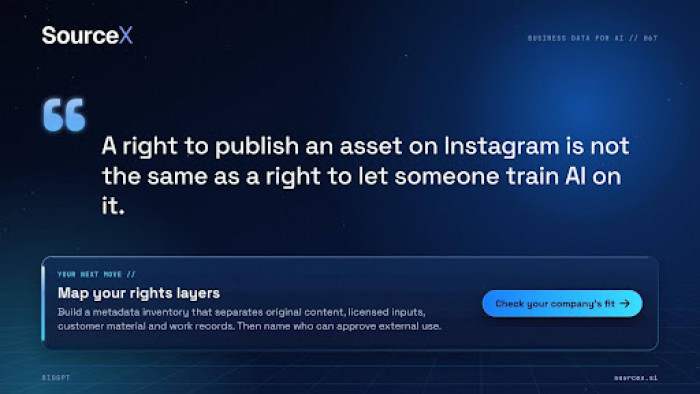
Map your rights layers. Build a metadata inventory that separates original content, licensed inputs, customer material and work records. Then name who can approve external use.
What should a marketing operator do first?
Build a metadata inventory that separates original content, licensed inputs, customer material and the work records around them. Then identify who in the company can approve an external use.
That map turns a vague idea into something a business can assess. Then go back to last year's best post and label each layer. If your team can do that for one post, it can do it for the archive.
Explore company eligibility with SourceX before offering the archive. Start with a description of the business and the rights questions your inventory has uncovered.
About the founder
Noah Loul is a four-time founder and the founder and CEO of SourceX, which licenses business data directly from companies for AI training and evaluation. He previously founded B2B Rocket, acquired by Blackpearl Group. His work focuses on building permission-based data infrastructure for AI.