


Table of Content
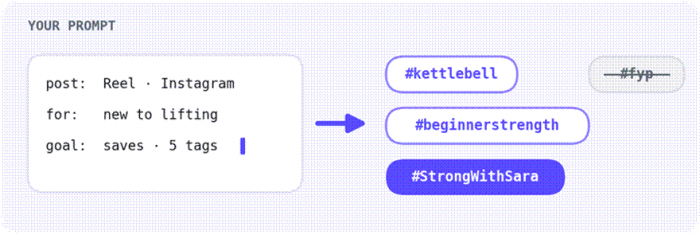
From a detailed prompt to a usable, on-brand set of hashtags.
THE 30-SECOND VERSION # Name the platform and how many tags you want. Both change with the network. # Describe the actual post: topic, format, and who it is for. # Say what you want the post to do: reach, saves, engagement, or follows. # Ask for a mix of broad, niche, and branded tags, not five of the same size. # Tell it what to skip, and ask for a few sets so you can pick and rotate. |
You open an AI tool, type "give me hashtags for my post," and the results come back looking like filler. The tool is not the problem. It did its best with what you handed it, which was almost nothing. Hashtag generation mirrors its input more closely than almost any other task. The more you tell the model about your platform, your content, your audience, and the result you want, the closer its suggestions land to something you would actually publish.
Below are the ten things worth putting in a prompt, in the order you would build one, plus tables and templates you can drop straight into your own workflow. Use the first five for a quick post. Use all ten when a post is worth getting right.
Your prompt matters more than the tool
Most hashtag tools, including the ones built into the platforms themselves, run on the same kind of general-purpose models. What separates a useful result from a throwaway one is the brief, not the brand on the box. This is why you can pull generic tags from one prompt and genuinely sharp ones from another using the identical app.
The numbers back this up. Targeted, niche hashtags have been found to drive somewhere between 12 and 40 percent more engagement than generic stuffing, depending on the platform, and niche tags tend to beat broad mega-tags by roughly three times on a reach-to-engagement basis. Those niche tags only surface when your prompt gives the model enough to find them. Vague in, vague out.
Reported engagement gains when hashtags are targeted rather than generic. Figures vary by account and study.
The platform you are posting on
The single most useful thing you can name is the platform, because every network treats hashtags differently. A prompt that says "for Instagram" or "for a LinkedIn post" lets the model apply the right count, tone, and placement instead of guessing. The differences are not cosmetic. Instagram and Meta now point you toward three to five hashtags, and the posting interface nudges toward five. X rewards restraint with one or two. Pinterest, which works more like a visual search engine, happily takes ten to fifteen.
Leave the platform out and you are asking the model to average across all of them, which is how you end up with twenty hashtags on a network that punishes anything over two. Use this as your reference:
| PLATFORM | SWEET SPOT | WHAT TO TELL THE PROMPT |
|---|---|---|
| 3 to 5 | Ask for five, mixed broad and niche | |
| TikTok | 3 to 5 | Trending, plus niche, plus one branded |
| 3 to 5 | Three industry-specific tags is the safe center | |
| X (Twitter) | 1 to 2 | One or two only; more lowers engagement |
| 1 to 3 | Use sparingly; heavy tagging reads as spam | |
| YouTube | 3 to 5 | Never pass 15 or every tag gets ignored |
| 10 to 15 | More is fine; it works like visual search | |
| Threads | 3 to 5 | Treat it much like Instagram |
Recommended hashtag counts by platform, based on 2026 platform guidance and engagement studies.
A specific description of your content
"My post" tells the model nothing, and your hashtags can only be as relevant as the description you give. Spell out what the post actually is: the topic, the format, and the angle. "A carousel on three budgeting mistakes first-time freelancers make" gets you far sharper tags than "a finance post." If you are tagging a Reel, a static image, a thread, or a long video, say so, because format shapes which communities are worth targeting.
Many AI hashtag tools, including Meta's, let you attach the image or video directly, which removes the guesswork entirely. Meta's own rule of thumb is a good test: include the details you would need if you were writing the hashtags for someone else, and leave out the rest.
Who the post is for
Audience is the difference between a tag that reaches strangers and a tag that reaches the right strangers. Tell the model who you want to find this post: their interests, their level of expertise, their region if location matters. A prompt aimed at "experienced home bakers in the UK" will surface different communities than one aimed at "people who have never baked before."
The data rewards specificity. On TikTok, relevant niche tags have been linked to around 40 percent more views, while generic ones add little measurable lift. Naming your audience is how you steer the model away from those crowded, low-signal tags and toward the communities that actually engage.
The goal you are optimizing for
Reach, engagement, saves, follows, and community-building are not the same objective, and they call for different tags. Name the goal and the model can weight its suggestions accordingly. If you want broad discovery, it can lean on a higher-volume tag. If you want qualified engagement from a smaller, invested audience, it should lean niche, because smaller communities tend to interact at a higher rate even when raw reach is lower.
State the outcome plainly: "I want saves from people who will actually try this recipe," or "I want this in front of recruiters in fintech." The clearer the goal, the less generic the output.
How many hashtags you want
This is the constraint people most often leave out, and it is the one the platforms care about most. Give the model a number, and tie it to the network. The penalties for getting it wrong are measurable. On X, one or two hashtags have correlated with roughly 21 percent higher engagement than none, while three or more have been linked to a 17 percent drop. On YouTube, going past fifteen tags does not just waste the extras, it makes the platform ignore all of them.
If you would rather not pick a number, ask the model to use the platform's recommended range. "Give me five for Instagram" or "no more than two for X" keeps the output publishable from the start.
The mix of hashtag types you want
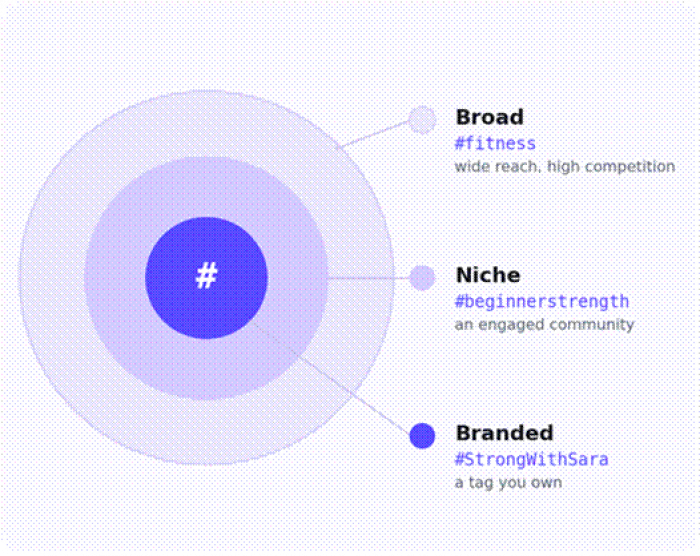
The strongest hashtag sets are rarely all the same size. A reliable structure used across LinkedIn, TikTok, and X blends three kinds of tag, and asking for that mix by name beats a flat request every time. A line like "give me one broad industry tag, two niche community tags, and one branded tag" maps straight onto how the algorithm reads your post.
A balanced set blends broad reach, a niche community, and a branded tag you own.
| TAG TYPE | WHAT IT DOES | EXAMPLE |
|---|---|---|
| Broad | Casts a wide net. High volume, heavy competition, short shelf life. | #fitness |
| Niche | Reaches a specific, engaged community. Lower volume, higher interaction. | #beginnerstrength |
| Branded | A tag you own that builds a searchable archive of your content over time. | #StrongWithSara |
Left to its own devices, a model often hands back five tags of the same size, which is the most common way reach gets diluted. Spell out the mix and you avoid that by default.
Your brand voice and any tags you own
If your hashtags are going on a brand account or a consistent personal brand, the tone of the tags should match the tone of your content. A playful skincare brand and a B2B compliance firm should not be handed the same register of hashtags. Add a sentence on your voice, and name any branded or campaign hashtag you already use so the model folds it in rather than inventing a competing one.
This is also where you protect consistency. Repeating the exact same five tags on every post can read as spammy to the algorithm, so ask the model to keep your branded tag fixed while rotating the rest across posts.
What you do not want it to use
Telling the model what to avoid is as useful as telling it what to include. Saturated and banned tags work against you, so hand the model a short blocklist. Here is what to keep out, and what to reach for instead:
| AVOID | WHY IT HURTS | REACH FOR INSTEAD |
|---|---|---|
| Mega-tags like #love or #photooftheday | Over a billion posts each. No real signal, so you are buried in seconds. | A specific niche tag tied to the post |
| Generic bait like #FYP or #followforfollow | Almost everyone uses it, so it carries no classification value. | A community tag that describes the actual content |
| The same five tags on every post | Reads as spammy and caps how many audiences you can reach. | Rotate the set; keep only your branded tag fixed |
| An off-topic trending tag | The algorithm spots the mismatch and cuts your reach. | A current trend that genuinely fits, paired with niche tags |
Put that list in your prompt, for example "avoid generic tags like #FYP and anything over a billion posts," and the model spends its suggestions on tags that can actually surface your content.
The format you want the output in
How the model returns the hashtags decides how fast you can use them. If you want them grouped by type, ask for that. If you want them ready to paste, ask for them on one line with no commentary. If you are feeding them into a tool or a spreadsheet, request a specific structure, such as a plain list or labeled categories.
Ask for several sets, too. Picking the best of three or four variations is faster than perfecting a single set, and it leaves you a small bank of tags to rotate across future posts, which helps you sidestep the repetition penalty above.
Examples and context from what already works
The fastest way to lift the quality of AI-generated hashtags is to show the model what good looks like for you. Paste in a past post that performed well, along with the hashtags it used, and ask for more in that spirit. If you track hashtag performance, tell the model which tags have driven saves or reach and which have flopped. That grounds the suggestions in your real audience rather than a generic notion of your niche.
Context is also where timing belongs. If you want to ride a current trend or a seasonal moment, say so, and pair the trending tag with your evergreen niche tags so the post works in both the short and the long term.
Putting It All Together
Here is how the elements come together. Start with a template you can fill in, then compare the same request written weakly and well.
STEAL THIS TEMPLATE
I'm posting [format: a Reel / carousel / thread] on [platform] about [topic and angle]. My audience is [who they are, their level, their region]. My goal is [reach / saves / engagement / follows]. Give me [number] hashtags: [the mix, e.g. one broad, two niche, one branded #YourTag]. Avoid [tags to skip], and give me three sets to choose from, each on one line. |
A WEAK PROMPT
| Give me some hashtags for my fitness post. |
A STRONG PROMPT
I'm posting a 30-second Reel on Instagram showing three beginner-friendly kettlebell moves. My audience is women in their 30s who are new to strength training. My goal is saves from people who will actually try the workout. Give me five hashtags: one broad fitness tag, two niche tags for beginner strength training, one community tag, and my branded tag #StrongWithSara. Avoid mega-tags with over a billion posts and avoid generic tags like #fitfam or #fyp. Give me three different sets to choose from, each on one line, ready to paste. |
Every part of that strong prompt is doing a specific job. Here is the same prompt mapped back to the ten elements:
| PART OF THE PROMPT | ELEMENT IT COVERS |
|---|---|
| "a 30-second Reel on Instagram" | #01, #02 |
| "women in their 30s, new to strength training" | #03 |
| "saves from people who will try the workout" | #04 |
| "five hashtags: one broad, two niche, one community" | #05, #06 |
| "my branded tag #StrongWithSara" | #07 |
| "avoid mega-tags and #fyp" | #08 |
| "three sets, each on one line, ready to paste" | #09 |
The strong version is longer, but every line you add takes a decision away from the model and hands it a fact instead. That is the whole trick.
The Prompt Checklist
Keep this beside you the next time you write a prompt. Each row is one thing to include and a quick way to phrase it.
| # | INCLUDE THIS | SAY IT LIKE |
|---|---|---|
| #01 | Platform | "for Instagram" / "for a LinkedIn post" |
| #02 | Content: topic, format, angle | "a carousel on 3 budgeting mistakes" |
| #03 | Audience | "for first-time freelancers in the US" |
| #04 | Goal | "I want saves" / "I want reach" |
| #05 | Count | "give me five" / "no more than two" |
| #06 | Mix | "one broad, two niche, one branded" |
| #07 | Voice and owned tags | "playful tone, include #StrongWithSara" |
| #08 | What to avoid | "no #FYP, nothing over a billion posts" |
| #09 | Output format | "one line, ready to paste, three options" |
| #10 | Examples | "more like this post: [paste it]" |
The Takeaway
Generating hashtags well has less to do with finding a magic tool and more to do with briefing the one in front of you. Every element on this list is a way of swapping a guess for a fact. Name the platform, describe the content, point at the audience, state the goal, set the count, ask for a mix, protect your voice, rule out the junk, fix the format, and show an example of what already works. Do that, and the change in output is not subtle. You stop editing generic suggestions and start approving ones that fit on the first try.