

Table of Content
TikTok appears to be pushing generative AI further into its everyday creator workflow, with a new feature called AI Imagine reportedly appearing inside the app’s Create tab. The feature has not been confirmed as a full global launch, but early signs suggest TikTok is testing ways to let users generate AI-powered visuals and video-style assets without leaving the normal creation flow.
That distinction matters. AI Imagine does not appear to be positioned as a separate professional tool or a desktop editor for advertisers. It seems designed for the same place where regular users already record, edit, remix, and publish short videos. If expanded more widely, it could make AI creation feel like a normal part of making a TikTok rather than a special feature reserved for advanced creators.
The reported feature appears alongside a broader set of AI creation tools, including Image to Video, Text to Video, and AI Transition. Together, they point to a larger shift inside TikTok: AI is moving from occasional effects and novelty filters into the actual timeline where videos are built.
AI Moves Into the Create Flow
AI Imagine is expected to let users create visual or video assets from prompts or uploaded material directly inside TikTok. While details remain limited, the most important part is its placement. A creator would not need to open another app, generate an asset elsewhere, export it, and upload it back to TikTok.
That lowers the barrier for casual creators. Someone could start with a photo, a product image, a travel shot, a meme idea, or a short written prompt, then use TikTok’s own tools to turn it into something more dynamic.
This kind of integration could also make AI video more common across the platform. When tools are built into the same screen where creators already edit, they tend to become part of regular posting behavior much faster than standalone apps.
From AI Alive to AI Imagine
TikTok’s earlier AI Alive feature already showed the company’s direction. AI Alive allowed users to animate a still photo into a short video inside Stories, adding movement, atmosphere, and visual effects directly from the app’s Story Camera.
AI Imagine appears to be a broader step in the same direction. AI Alive focused mainly on turning one photo into a moving Story. AI Imagine seems closer to a flexible creation tool that could sit nearer to TikTok’s main Create tab and support more types of visual generation.
That evolution is important because TikTok is not only trying to give users one AI trick. It is building toward a creation environment where AI can help generate clips, transitions, effects, and visual ideas while a video is being assembled.
In-Timeline AI Video
The idea of in-timeline AI video is especially important for creators. It suggests that AI tools may appear directly inside the editing process rather than before or after it.
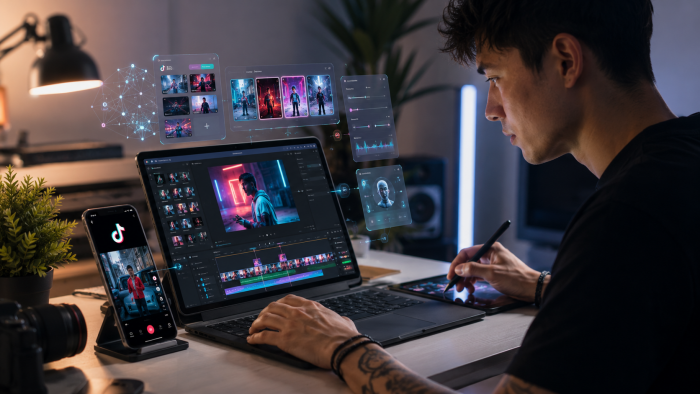
That could change how short videos are made. A creator might generate a transition, turn a static image into a moving clip, create background visuals, or test a prompt-based scene while editing the same video. This would make TikTok feel less like only a publishing app and more like an AI-powered production workspace.
For many creators, speed is the biggest advantage. Short-form content moves quickly, and creators often need to respond to trends while they are still active. Built-in AI tools could help users move from idea to post faster, especially if they do not have advanced editing skills.
TikTok’s Bigger AI Strategy
TikTok’s AI push is not limited to everyday creators. The company is also adding AI across its business and advertising tools. Its broader creative suite for brands and agencies is designed to help generate video assets, campaign ideas, product visuals, and ad variations at scale.
A key part of that strategy is ByteDance’s video-generation technology, which is being integrated into TikTok’s advertising and creative products. These tools are meant to help advertisers create more consistent and polished video content from prompts, references, and campaign material.
That creates a two-track AI strategy. On one side, TikTok is making AI easier for normal users inside the Create tab. On the other, it is giving businesses more powerful tools to produce marketing content faster.
Safety and Labeling
As AI video tools become easier to use, transparency becomes more important. TikTok has already used labels and metadata for AI-generated Stories, helping identify synthetic content even if it is downloaded and shared elsewhere.
The company has also used safety checks for uploaded photos, prompts, and generated videos before posting. That matters because AI-generated video can create realistic people, places, and events. Without labels and moderation, the same tools that help creators could also make misleading content easier to produce.
TikTok has also experimented with controls that let users reduce how much AI-generated content appears in their feed. Those controls may become more important if AI creation becomes a bigger part of the platform.
What It Means for Creators
For creators, the key takeaway is that TikTok is becoming more self-contained. Users may soon be able to generate ideas, transform images, create clips, apply transitions, and publish without relying as heavily on outside tools.
That could make content creation faster and more accessible, but it may also make TikTok more influential over how videos look and feel. If the platform controls both the creation tools and the distribution algorithm, it can shape not only what gets seen, but how content is made in the first place.
AI Imagine should still be treated as a reported or limited feature rather than a confirmed worldwide rollout. But the direction is clear. TikTok is moving AI deeper into the native creator experience, turning the app from a place to post short videos into a built-in AI video studio.