

Table of Content
- Introduction
- Understanding RTPS in India
- What Is RTPS 4?
- Why RTPS 4 Exists in Government Portals
- Where Citizens Commonly See RTPS 4
- Does RTPS 4 Affect Approval or Rejection?
- Does RTPS 4 Affect Processing Time?
- Why RTPS 4 Means Different Things in Different States
- Common Myths About RTPS 4
- What Citizens Should Do If They See RTPS 4
- Final Thoughts: RTPS 4 Is Background Noise, Not a Decision
Introduction
Across India, state governments use RTPS (Right to Public Services) portals to deliver essential certificates and approvals in a time‑bound and transparent manner. When citizens apply online for services like caste, income, residence, birth, or death certificates, they sometimes encounter cryptic labels such as “RTPS 1”, “RTPS 2”, or “RTPS 4”. This often confuses, and many assume “RTPS 4” represents a stage, a higher priority, or even an approval or rejection code. In practice, RTPS 4 is part of the technical organization of services on certain portals, not a verdict on your application.
Understanding RTPS in India
The broader RTPS framework is about legal rights and service accountability, not just portal labels.
- RTPS stands for Right to Public Services and is implemented through state‑level laws.
- These laws mandate time‑bound delivery of notified public services and define consequences if officials do not comply.
- Citizens can apply for services like certificates, licences, and permissions under these Acts.
- Designated officers are identified for each service, with clear responsibilities and deadlines.
Most states have their own RTPS or Right to Service Acts, typically defining the citizen’s right as the right to receive specified services within a stipulated time frame. The core objective is to reduce corruption, bring transparency, and fix accountability in routine government service delivery. To make this scalable and user‑friendly, states have launched online portals often powered by common frameworks, where citizens can submit, track, and receive services digitally.
What Is RTPS 4?
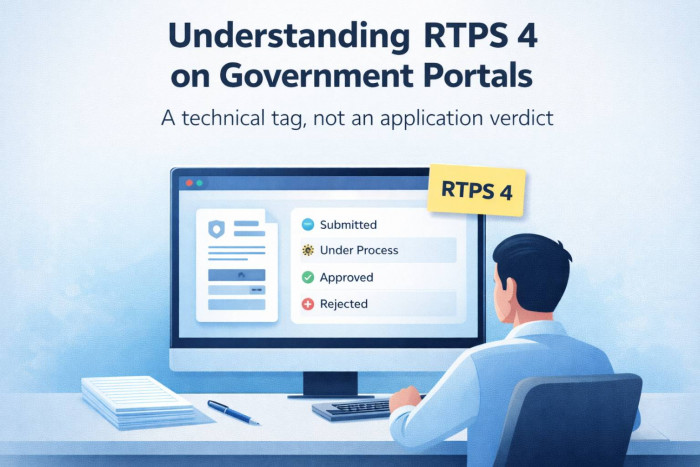
RTPS 4 appears mainly as a label within specific state portals and is tied to how services are technically grouped or deployed.
- It is generally used as a version, module, or bundle name within an RTPS portal environment.
- On some portals (like those in Bihar), RTPS 4 sits alongside labels such as RTPS or RTPS 2.
- These labels often correspond to phases of rollout, internal configurations, or sets of services.
- RTPS 4 usually refers to how a group of services is hosted or processed, not to individual application outcomes.
For citizens, RTPS 4 is visible in places like help pages, public guides, and sometimes in links or environment names. However, your application’s journey submission, verification, approval, rejection is still shown separately through familiar, human‑readable status messages.
Why RTPS 4 Exists in Government Portals
Technical teams managing large RTPS ecosystems need ways to categorize and maintain hundreds of services across many departments. RTPS 4 emerges from that internal need.
- Portals host numerous services that must be grouped for configuration and maintenance.
- Labels such as RTPS 1, RTPS 2, and RTPS 4 help distinguish different modules or deployment batches.
- They may correspond to:
- Particular phases of rollout.
- Specific infrastructure or server environments.
- Sets of services enabled at certain centres or departments.
- These tags simplify tasks like software updates, integration, and offline–online data sync.
For citizens, none of this changes the name of the service they are applying for (e.g., “Income Certificate”). The label RTPS 4 is essentially an internal pointer that the service belongs to a particular technical cluster on the backend.
Where Citizens Commonly See RTPS 4
You are unlikely to see RTPS 4 on every RTPS‑enabled website, but when you do, it usually appears in limited, non‑decision contexts.
- On state RTPS information websites or blogs explaining how to use the portal.
- In help pages or environment URLs that mention “RTPS 4” as part of the portal configuration.
- In training material and internal documentation used by officials and operators at service centers.
- Occasionally in headings or labels on login or menu screens that differentiate among RTPS environments.
By contrast, when you check your own application’s progress, you should see straightforward statuses like “Submitted”, “Under Process”, “Approved”, “Rejected”, or “Certificate Issued”. Those are the indicators that matter for your case not the RTPS 4 tag.
Does RTPS 4 Affect Approval or Rejection?
Approval or rejection is a legal and administrative decision, not a technical artifact. RTPS 4 does not have the power to change that.
Decisions are taken by designated officers based on:
- Eligibility criteria for the service.
- Documents submitted by the applicant.
- Relevant rules, circulars, and government orders.
- The officer issues an order, approval or rejection within the RTPS‑notified timeframe.
- The portal then updates the status to reflect the officer’s decision.
- RTPS 4, as a backend label, neither approves nor rejects applications.
So, if your application is rejected, the reason will be described in the status or order document. If it is approved, the system will indicate certificate generation or issuance. RTPS 4 is not a hidden code for either outcome.
Does RTPS 4 Affect Processing Time?
Processing time is governed by law and service notifications, not by the internal “RTPS 4” label assigned to a technical module.
- Each service has a notified time limit (e.g., 7 days, 15 days, 30 days).
- These time limits are part of the RTPS/Right to Service Act and related notifications.
- Officials can be held accountable if they fail to deliver within these timelines.
- Delays can trigger reminders, escalation, appeals, or penalties, depending on the Act.
Whether a service runs under RTPS 1, RTPS 2, or RTPS 4 does not change the legal obligation to deliver within the prescribed period. The label only reflects how the system is structured, not how long you must wait.
Why RTPS 4 Means Different Things in Different States
RTPS is a national reform idea implemented through state‑specific laws and IT systems. Because of this, internal naming conventions differ significantly.
- Each state has its own RTPS/Right to Service Act, rules, and digital portal structure.
- Some states emphasise RTPS branding, while others use names like e‑District, Lok Seva, or Sewa Kendra.
- Technical modules and environment labels are chosen by state IT teams, not centrally standardised.
- A label like RTPS 4 in one state may not exist, or may be used differently, in another state.
That means you cannot assume that “RTPS 4” in one portal has a national meaning. It is a local, technical shorthand, and in many states you may never encounter such a label at all.
Common Myths About RTPS 4
To make your article practical and citizen‑friendly, it helps to explicitly list and debunk the most common myths.
- “It means my application is in the final stage.”
- “RTPS 4 guarantees faster processing or VIP treatment.”
- “It is a coded way of saying my application is rejected.”
- “If my application is linked to RTPS 4, I get extra benefits under the Act.”
- “RTPS 4 is the same everywhere in India.”
In reality:
- Stages are clearly labelled as under scrutiny, approved, rejected, etc.
- Processing time is fixed by law and applies equally to all applications of that service.
- Rejection is always explicitly stated, often with reasons.
- Legal rights flow from the RTPS Act and notifications, not from internal labels.
- RTPS 4 is state‑specific and portal‑specific, not a nationwide code.
What Citizens Should Do If They See RTPS 4
If you are an end‑user on a government portal, you do not need to interpret or worry about RTPS 4. Focus on the elements that actually affect you.
Concentrate on:
- The service name (e.g., Income Certificate, Caste Certificate).
- Your Application ID or reference number.
- The status message shown on the portal.
- The notified time limit for that service.
Use the portal’s status tracking feature to see whether your application is:
- Submitted/received.
- Under process/under verification.
- Approved and certificate generated.
- Rejected (with or without reasons).
If anything is unclear, you can:
- Check the official FAQs or help section for status definitions.
- Visit or call the relevant service centre or department office with your Application ID.
- File an appeal or complaint if the notified time limit has been exceeded without a decision.
Treat RTPS 4 as a technical note in the background. The real “story” of your application is told by the status line, timeline, and any orders or certificates issued in your name.
Final Thoughts: RTPS 4 Is Background Noise, Not a Decision
RTPS laws were introduced to put citizens at the centre of public service delivery by guaranteeing time‑bound, transparent, and accountable services. Online RTPS portals are tools to operationalise those rights, and in building these systems, governments naturally use internal labels like RTPS 4 to manage their technology environments. For citizens and applicants, however, RTPS 4 is background noise—a technical label that does not decide approval, rejection, speed, or priority.
What truly matters for you is: which service you applied for, what documents you submitted, what status the portal shows, how the decision aligns with the RTPS timelines, and what appeal or grievance options you can use if something goes wrong. When viewed from that lens, RTPS 4 becomes what it really is: a harmless configuration tag, not a judgment on your application.