

Table of Content
Meta has expanded Pocket, its experimental AI-powered app for creating simple games and interactive experiences, to users in the United States.
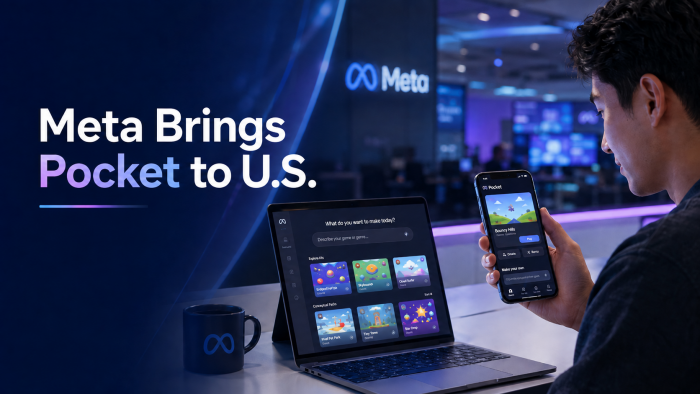
The app lets people describe an idea in natural language, then uses AI to turn that prompt into a playable mini experience. Users can adjust the result, publish it to their profile and allow others to play or remix it. Meta calls these creations “gizmos,” positioning Pocket as a new kind of social app where users do not just watch content, but interact with it.
The U.S. rollout follows a quieter test in Brazil earlier this year. Pocket appears to be available on iOS for now, with no direct messaging feature and no current integration with Instagram, Facebook or Meta’s other major apps.
How Pocket Works
Pocket is built around what has become known as vibe coding, where users create software-like experiences by describing what they want instead of writing code.
A user might ask the app to build a memory game, a quiz, a simple adventure, a personality test, a tap-based challenge or an interactive visual toy. Pocket then generates a playable version, which the user can revise through additional prompts.
Once shared, the gizmo appears in a vertical discovery feed that resembles short-form video feeds, but with one key difference: users play the content instead of only watching it.
That gives Meta a new type of AI-created social format. A game or interactive tool can be remixed by other users, which could turn one prompt into a chain of variations, similar to how audio trends, templates and memes spread across social platforms.
Built From the Gizmo Team’s Work
Pocket is closely tied to the team behind Gizmo, an AI startup founded by former Snapchat employees. Meta hired the engineering team earlier this year and took a non-exclusive license to the technology.
Gizmo had already gained attention as a “TikTok for interactive mini apps,” where users could create playful experiences from text, images, sound and touch. Pocket appears to carry forward that same idea under Meta’s ecosystem.
The timing is notable because the original Gizmo app is being wound down as Pocket expands. That makes Pocket less of a completely separate experiment and more of Meta’s version of an existing concept it moved quickly to absorb.
Meta’s AI App Push Continues
Pocket is part of a wider wave of standalone AI apps and experiments from Meta. The company has been testing faster product launches around AI-generated images, videos, community apps, shopping tools and lightweight social experiences.
Meta’s leadership has suggested that AI-assisted development could make it easier to ship new apps more quickly. Pocket fits that strategy because it tests two ideas at once: whether users want to create interactive software with prompts, and whether those creations can become a social feed.
If the model works, Meta could move beyond images, videos and chatbots into AI-generated apps as a form of content. A user would not need to learn game design or programming. They would only need an idea and a prompt.

The Social Content Shift
The bigger question is whether interactive AI creations can become part of everyday social behavior.
Short-form video became popular because it was easy to watch, remix and share. Pocket is trying to apply that same logic to playable experiences. A good gizmo could spread because it is funny, addictive, useful or easy to customize.
For creators, this could open a new format. Instead of posting a Reel or meme, someone could post a quiz, challenge, mini-game or branded interactive experience. For businesses, the app could eventually support simple product games, customer quizzes, educational tools or campaign experiences.
For now, Pocket remains experimental, and Meta has not announced broad integration with its larger platforms. That means its reach may depend heavily on whether users are willing to adopt another standalone Meta app.
Concerns Around Data and Safety
The app also raises privacy, safety and moderation questions.
Interactive AI content is more complex to moderate than a photo or video. A harmful image can be reviewed visually, but an interactive experience may need to be tested to understand what it does. It could request inputs, simulate behavior, remix into something different or create unexpected interactions.
There are also concerns about data use. AI-generated apps can produce valuable behavioral signals, including which prompts create engaging experiences, how users interact with them and which mechanics keep people playing. That data could help Meta improve its AI systems and recommendation tools.
Account control is another issue. Pocket requires a Meta account, and users may have limited separation between their Pocket identity and their wider Meta account. That could discourage people who want to test the app without tying it deeply to their existing Meta presence.
App Store Questions
Pocket may also face scrutiny because app stores have rules around apps that run or generate executable code. Since Pocket creates interactive experiences inside the app, Meta will need to ensure the system does not violate platform policies or allow unsafe behavior through user-generated content.
That could become more important if Pocket grows beyond simple games and starts supporting richer tools or more complex interactions.
What Happens Next
Pocket shows where Meta’s AI strategy is heading. The company is not only building AI assistants that answer questions. It is testing whether AI can turn ordinary users into creators of games, apps and interactive experiences.
The challenge is adoption. Standalone Meta apps have a mixed history, and users may not want another separate app unless the experience feels truly new.
Still, Pocket is a notable experiment. If people start treating AI-made mini games as social posts, Meta may have found a new content format for the AI era: not something to watch, but something to play, remix and share.