


Table of Content
Most people think they have a content problem. They sit down to plan a week of posts, stare at the calendar, and feel like they have already said everything worth saying. The well feels dry by Tuesday.
Here is the thing I keep coming back to after years of writing for social media: you almost never have an idea problem. You have a packaging problem. One decent idea is not a single post. It is raw material, and with a little patience you can pull ten social media posts out of it without repeating yourself or boring the people who follow you.
This guide walks through exactly how to do that. I will give you a real example and stretch one ordinary thought across ten different posts, then show you how to shape each one for the platform it lives on and batch the whole thing so it does not eat your week.
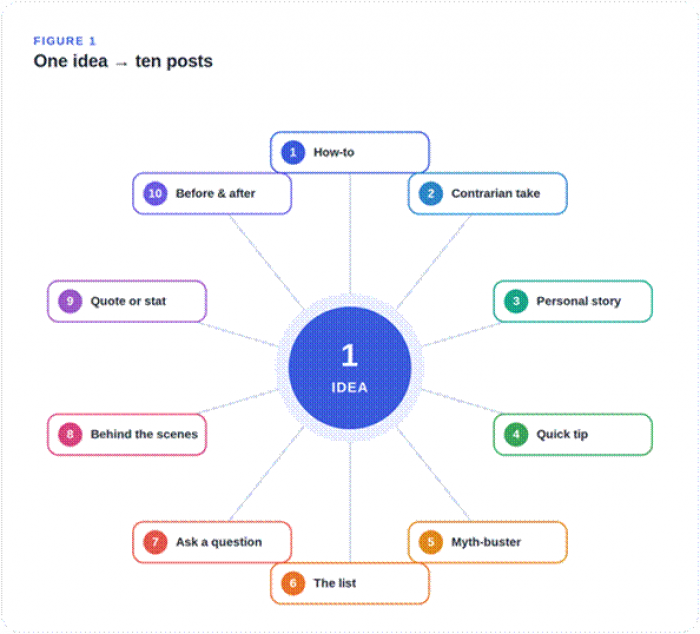
One idea sits at the center. Each spoke is a different post you can pull from it.
Why one idea is worth ten posts
A single idea has more surfaces than you think. There is the claim itself, the reason it is true, the story behind it, the mistake people make around it, the step-by-step of how to do it, and the result you get when you pull it off. Each of those is its own angle, and each angle speaks to a slightly different person.
Some of your followers want a quick tip they can use today. Others want the proof before they believe you. A few want to hear that you struggled with the same thing they are struggling with. When you carve one idea into many angles, you stop talking to the same person over and over and start reaching the whole room.
There is a practical reason too. People rarely see everything you post. Algorithms are moody, feeds move fast, and a good idea deserves more than one shot at being seen. Saying the same thing in five different ways is not lazy. It is how a message finally lands.
Start with one idea worth stretching
Before you split anything, pick a core idea that can carry the weight. The best ones usually share three traits.
First, they take a clear position. “Sleep is important” is too soft to build on. “You are probably sleeping in too late on weekends and wrecking your Monday” gives you something to defend.
Second, they come from your own experience. An idea you have lived through gives you stories, specifics, and the small details no one can copy. That is also what readers and search engines reward now: content that clearly comes from someone who has done the thing rather than someone summarizing the internet.
Third, they solve a real problem for the people you are trying to reach. If the idea makes someone’s day a little easier or settles a question they keep arguing about, it has legs.
For the rest of this guide I will use one example so you can watch it grow:
“You do not need an hour at the gym to get stronger.”
It takes a position, it is something plenty of people have learned the hard way, and it solves a real frustration. Let us turn it into ten posts.
The 10 posts, built from one idea
1. The straight how-to
Start with the most useful version: show people how to do it themselves. Break the idea into a short, ordered set of steps they can follow without you in the room.
For our example, that is a post like “How to get a real strength workout in 20 minutes.” You list three or four compound movements, suggest sets and reps, and explain why short and focused beats long and scattered. The how-to is the workhorse of your content because it gives immediate value, and useful posts get saved. Saves are quiet, and they often matter more than likes.
2. The contrarian take
Now flip the common belief on its head. People scroll past what they expect and stop for what surprises them.
“Spending two hours in the gym is probably making your results worse” is the same idea wearing a bolder jacket. You explain how longer sessions often mean lower intensity, junk volume, and skipped recovery. You are not picking a fight for the sake of it. You are giving a reason to rethink a habit. Keep the tone confident but fair, and back the claim up so it reads as insight instead of noise.
3. The personal story
This is the post that builds trust, and it is the one most people skip. Tell the story of how you learned the idea yourself.
Maybe you used to grind through ninety-minute sessions, burned out, quit for six months, then came back with short workouts and got stronger than before. Specifics make it real: the evening you almost did not go, the timer running on your phone, the moment you noticed less was working better. Stories like this are hard to fake and harder to copy, which is exactly why they connect. They also tell readers that a real person with real experience is behind the advice.
4. The single tip
Strip the idea down to one thing someone can use in the next ten minutes. No setup, no story, just a clean piece of advice.
“Pick the heaviest weight you can lift for five clean reps, and stop there. That is the whole session some days.” Short posts like this are easy to read, easy to save, and easy to forward to a friend in a group chat. They also work well as the opening line of a longer post, so you can put them to work more than once.
5. The myth you want to bust
Find the false belief that surrounds your idea and take it apart. Myth-busting works because it gives people permission to drop a rule they secretly hate following.
“Myth: more sets always mean more muscle.” Then you explain what is really going on, calmly and clearly. The trick is to name the myth plainly in the first line so the right person feels called out in a good way, then deliver the correction without sounding smug about it.
6. The list
Lists are easy to scan and easy to finish, which is why they tend to perform. Turn your idea into a short, themed list.
“5 exercises that give you the most strength for the least time.” Each item gets a line or two. You are covering the same ground as your how-to, but the format feels different enough that it will not read as a repeat. Lists also travel well as carousels and as the skeleton for a short video, so this one post can quietly become three formats.
7. The question
Sometimes the smartest move is to stop talking and ask. A good question pulls people into the comments, and comments tell the platform your post is worth showing around.
“What is the shortest workout that has ever really worked for you?” You are inviting your audience to share their own version of your idea. Their answers become social proof, hand you fresh material for future posts, and make people feel like part of a conversation rather than an audience being lectured at.
8. The behind-the-scenes
Show the messy, real, in-progress version of the idea. People are tired of polish, and they lean toward the human stuff.
Film yourself doing your real 20-minute session, sweat and all, with no fancy editing. Or share a photo of the scribbled notebook where you track your lifts. This kind of post does two jobs at once: it proves you practice what you preach, and it makes you relatable. It also takes almost no effort to make, which is a gift on a busy week.
9. The quote or number
Pull a single sharp line or a striking number from your idea and let it stand on its own. This is the most shareable format there is.
It might be a stat (“3 sets, 20 minutes, twice a week is enough for most people to get noticeably stronger”) or a line worth remembering (“Strength is built in the reps you can repeat, not the ones that wreck you”). Put it on a clean graphic or say it straight to camera in the first three seconds. People share these because they capture something the person already believed but could not quite put into words.
10. The before-and-after
End with proof, because results are what make a stranger trust you. Show the change the idea produced.
For our example, that is a simple comparison: the weight you could lift before you switched to short sessions and the weight you can lift now, or how your week looked when workouts ate two hours versus thirty minutes. You do not need a dramatic transformation. A small, honest result told well is more convincing than a flashy one that feels staged. Tie it back to the idea so the lesson is clear: the change came from the approach, not from luck.
Make each post fit its platform
The angle stays the same. The shape changes depending on where it lives. A how-to that works as a long caption in one place becomes a carousel in another and a thirty-second video somewhere else. You are not rewriting the idea. You are dressing it for the room.
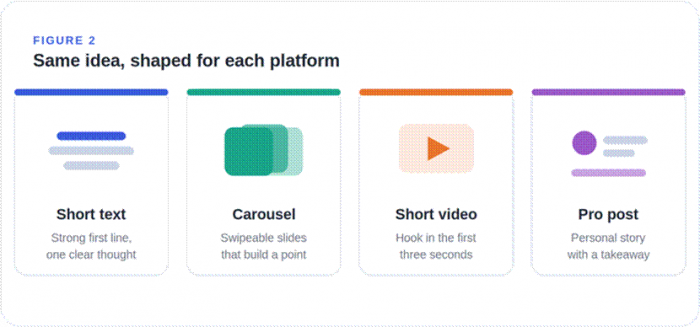
The angle stays the same. Only the format changes to fit the platform.
A rough rule of thumb helps here. Short text platforms reward a strong first line and a single thought. Visual platforms reward the carousel and the clean graphic. Video platforms reward the first three seconds and a clear payoff. Professional networks reward the personal story with a takeaway at the end. Take each of your ten posts, ask which format suits the angle best, and build that version first.
Batch it so it does not run your week
Doing all this one post at a time is exhausting. The reason the method works is that you do it in a single sitting.
Block ninety minutes. Spend the first fifteen choosing your one idea and jotting the ten angles as quick headlines. Then write all ten in a row while your head is still inside the topic. Do not polish yet. Get the rough version of each one down, take a short break, then come back and tighten them. Finally, sort them across two or three weeks so the same idea is not landing on the same day. One focused session can fill most of a month.
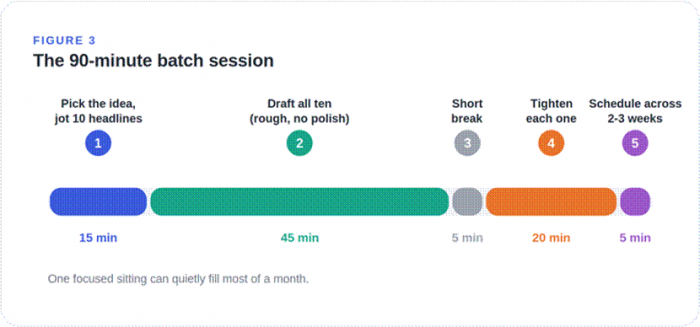
A single ninety-minute block, start to finish.
A few mistakes to skip
The biggest one is making all ten posts say the same thing in the same voice. The angle itself has to change, or your audience will feel the repetition even if they cannot name it. Read your ten back to back and cut any that blur together.
The second is stretching a weak idea. If you are forcing the tenth angle and it feels thin, stop at seven. The quality of the angle beats hitting a round number.
The last one is dropping the personal layer to save time. The story, the behind-the-scenes, the honest result: those are the posts that separate you from everyone else repackaging the same advice. They take a little more nerve, and they are worth it.
The takeaway
You are sitting on more content than you think. The next time the calendar feels empty, do not reach for a brand new idea. Take one thing you already know to be true, one thing you have lived, and turn it slowly over in your hands. Look at the claim, the reason, the story, the steps, the myth, and the result. Ten social media posts are usually hiding inside a single good thought. Your job is just to give each one its own shape and let it out.