

Table of Content
It’s Tuesday afternoon. You meant to post yesterday. And the Thursday before that. Your account isn’t dead, exactly. It’s just gone quiet. You have half-formed ideas somewhere, but every time you sit down to actually post, the blank caption box wins.
If that sounds familiar, here’s the good news: you don’t have a discipline problem. You have a workflow problem. And workflow problems are fixable.
Most advice just tells you to “stay consistent,” which is a bit like telling someone stressed about money to “just save more.” True, useless, and a little annoying. What actually works is changing the system so that consistency stops depending on whatever mood you woke up in. That is the entire job of an AI content calendar. Let’s walk through why consistency matters this much, why you keep slipping, and a simple system that fixes it for good.

Plan the whole month in one sitting, then let the calendar carry it.
Consistency Wins, and It’s Honestly Not Close
Before you change anything, it helps to see the size of the prize. The data here all points the same direction.
Creators who posted at least once a week for 20 weeks or more saw engagement rates 4.5 times higher per post than people who posted whenever the mood struck, according to a consistency analysis in Dreamgrow’s 2025 round-up. Buffer’s look at more than 100,000 users found the same shape: accounts that post on a steady rhythm pull in roughly five times the engagement of accounts that post in random bursts.
Buffer also studied around 4.8 million channel-weeks and found something they nicknamed the “no-post penalty.” Whenever an account went silent for a week, it reliably underperformed its own normal growth. Here’s the part you’ll like, though: almost any consistent posting beat going quiet. You don’t have to be brilliant every single time. You mostly just have to not disappear.
The one number to remember Post at least weekly for 20+ weeks and you can see 4.5× higher engagement per post. The win comes from rhythm, not from going viral. |
And here’s the twist that takes the pressure right off: consistent does not mean constant. ZoomSphere studied more than 25,000 profiles and found engagement often peaks at just one or two strong posts a week, then gets shakier as the volume climbs. So the goal was never “post more.” It’s “post a sane amount, every single week, without fail.”
What counts as sane? Treat these as starting ranges, not commandments:
| Platform | Sustainable cadence | What the data suggests |
|---|---|---|
| 3 to 5 / week | Mix static images, carousels, and Reels | |
| 2 to 6 / week | Consistency drives reach more than format | |
| TikTok | 3 to 5 / week | Highest engagement; recency gets rewarded |
| 1 to 3 / week | Low competition, strong B2B engagement | |
| X / Threads | Daily, short bursts | Cheap to post; reply early and often |
Pick the low end of whatever fits you. A rhythm you can actually keep will beat an ambitious schedule you abandon by February, every time.
Let’s Be Honest About Why You Keep Falling Off
If trying harder worked, you would already be consistent. You’re not slipping because you’re lazy. You’re slipping because the usual way of posting is quietly built to fail. See how many of these land:

The “I’ll post later” moment is a workflow problem, not a willpower one.
• The blank-page tax. Every post hits you with a pile of questions at once. What do I post? Which platform? What’s the angle? What’s the caption? When? Answering all of that from scratch, every day, is exhausting. Eventually you just don’t.
• The batch you never batch. You keep meaning to plan a whole month in one sitting. Then the week eats you alive and you’re improvising something ten minutes before lunch again.
• The “it has to be good” spiral. Caring about quality makes each post slower. Slower posts make a steady cadence feel impossible. So you burn out, or you quietly ghost your own account.
• Real life. A launch, a trip, a head cold, a busy season. Consistency always breaks at the worst possible moment, which is exactly when a calendar you filled in advance saves you.
Notice that none of these are creativity problems. They’re friction problems. Take the friction away and the consistency mostly takes care of itself.
What an AI Calendar Actually Does for You
Forget the hype for a second. An AI content calendar is just a planning system where the AI handles the boring, repetitive heavy lifting (ideas, first-draft captions, reshaping one idea into five, suggesting good times to post) while you keep your hands on the wheel for strategy, voice, and the final yes or no.
Think of the difference between staring at an empty page and editing a solid first draft. The AI doesn’t decide who you are or what you stand for. It just kills the cold-start friction, so showing up no longer depends on having a great, high-energy day. You move from reactive scrambling to a calm, repeatable routine. You plan once, and the system carries the rest.
The reframe that makes it stick An AI calendar doesn’t make you a more disciplined person. It makes consistency need less discipline, which is exactly why it actually works. |
Your 7-Step System (Steal This)
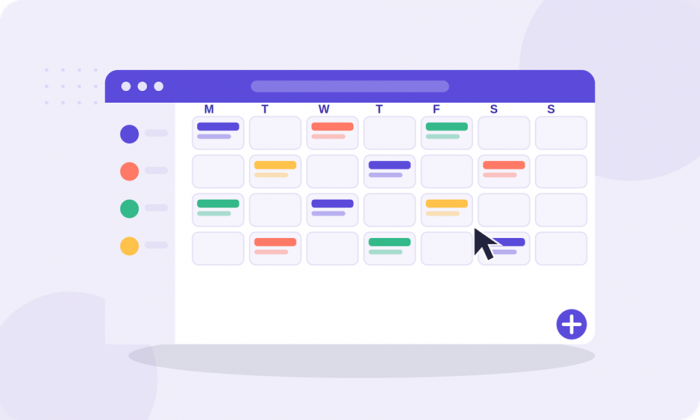
Here’s a system that works whether you’re a solo creator or a small team, and whether your “AI calendar” is a dedicated scheduling tool or just a chat assistant paired with a simple planner.
1. Set a cadence you can survive
Start with what you could keep on your worst week, not your best. Three solid posts a week, held all year, will quietly beat a daily streak that dies in three weeks. Lock that rhythm in first. Everything else fills in around a number you’ve already promised yourself.
2. Give the AI guardrails
Generic prompts make generic content, which is the fastest way to sound like everyone else. Before you generate anything, write down three to five content pillars: the themes you actually want to be known for, like quick tips, behind-the-scenes, customer wins, hot takes, and product updates. Feed those to the AI as standing context. Now every idea it gives you is anchored to your strategy instead of drifting off into filler.
3. Generate a whole month in one sitting
This is where the time savings actually live. In one focused session, ask the AI to draft a month of post ideas mapped to your pillars and cadence, then turn the keepers into caption drafts. Teams that adopted AI content tools report producing about 3.8 times more content per person each month (HubSpot), not by working longer hours, but because the first draft stopped being the bottleneck.
4. Let the calendar handle timing
Most AI schedulers look at when your audience is actually online and either suggest or auto-fill the best slots. Hand this over. Strong early engagement is what tells the algorithm a post deserves a wider audience, and agonizing over the “perfect minute” yourself is exactly the kind of busywork you’re trying to delete.
5. Keep a human on every post
This one is non-negotiable, and the data is blunt about why. In Sprout Social’s Q3 2025 survey, 52% of users said they’re worried about brands posting AI content without disclosing it, and other research found 62% are less likely to trust or engage with content they think is AI-made. Remember Coca-Cola’s AI holiday ads in 2025 that got roasted as soulless? Same trap. Use AI for speed, never for taste. Every post gets a quick human pass for voice and accuracy before it ships.
6. Repurpose instead of reinventing
One good idea is almost never just one post. Have the AI stretch a single thought across formats: a long insight becomes a LinkedIn post, a carousel, a short-video script, and three standalone tips. You keep the calendar full without inventing a brand-new idea for every slot, and you meet each platform where its people already are.
7. Let it learn from what works
Consistency without feedback is just stubbornness. Every couple of weeks, feed your results back in: which pillars landed, which formats popped, which times worked. Let that reshape next month. And do the single highest-payoff thing in the entire dataset: reply to your comments. Buffer found that simply replying lifted engagement by 21% to 42% across platforms. The calendar gets you out there reliably. The replies turn that reach into actual relationships.
The Hours You Actually Get Back
Let’s be real about the reason consistency dies: it costs time you don’t have. This is where an AI calendar earns its keep, and the numbers aren’t small.
| Source | Reported time or output gain |
|---|---|
| HubSpot | About 6.1 hours saved per week, per marketer |
| Sociality.io | 71% name time savings as AI’s single biggest benefit |
| McKinsey | Around 40% productivity boost; 5.4% of work hours saved weekly |
| 2026 scheduler survey | 10 to 15 hours saved weekly; 82% report better productivity |
| HubSpot (output) | 3.8× more social content produced per person each month |
Even the conservative end is a lot. Save six hours a week and you’ve reclaimed more than 300 hours a year, close to eight full work weeks. For a solo creator or a team of one, that’s often the gap between an account that limps along and one that actually grows. And the point of those hours isn’t to do nothing with them. It’s to pour them back into the parts only you can do: the strategy, the relationships, and the replies.
Keep It Human, or It Backfires
Two things are true at the same time. Almost everyone uses AI now (HubSpot says 88% of marketers already use it day to day, and 94% plan to use it for content). And yet the brands that win aren’t the ones automating the most. They’re the ones automating the right things.

Use AI for speed, never for taste. The human part is what people follow.
The pattern across every credible report is the same: treat AI as a system with a human at the center. A few simple rules keep you on the right side of it:
• Use AI for drafts and options, never for the final call on what represents you.
• Build a voice bank: a few examples of how you actually sound, so the AI starts from your tone instead of a generic one.
• Keep editing sacred. The gap between “fine” and “actually worth following” is where this whole game is won or lost.
• Protect authenticity. People quietly reward content that feels human, and quietly tune out the stuff that doesn’t.
Done right, the AI calendar isn’t a stand-in for you. It’s the scaffolding that lets the human part of your brand show up more often, with more energy left over for the moments that count.
What a Normal Week Looks Like
Here’s the payoff made concrete. The heavy planning happens once a month. The weekly upkeep is light enough that a bad day can’t break it.
| When | What you do | Roughly |
|---|---|---|
| Once a month | Refresh pillars, generate next month’s ideas and caption drafts with AI | 60 to 90 min |
| Monday | Edit the week’s drafts for voice and accuracy | 20 to 30 min |
| Tue to Fri | Let the calendar publish at the best times; reply to comments | 10 to 15 min/day |
| Friday | Skim what worked, jot a note for next month | 15 min |
See what this protects? The creative calls and the real conversations stay with you. The repetitive, draining, easy-to-skip stuff, the exact things that usually snap your streak, get absorbed by the calendar. That’s the whole trade, and it’s a good one.
Bottom Line
If consistency has been your sticking point, the problem was never your willpower. You were asking willpower to do a job that belongs to a system. The data could not be clearer: showing up consistently compounds, and going quiet quietly costs you. The tools to make that easy have never been better than they are right now.
An AI calendar won’t hand you an audience. But it will clear out the friction that has quietly killed a thousand promising accounts. Set a cadence you can keep. Give the AI your pillars and your voice. Batch a month at a time. Keep a human hand on every post. Then spend your reclaimed hours on the replies and relationships a machine can’t fake. Do that, and “stay consistent” stops being the thing you keep meaning to do. It becomes the thing that just happens.