


Table of Content
- Know the box you're writing into
- Five inputs, or the model will make something up
- A prompt that returns a menu, not an answer
- This is where the value actually is
- The same facts, five different jobs
- Three before-and-afters
- Where AI genuinely beats you, and where it can't
- The sixty-second check
- What we actually shipped
Last month I ran a small and slightly petty experiment. I took one person, a freelance data analyst I've worked with, eleven years in and unusually good at supply-chain forecasting, and fed the same three facts about her into six different AI bio tools.
Four of the six returned a version of the same sentence.
What four of six tools produced, near-verbatim
| Data Analyst | Turning Data Into Actionable Insights | Passionate About Driving Results | |
| grammatical, professional, worthless | 87/220 |
Not similar. The same. Same pipes, same verbs, same nothing.
That isn't the tools failing. That's them working exactly as built. A language model returns the most probable next word, so hand it three generic facts and the most probable bio is the one already sitting on ten thousand other profiles. You get the average of the internet handed back: polished, grammatical, invisible.
Which is why this guide skips the part everyone else leads with. What follows is the twenty minutes on either side of the prompt: what you feed the model, and what you cut from what it returns.
The stakes on that second part moved recently. In May 2026, LinkedIn's VP of product, Laura Lorenzetti, announced the platform would start reducing the reach of content carrying the hallmarks of low-effort AI writing. Flagged posts aren't deleted, they just stop being recommended, and LinkedIn said its detection caught generic AI content correctly 94% of the time in early testing. Separately, a study of 1.2 million LinkedIn posts found those scoring highest on an AI-likelihood model earned a median of 15 likes against 35 for posts reading as human. The researchers were careful to say the mechanism probably isn't the algorithm. It's readers recognising the cadence and scrolling past.
Your bio isn't a post. It isn't ranked in a feed and no algorithm suppresses it. But it's read by those same people with that same reflex, and it's the one line every visitor to your profile sees.
01 · Before you open the AI
Know the box you're writing into
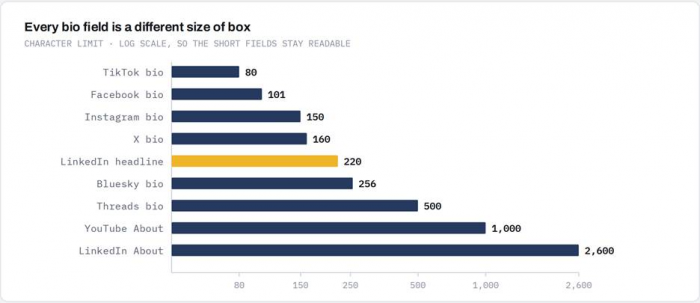
The most common bio problem I see isn't bad writing. It's good writing sized for the wrong container.

| Platform | Bio field | Limit | Visible before cutoff |
|---|---|---|---|
| TikTok | Bio | 80 | All of it |
| Profile bio | 101 | All of it | |
| Bio | 150 | ~125, then "more" | |
| X | Bio | 160 | All of it |
| Headline | 220 | ~60–70 in search & comments | |
| Bluesky | Description | 256 | Truncates on mobile |
| Threads | Bio | 500 | ~4 lines |
| YouTube | Channel "About" | 1,000 | ~150, then "more" |
| About section | 2,600 | ~200–300, then "see more" |
Limits verified July 2026 across platform documentation and character-limit references. Emoji usually consume 2+ characters because of UTF-16 encoding, so an emoji-heavy Instagram bio hits 150 faster than it looks.
Three things in that table are worth more than the rest of this section.
LinkedIn's headline is 220 characters, not 120. The cap changed in late 2024 and a large share of templates still circulating assume the old one. Write to 120 and you leave nearly half of the most valuable field on your profile empty.
What's allowed and what's visible are different numbers. LinkedIn gives you 220 characters but shows roughly the first 60 to 70 in search results, comment threads, and connection requests. Everything after that helps you get found and almost nobody reads it. Identity in the first 70, the rest earning its keep behind the fold.
What's searchable and what's read are also different. Instagram's own guidance says search matches a query against usernames, bios, captions, hashtags, and places, and recommends a handle and profile name that describe what you post. That Name field, the bold line above your bio and separate from your @handle, is the highest-leverage keyword slot on the profile. Most people spend it on their name and an emoji.
Five inputs, or the model will make something up
An AI cannot invent your numbers. If you don't give it one, it hands you an adjective instead, and adjectives are precisely what make bios interchangeable. "Results-driven" is what a model writes when nobody told it the result.
Open a notes app and fill in this table badly. Ten minutes, no editing.

| Input | The question it answers | Weak | Usable |
|---|---|---|---|
| Role + niche | What are you, specifically? | Marketer | Lifecycle email marketer for DTC skincare |
| Audience | Who is this for? | Businesses | Founders at $2–10M ARR |
| Outcome | What changes because of you? | Better results | Cut churn from 6.1% to 3.4% |
| Proof | Why should they believe it? | Experienced | Ex-Glossier · 40+ launches · CFA |
| Next step | What do you want them to do? | (nothing) | Open to fractional work |
This document is the real asset. The bio is downstream of it, and so is your next one, and your conference bio, and your email signature.
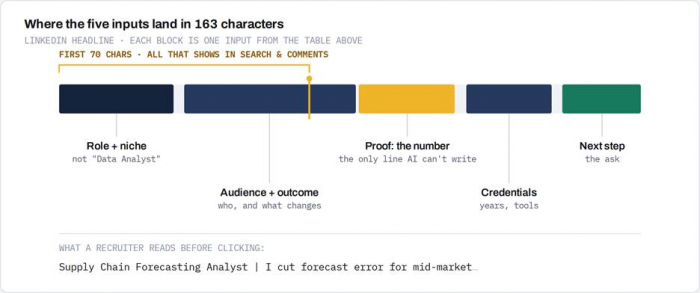
The fold lands mid-word, which is fine. It lands after the role and the verb, which is the part that matters. Segment widths are to scale.
The test Could your closest competitor paste your finished bio onto their own profile without changing a word? If yes, it isn't a bio. It's a category description, and you've written it for free on their behalf. |
A prompt that returns a menu, not an answer
Here's the one I actually use. Fill the brackets from the table above.
ROLE You are editing a professional profile, not writing marketing copy. FACTS (use only these; invent nothing) - Role + niche: […] - Audience: […] - Outcome, with the number: […] - Proof: […] - Next step I want: […] - Two words a colleague would use about me: […] TASK Write 10 options for a [LinkedIn headline], max [220] characters each. Front-load the role and the number into the first 70 characters. Vary the structure across the 10 — do not give me ten of the same shape. Number each one and print its exact character count. BANNED passionate, results-driven, seasoned, dynamic, leverage, unlock, elevate, delve, navigate, "turning X into Y", "helping X do Y", "it's not X, it's Y", em dashes, any emoji I did not ask for. THEN Tell me which single fact above is the weakest, and what you'd need from me to make these better. |
The last instruction is the one people skip. It routinely comes back with "your outcome has no number" and it's routinely right.
Three things that prompt does that a one-line request doesn't.
It asks for ten, not one. Ten options is a parts bin. One is a decision the model made for you. In practice you take the structure from #3, the verb from #7, and write the rest yourself.
It bans the vocabulary up front, which is far cheaper than editing it out afterwards.
It forces a self-critique. Models are decent at spotting a thin input when asked directly and will never mention it unprompted.
One honest warning: models cannot reliably count characters. They tokenise text rather than count it, so those numbers are estimates. Paste every finalist into a real counter.
This is where the value actually is
The distinctive vocabulary of machine writing is now measured, not vibes. Kobak and colleagues at Tübingen analysed 15.1 million PubMed abstracts from 2010 to 2024 and found 379 style words whose frequency jumped abruptly after ChatGPT's release. "Delves" appeared at 28 times its pre-2023 rate, "underscores" at 13.8, "showcasing" at 10.7. They estimated at least 13.5% of 2024 abstracts had passed through a model, up to 40% in some subcorpora, a shift larger than the one COVID caused.
Those are academic abstracts, not bios. The point transfers: models pull from the fat middle of the distribution, everyone's model pulls from the same middle, and readers have seen that middle several thousand times.
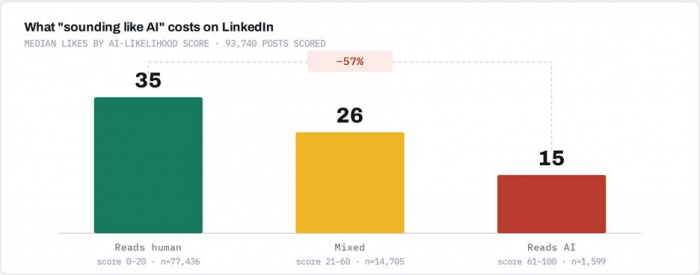
Fig. 3 — From MagicPost's June 2026 analysis of 1.2M LinkedIn posts. Correlation, not proof of algorithmic penalty; the authors suggest the mechanism is human readers, not the feed. Originality.ai independently found likely-AI posts drew 45% less engagement across 2,726 posts.
LinkedIn has since named its own targets. Lorenzetti's announcement singled out engagement bait, recycled thought leadership, and contrastive construction, the "it's not X, it's Y" tic. Consumers report the same instinct through a different door: in Klaviyo's 2026 trends report, the giveaways were replies arriving too fast (50%) and language that sounded too formal or robotic (49%). A 2026 Gartner survey found half of US consumers prefer brands that keep generative AI out of customer-facing copy.
| The tell | Why the model does it | The fix |
|---|---|---|
| "Passionate about…" | Filler where a fact should be. Costs nothing to claim. | Replace with the fact. What did the passion produce? |
| "Turning data into insights" | Highest-probability phrase for the input "data". | Name the input and the output. "Forecast error 31% → 12%". |
| "It's not X, it's Y" | Trained-in rhetorical default. Explicitly named by LinkedIn. | Say Y. Drop X entirely. |
| Three-item lists | Models love a tricolon. "Strategy, execution, growth." | Cut to the one you'd defend in an interview. |
| Em dash pile-up | Frequency far above human baseline since 2024. | Use a period. Bios don't need subclauses. |
| Perfect symmetry | Every clause the same length, same shape. | Break one. Make a fragment. Like that. |
| No proper nouns | Model has none, so it generalises. | Add one real name: tool, employer, city, client. |
None of these words are banned. Humans wrote every one of them first. The signal is density, not presence.
The same facts, five different jobs
Running one bio everywhere is the second-most common mistake. Each field answers a different question, so each needs a different prompt.
| Platform | The question it answers | Lead with | Cut |
|---|---|---|---|
| Should I reply to this person? | Role + the number, inside 70 chars | Personality. Save it for the About. | |
| Will I like what this account posts? | Keyword in the Name field, not the bio | Your job title. Nobody came for it. | |
| X | Is this person interesting or noise? | A stance, not a résumé | Pipes. They read as LinkedIn there. |
| TikTok | What am I going to get? | The niche, in four words | Everything else. You have 80 characters. |
| YouTube | Should I subscribe? | Format + cadence: "weekly teardowns of…" | "Welcome to my channel!" |
Add the target field and its limit to the prompt each time. A model given no limit defaults to a paragraph, every time.
Three before-and-afters
Same person, same facts, first draft versus shipped version. Counts are real.
A · Pediatric dentist · Instagram bio · 150
| Passionate pediatric dentist dedicated to creating healthy smiles and building lasting relationships with families in our community. Book today! | |
| could be any of 40,000 dentists | 144/150 |
| Kids' dentist in Tempe. Sedation-free fillings, laughing gas if you want it. We see nervous 3-year-olds every day. Sat mornings open. Book below | |
| three facts no competitor can copy | 144/150 |
B · Career-changer, teacher → PM · LinkedIn headline · 220
| Aspiring Product Manager | Passionate about leveraging technology to drive meaningful change | Former Educator | Open to new opportunities | |
| "aspiring" tells a recruiter to skip you | 138/220 |
| Product Manager, edtech | 8 yrs teaching 9th-grade math before this, so I've been the user | Shipped a grading tool 400 teachers use daily | Looking for my first PM seat | |
| the career change reframed as the qualification | 169/220 |
C · Newsletter writer · X bio · 160
| Writer | Thought Leader | Sharing insights on the future of work | Newsletter ↓ | |
| nobody has ever followed a thought leader | 79/160 |
| I read 200 job ads a week so you don't have to. Mostly what companies say vs. what they mean. Wrong loudly, corrected weekly. 14k readers. | |
| a voice, a stance, and a number | 138/160 |
Where AI genuinely beats you, and where it can't
The "just write it yourself" advice is lazy in the other direction. There are things a model does better than you will at 11pm on a Tuesday.

| The model is better at | You are better at |
|---|---|
| Producing 10 structures in 20 seconds so you have something to react to | The number. It has no access to your MAPE, your churn rate, your headcount. |
| Escaping the blank field, which is the real reason most bios stay bad | Knowing which fact is the interesting one. Models weight everything equally. |
| Translating internal jargon into words an outsider parses | The detail that's slightly too specific. Nine-year-olds. Sat mornings. 200 job ads. |
| Keyword coverage: surfacing the terms your niche actually searches | Knowing what you want next, which is the only thing a CTA can be built from. |
| Compression. "Cut 40 characters, keep the number" is a task it nails. | The judgment call on whether it sounds like you. It has never heard you talk. |
Rough split in practice: the model does about 40% of the work and 5% of the deciding.
The sixty-second check
– Read it out loud. If you'd never say it to someone at a bar, it fails. This catches more than any detector.
– Count it properly. In a real counter, not the model's estimate. Remember emoji eat two characters each, sometimes more.
– Find the proper noun. If there isn't a single real name, number, tool, or place in there, you have a template.
– Run the competitor test. Could a rival paste it in unchanged? Then rewrite.
– Check the first 70 characters alone. Cover the rest with your thumb. Does what's left still say who you are?
– Confirm there's a next step. Hiring, open to work, booking, subscribing. A bio with no ask is a plaque.
What we actually shipped
Back to the data analyst. This went live in March.
| Supply Chain Forecasting Analyst | I cut forecast error for mid-market distributors (last one: 31% to 12% MAPE) | 11 yrs, Python + Anaplan | Taking fractional work | |
| first 70 chars carry the role and the claim | 163/220 |
The AI wrote none of that. It wrote roughly forty versions around it, and two had a phrase worth stealing. That's a real contribution and I want to be fair about it: she'd stared at that empty field for two months, and the model got words into it. Blank-page paralysis is the real disease, and this is a good cure.
But the 31% and the 12% came from a spreadsheet on her laptop. "Taking fractional work" came from a conversation about what she wanted 2026 to look like. Dropping "Data Analyst" for "Supply Chain Forecasting Analyst" came from noticing 400,000 other people have the vague title. No model had access to any of that, because none of it was in the room until she put it there.
That's the whole division of labour, and it's not a grudging one. The model brings speed, volume, and a willingness to be wrong forty times without getting discouraged. You bring the two or three facts nobody else can claim. Skip your half and you'll still have a bio in ninety seconds. It'll just be the same one everybody else got.
If you only do one thing Go and find one number. Any number. A percentage, a headcount, a year, a client count. Put it in the first seventy characters of your LinkedIn headline and delete whichever adjective it displaces. |