

Table of Content
- What Is Snapchat Planet Order and Why It Exists
- Who Can See the Snapchat Solar System
- Complete Snapchat Planet Order and Meaning
- 1. Mercury- Closest planet
- 2. Venus
- 3. Earth
- 4. Mars
- 5. Jupiter
- 6. Saturn
- 7. Uranus
- 8. Neptune- Farthest planet
- What the Planet Order Actually Measures
- Best Friends List vs Solar System Ranking
- Comparison With Other Platforms
- Snapchat Planet Order FAQs
- Final Verdict: Useful Feature or Gamified Distraction?
The Snapchat Planet Order is one of the most misunderstood features on the platform. Some users treat it like a public ranking. Others assume it reflects emotional closeness or mutual loyalty. In reality, it is a private, interaction-based visualization tied directly to Snapchat+ and designed to gamify attention.
This article breaks down exactly what the Snapchat Solar System is, how it works, what each planet means, and why it creates both curiosity and anxiety among users. No hype, no guessing, no myths.
What Is Snapchat Planet Order and Why It Exists
The Snapchat Planet Order is part of the Friend Solar System feature, available only to Snapchat+ subscribers. It visually represents where you rank among another user’s Best Friends, based entirely on interaction data.
The concept borrows from a familiar metaphor:
● You are the Sun
● Your friends orbit you as planets
● The closer the planet, the more you interact with that person
Snapchat introduced this system to:
- Make engagement metrics feel playful instead of numerical
- Encourage frequent messaging and streak maintenance
- Add perceived value to Snapchat+
- Increase time spent comparing relationships
It is important to understand one thing upfront:
This system measures activity, not emotional importance.
Who Can See the Snapchat Solar System
- Only Snapchat+ subscribers can see planets
- The feature is private, not public
- You only see your position in someone else’s solar system
- You cannot see a full ranking list of their friends
If you do not have Snapchat+, you will not see planets at all.
Complete Snapchat Planet Order and Meaning
Snapchat uses the eight planets of the solar system. Each one corresponds to a relative position in another person’s Best Friends list.
Below is the exact order, closest to farthest.
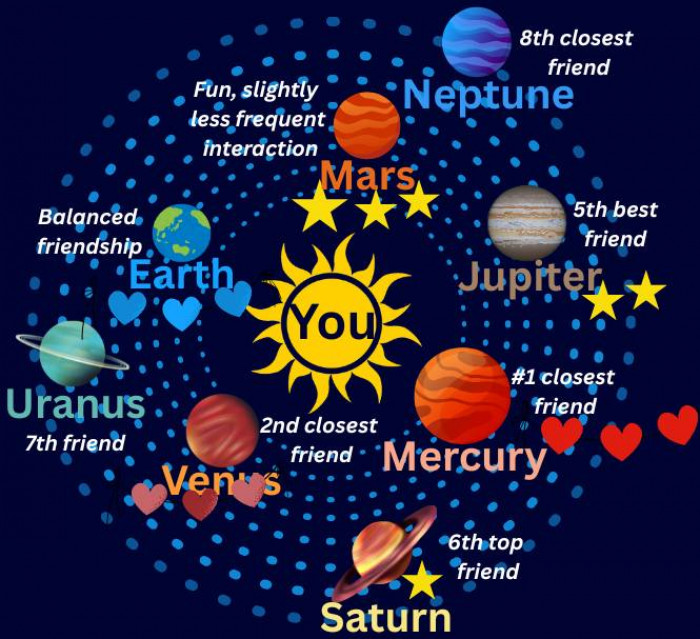
1. Mercury- Closest planet
Meaning
● You are their #1 Best Friend
● Highest level of interaction
● Most frequent snaps, chats, and engagement
What it represents
● Constant communication
● Daily snapping
● Strong streak consistency
Emoji indicators
● Red heart
● Planet Mercury with hearts
2. Venus
Meaning
● Second closest friend
● Very high interaction but not the top spot
What it represents
● Regular daily snaps
● Strong but slightly less frequent engagement than Mercury
Emoji indicators
● Pink or yellow hearts
● Venus planet symbol
3. Earth
Meaning
● Third position in Best Friends ranking
What it represents
● Consistent interaction
● Often part of group chats or shared streaks
● Stable but not dominant engagement
Emoji indicators
● Earth globe emoji
● Small hearts or stars
4. Mars
Meaning
● Fourth closest friend
What it represents
● Noticeable but uneven interaction
● Often messaging in bursts rather than daily
Emoji indicators
● Red planet
● Occasional hearts
5. Jupiter
Meaning
● Mid-level Best Friend ranking
What it represents
● Sporadic interaction
● You snap them, but not habitually
● Often replaced if engagement drops
Emoji indicators
● Large striped planet
● Few or no hearts
6. Saturn
Meaning
● Lower-tier Best Friend
What it represents
● Interaction exists but is inconsistent
● More passive communication
Emoji indicators
● Ringed planet
● Minimal decoration
7. Uranus
Meaning
● Near the edge of Best Friends
What it represents
● Occasional replies
● Limited snapping
● Often temporary ranking
Emoji indicators
● Pale blue planet
● No hearts
8. Neptune- Farthest planet
Meaning
● Lowest Best Friend ranking
What it represents
● Rare interaction
● At risk of disappearing from Best Friends entirely
Emoji indicators
● Dark blue planet
● Empty or minimal visuals
What the Planet Order Actually Measures
Snapchat has never published a formula, but repeated testing and user behavior patterns show the system prioritizes:
- Number of snaps sent and received
- Frequency of chats
- Consistency over time
- Recency of interaction
- Mutual engagement
It does not measure:
- Who you care about most
- Who you talk to longest
- Who you trust
- Who sees your private stories
This is a behavioral metric, not a relationship metric.
Best Friends List vs Solar System Ranking
Many users confuse these two features. They are related but not identical.
| Feature | Best Friends List | Solar System |
| Visibility | Private | Private |
| Who sees it | You | Snapchat+ users |
| Ranking shown | Names only | Planet position |
| Emotional context | None | Implied |
| Accuracy | Interaction-based | Same data, visualized |
The Solar System does not add new data. It repackages existing data in a more emotionally engaging format.
Comparison With Other Platforms
- No visible friendship ranking
- Algorithmic feed prioritization only
- Less personal comparison
- No engagement-based ranking
- No gamification
- Relationship context stays private
Snapchat
- Direct visualization of interaction
- Gamified hierarchy
- Emotional interpretation encouraged
Snapchat goes further than competitors in turning activity into perceived intimacy.
Here are 5 high-SEO FAQs tailored to your article. These are optimized for featured snippets and People Also Ask visibility.
Snapchat Planet Order FAQs
1. What does the Snapchat Planet Order actually mean?
The Snapchat Planet Order shows how frequently you interact with someone compared to their other Best Friends. It is based on snaps, chats, and overall engagement, not emotional closeness or real-life importance. The closer your planet is to the Sun, the more you interact with that person.
2. Can someone see my planet position on Snapchat?
No. The Friend Solar System is private. Only Snapchat+ subscribers can view their own position in someone else’s Best Friends ranking. Other users cannot see your full ranking list.
3. Why am I not Mercury on Snapchat?
You are not Mercury because another friend has higher interaction levels with that person. Snapchat prioritizes frequency, consistency, and recency of communication when assigning planet positions.
4. How often does the Snapchat Solar System update?
The Snapchat Planet Order updates dynamically based on recent activity. Changes in snapping frequency, chat behavior, and engagement patterns can shift your planet position over time.
5. Does Snapchat Planet Order reflect real friendship strength?
No. The system measures activity patterns only. It does not evaluate emotional closeness, trust level, call duration, or real-world relationship strength. It is purely an engagement-based visualization.
Final Verdict: Useful Feature or Gamified Distraction?
The Snapchat Planet Order is neither meaningless nor profound. It accurately visualizes interaction patterns, but it also amplifies emotional interpretation.
As a tool, it can:
- Offer insight into communication habits
- Reveal shifting attention patterns
As a social signal, it can:
- Create unnecessary anxiety
- Encourage performative interaction
- Confuse activity with importance
Used casually, it is harmless. Taken seriously, it becomes misleading.
In the end, Snapchat Planet Order is not about who matters most. It is about who snaps most. Whether that distinction stays clear is up to the user.