


Table of Content
- What the Platform Is Really Trying to Do
- First Contact With the Interface
- Device Experience
- ●Desktop
- ●Mobile
- How Access Turns Into Payment
- Pricing Structure Overview
- Listening to the Crowd Without Amplifying It
- Common Positive Themes
- Recurring Complaints
- Sentiment Breakdown
- What Ratings Reveal and What They Do Not
- Ratings Snapshot
- Moderation, Boundaries, and Shared Risk
- Pink Video Chat typically provides:
- Users play an active role in their own safety by:
- Conceptual Comparison Without Feature Arms Races
- Platform Positioning Comparison
- Who Tends to Find Value Here
- Users who often find value include:
- At the same time, the platform may feel frustrating for:
- A Grounded Closing Perspective
Random video chat platforms do not rise because people suddenly forget how to use social networks. They rise because modern digital spaces are increasingly predictable. Algorithms decide what you see. Feeds recycle familiar faces. Conversations arrive with expectations attached.
Platforms like Pink Video Chat exist in reaction to that predictability.
They sit inside a growing category of live, real-time video interaction services built around chance rather than curation. The appeal is not depth or long-term connection. It is immediacy. You open the site or app, and something happens right away.
This category attracts attention because it taps into two competing instincts at once:
● Curiosity about the unknown
● Desire for low-effort, low-commitment interaction
Pink Video Chat is not unique in that sense. What matters is how it positions itself within this ecosystem, how it structures access, and how users actually experience it once curiosity turns into use.
What the Platform Is Really Trying to Do
At a conceptual level, Pink Video Chat promises a simple exchange: live, one-to-one video conversations with people you do not already know.
There is no emphasis on building a public identity. No long bios to fill out. No social graph to manage. The platform reduces interaction to a moment shared between two users, often brief, sometimes extended, but rarely permanent.
Typical interaction flow looks something like this:
1. A user enters the platform with minimal setup
2. Camera and microphone permissions are requested
3. A random pairing is initiated
4. The conversation continues until one party leaves or time runs out
What matters is not who you meet but that you meet someone at all.
The platform’s purpose appears to be experiential rather than outcome-driven. There is no explicit promise of friendship, dating, or networking. Instead, it offers access to unscripted interaction and leaves interpretation to the user.
That ambiguity allows different users to project different intentions onto the same interface.
First Contact With the Interface
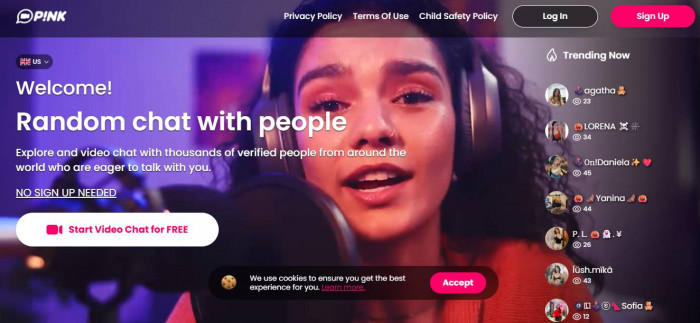
Random video platforms succeed or fail quickly. Most users decide within seconds whether to stay or leave.
Pink Video Chat’s interface reflects this reality.
The design prioritizes speed over customization. Visual elements are functional rather than decorative. Buttons are large, language is minimal, and the path from landing page to live interaction is short.
For first-time users, the experience can feel:
● Refreshingly direct, because there is little friction
● Slightly abrupt, because guidance is limited
There is no onboarding narrative explaining what kind of experience you should expect. You are placed into the core mechanic almost immediately.
From a usability perspective, this has advantages:
1. No learning curve
2. Minimal cognitive load
3. Faster time to interaction
But it also creates uncertainty. Users unfamiliar with random video chat platforms may feel disoriented at first.
Device Experience
● Desktop
a. Larger video frames
b. Clearer controls
c. Generally more stable performance
● Mobile
a. Convenient access
b. Heavily dependent on device quality and network strength
c. Interface may feel compressed on smaller screens
Accessibility features are limited, which is common in this category, but still worth noting for users who rely on assistive tools.
How Access Turns Into Payment
Like most platforms in this space, Pink Video Chat follows a freemium model.
Initial access is typically free. Users can enter, connect, and experience the core concept without paying upfront. This lowers psychological barriers and encourages experimentation.
Monetization appears after engagement begins.
Common mechanisms include:
1. Time-limited free sessions
2. Credit systems tied to continued interaction
3. Paid tiers that extend access or reduce interruptions
Pricing Structure Overview
| Plan / Credits | Cost Range | Access Level | Intended User Type |
| Free Entry | $0 | Short sessions, limited continuity | First-time or casual users |
| Small Credit Pack | Low one-time fee | Extended sessions | Curious repeat users |
| Larger Credit Bundles | Higher upfront cost | Longer or priority access | Frequent users |
| Subscription Option | Monthly fee | Ongoing access with fewer limits | Regular users |
The success of this model depends on transparency. Users tend to accept paid access when the boundaries are clear and frustration grows when limits feel unexpected.
In this category, pricing dissatisfaction is often less about cost and more about timing.
Listening to the Crowd Without Amplifying It
Public opinion around Pink Video Chat is fragmented. There is no single dominant review hub. Instead, sentiment appears across:
1. Online forums
2. Niche review blogs
3. Comment sections on unrelated articles
When these sources are viewed collectively, patterns emerge.
Common Positive Themes
Users who speak favorably often mention:
1. Fast connections with minimal setup
2. A sense of novelty compared to traditional social platforms
3. Low commitment and easy exit from conversations
These users tend to frame the platform as entertainment rather than a social solution.
Recurring Complaints
Criticism tends to cluster around:
1. Session limits ending sooner than expected
2. Inconsistent user behavior
3. Occasional technical issues
4. Unclear expectations about who will appear on screen
Importantly, many of these complaints are category-wide rather than platform-specific.

Sentiment Breakdown
| Sentiment | Share |
| Positive | 30–40% |
| Neutral / Mixed | 25–35% |
| Negative | 30–40% |
This distribution suggests polarized experiences rather than universal dissatisfaction or praise.
What Ratings Reveal and What They Do Not
Where numeric ratings are available, they tend to sit in the middle range.
Ratings Snapshot
| Platform Source | Average Rating | Sample Size |
| Review Blogs | ~3.4 / 5 | Small |
| App Aggregators | ~3.2 / 5 | Medium |
| Forums (Qualitative) | Mixed | N/A |
Higher scores are usually tied to ease of access and novelty. Lower scores often relate to unmet expectations rather than outright malfunction.
Ratings in this category should be read as indicators of fit, not quality alone.
Moderation, Boundaries, and Shared Risk
Random video chat platforms operate in a space where moderation is both essential and imperfect.
Pink Video Chat typically provides:
1. Reporting mechanisms
2. Community guidelines
3. Session termination controls
Automated moderation can catch some violations, but real-time enforcement across live video interactions is inherently difficult.
Users play an active role in their own safety by:
1. Ending uncomfortable interactions quickly
2. Avoiding personal information sharing
3. Using reporting tools when necessary
The platform’s responsibility is to provide safeguards. The user’s responsibility is to use judgment. Neither alone is sufficient.
This shared responsibility model is standard across the category.
Conceptual Comparison Without Feature Arms Races
Rather than listing features, it is more useful to look at how Pink Video Chat positions itself philosophically.
Platform Positioning Comparison
| Platform Type | Core Focus | Monetization Style | Typical Intent |
| Pink Video Chat | Spontaneous video encounters | Freemium, time-based | Casual interaction |
| Traditional Random Chat | Speed and volume | Ads or free | Entertainment |
| Dating-Oriented Video Apps | Matching and identity | Subscription-heavy | Romantic connection |
| Community Video Platforms | Groups and persistence | Mixed | Social belonging |
Pink Video Chat prioritizes immediacy over continuity. It does not attempt to convert brief encounters into long-term networks.
Who Tends to Find Value Here
Users who often find value include:
1. Those comfortable with unpredictability- Conversations are random and outcomes vary widely. Users who accept this uncertainty as part of the experience are less likely to feel disappointed.
2. People looking for short, unscripted interactions- The platform suits brief exchanges rather than long conversations. It works best when approached as a momentary interaction, not an ongoing connection.
3. Users who prefer minimal setup and fast entry- With little onboarding or profile building, the experience favors people who want to start quickly without investing time upfront.
4. Those who view the experience as temporary- Satisfaction is higher when users treat sessions as disposable rather than meaningful milestones.
At the same time, the platform may feel frustrating for:
1. Users seeking structured relationships- There are no systems designed to support continuity, matching preferences, or long-term interaction.
2. People expecting consistent conversation quality- Random pairing means conversation depth and tone can vary significantly from session to session.
3. Users uncomfortable with anonymity- The lack of identity context can feel unsettling for those who prefer knowing who they are interacting with.
4. Those wanting extended sessions without payment- Time limits and paid access can interrupt conversations, which may not suit users expecting uninterrupted use.
In practice, satisfaction depends less on the platform itself and more on whether users enter with expectations that match its purpose.
A Grounded Closing Perspective
Pink Video Chat represents a familiar digital impulse: the desire for connection without preparation, without history, and without long-term obligation.
It is not designed to replace social networks or messaging apps. It exists alongside them, offering a different rhythm. Faster. Riskier. Lighter.
For someone researching the platform, the most useful conclusion is not whether it is “good” or “bad,” but whether its design philosophy matches their expectations.
Pink Video Chat offers moments, not outcomes. Understanding that distinction is the difference between curiosity fulfilled and frustration created.