


Table of Content
- The “only girls” promise is not just branding — it’s the business model
- What you can do for free
- The Diamond Meter: The Key Number is 28
- Why this matters more than a simple subscription
- What we can’tfully compute from public pages
- The company and payment stack
- Public Traffic and Engagement Estimates
- A quick visual: Mirami vs a few direct web competitors
- Reviews and Ratings
- Google Play: high rating, meaningful review count
- AppBrain: same app, plus a star histogram snapshot
- Trustpilot
- What Users Tend To Complain About
- 1) “My credits disappeared fast” (meter shock)
- 2) “The quality isn’t worth the money” (value mismatch)
- 3) “Are these real people?” (authenticity suspicion)
- 4) “Refunds are hard / I can’t reverse virtual currency”
- 5) “Support is slow or unhelpful”
- What’s Stated vs What’s Observable
- Stated in Terms: moderation rights and age gating
- Stated in Privacy Policy: user-posted data becomes effectively public
- Reality check (not moralizing, just practical)
- A Competitor Section That’s Actually Sourced
- The closest web competitors
- Competitor comparison table
- Final note
If you strip away the marketing language, mirami.chat is a metered 1-to-1 random video chat service with a very specific promise: men are matched only with women (and vice-versa), and the platform earns money by charging per minute through a virtual currency (“diamonds”). Similarweb’s category labeling also places it in Adult for traffic analytics, which matters because it changes what “normal” engagement and churn looks like compared with mainstream social apps.
This article is a platform breakdown using publicly available numbers: traffic estimates, app-review distributions, and the site’s own legal documentation. It avoids telling anyone to use the service; the goal is to understand what it is, how it works economically, and what real users tend to complain about or praise.
The “only girls” promise is not just branding — it’s the business model
Most random chat sites struggle with the same problem: many users want to meet the opposite gender, but open matching produces a lot of same-gender pairings and rapid skipping. mirami.chat advertises it “solved” this by matching “guys only with girls.” Similarweb’s site description repeats the same positioning.
That’s not a minor detail. It implies at least one of the following must be true behind the scenes:
● There is a large, steady supply of women who want to be on camera with strangers, consistently.
● Or the platform uses incentives and/or professional participation (paid hosts, revenue share, affiliate funnels, etc.).
● Or the “girl supply” is partially synthetic (moderation bots, scripted openers, pre-recorded loops, etc.).
● Or the platform accepts high churn and uses the paywall to monetize short sessions.
You can’t prove which mixture is used purely from public pages. But you can see the economic design: the service gives a tiny free sample, then moves you into per-minute billing.
What you can do for free
In its Terms of Service, mirami.chat states that free video chat is available once a day and limited to 30 seconds. (mirami.chat )
That’s an unusually specific “trial” size. It’s long enough to:
● confirm your camera works,
● see a match appear,
● feel the social hook of a live connection,
…and short enough that you can’t really settle into a conversation without paying.
This is classic “meter preview” design: you’re not evaluating a full product; you’re evaluating whether the moment is compelling enough to fund.
The Diamond Meter: The Key Number is 28
The Terms of Service also reveal the core price mechanic:
● 28 diamonds per minute for video chat beyond the free limit
● 28 diamonds per minute for direct calls
So the platform’s true unit cost isn’t “a subscription” or “premium.” It's a per-minute burn.
Why this matters more than a simple subscription
A subscription tends to make users ask: “Is this worth $X per month?”
A per-minute meter makes users ask: “How fast did my credits disappear?”
What we can’t fully compute from public pages
mirami.chat’s public pages clearly define diamonds per minute, but the website does not present a simple, static public “$ → diamonds” conversion table in the parts accessible without going through the purchase flow. So we can’t reliably compute a universal $/minute rate from first-party pages alone.
What we can do is analyze:
● the per-minute consumption rate (known: 28 diamonds/minute),
● how competitors price per minute (often publicly visible via plans),
● and how users react to “metered chat” pricing in reviews.
The company and payment stack
The Terms of Service identify the producer as:
● Infoholders s.r.o., with an address in the Slovak Republic
Their Billing Support page lists payment processors and support contacts:
● Verotel (support email provided)
● SecurionPay (support email provided)
● and [email protected] for questions
This doesn’t “prove legitimacy” in a moral sense, but it is a concrete operational signal: the service is wired into recognized payment rails and provides at least some direct support contact points.
Public Traffic and Engagement Estimates
Traffic data for sites like this is always an estimate unless the company publishes numbers. But Similarweb provides comparative metrics that are useful for relative scale.
Similarweb lists mirami.chat with:
● Global Rank: #132,129
● Bounce rate: 33.44%
● Pages/visit: 3.97
● Avg visit duration: 00:01:03
Those numbers imply a pattern typical of roulette-style experiences: lots of people arriving, sampling quickly, and leaving — which fits a “30 seconds free, then meter” design.
A quick visual: Mirami vs a few direct web competitors
| Site (web) | Global Rank | Bounce Rate | Pages/Visit | Avg Duration |
| mirami.chat | #132,129 | 33.44% | 3.97 | 00:01:03 |
| luckycrush.live | #59,970 | 50.04% | 2.61 | 00:02:00 |
| callmechat.com | #36,705 | 27.56% | 13.21 | 00:03:34 |
| flirtify.com | #3,425 | 56.86% | 9.59 | 00:02:19 |
| pinkvideochat.com | #23,103 | (listed) | (listed) | (listed) |
Notes on interpretation:
● mirami.chat’s average visit duration (1:03) is short even by roulette standards, suggesting lots of brief tests and exits.
● Some competitors show very high pages/visits (e.g., callmechat.com at 13.21), which can indicate deeper browsing, repeated attempts, or heavier “in-site navigation” (sometimes pricing pages, profiles, upsell flows).
Reviews and Ratings
On Android, mirami.chat appears as “Random video chat – Mirami”.
Google Play: high rating, meaningful review count
The Google Play listing shows:
● 4.2/ 5 rating
● 4.84K reviews
That’s a substantial amount of feedback compared to the tiny sample sizes you’ll see on some review sites.
AppBrain: same app, plus a star histogram snapshot
AppBrain (a third-party tracker that summarizes Play Store data) reports:
● 4.2/ 5 average rating
● ~4,839 ratings
● star-count distribution shown as: 3.3K / 370 / 270 / 39 / 820
● A chunky 1★ tail (here, ~820) suggests a non-trivial group had a sharply negative
Trustpilot
Trustpilot is often what people cite in arguments—sometimes unfairly—because it ranks in Google results. For mirami.chat, it’s a very small dataset:
● 3.2 / 5
● 2 reviews
● 50% (1 review) are 3 star, 50% (1 review) is 1 star
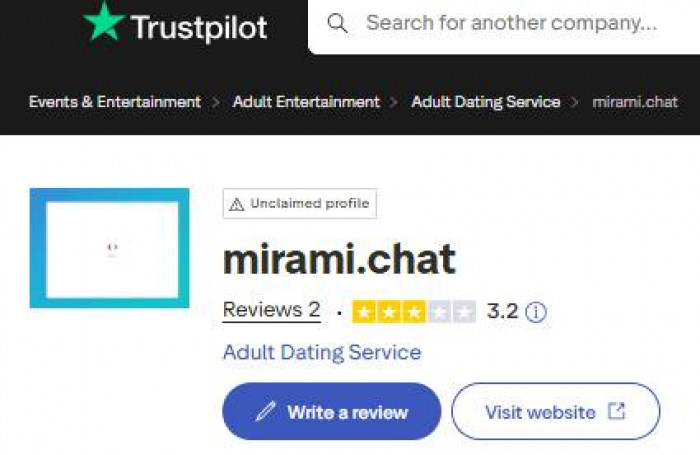
One visible review states (paraphrased tightly): support is very bad and quality is poor for the money.
You should treat Trustpilot here as qualitative, not statistical: it’s too small to generalize, but it’s still a data point that aligns with a common failure mode for per-minute platforms—users feeling the value doesn’t match the spend.
What Users Tend To Complain About
Because full text mining of thousands of reviews isn’t available from public pages alone in this environment, the most honest approach is:
1. rely on the large-N distribution (Google Play/AppBrain),
2. anchor complaints in verbatim review excerpts we can cite, and
3. connect those complaints to the known product mechanics (30-second free limit, 28 diamonds/minute, non-refundable virtual currency).
Here are the most “relatable” complaint buckets for this category, and why they specifically apply to mirami.chat’s design:
1) “My credits disappeared fast” (meter shock)
This is the signature complaint of pay-per-minute chat apps. Mirami’s terms explicitly define that video chat beyond the daily free limit costs 28 diamonds per minute.
Why it happens
● Users think they’re buying “access,” but they’re buying time.
● If the UI doesn’t show a loud countdown/meter, people feel “charged in the background,” even if it’s technically disclosed.
What to look for in-app
● Is there a persistent timer showing “diamonds/minute” and “diamonds remaining” during the call?
● Does the app warn you at thresholds (e.g., 60 seconds left)?
2) “The quality isn’t worth the money” (value mismatch)
Trustpilot’s visible review says the user didn’t get “much quality” for their money and criticized support. (Trustpilot)
Why it happens
On a roulette platform, you’re paying for attempts, not outcomes:
● not every match will talk,
● not every match will be your language,
● not every match will stay.
If the cost is per minute, the worst feeling is paying for silence, lag, or immediate disconnects.
3) “Are these real people?” (authenticity suspicion)
This is common in “guys matched only with girls” ecosystems because supply constraints are real. Similarweb’s description repeats that men get matched with women, which invites scrutiny: how is the supply maintained at scale?
Even when everyone is real, the incentive structure can produce behavior that feels scripted:
● people optimizing for tips/coins,
● repeated openers,
● short “hook then upsell” interactions.
This is where users often jump from “this feels repetitive” to “this is fake,” even without proof.
4) “Refunds are hard / I can’t reverse virtual currency”
The Terms state virtual currency purchases are non-refundable and can be lost if the account is deleted/terminated.
That policy is not unique in the app world, but in pay-per-minute services it becomes emotionally “hot” because:
● the spend can happen quickly,
● disputes feel time-sensitive,
● and people often regret purchases immediately after an unsatisfying call.
5) “Support is slow or unhelpful”
Again, the Trustpilot review explicitly calls support “very bad.”
From the platform side, billing support contacts exist (Verotel, SecurionPay, and mirami.chat email).
So this bucket isn’t “no support exists,” it’s “support didn’t resolve what I expected.”
What’s Stated vs What’s Observable
Stated in Terms: moderation rights and age gating
The Terms emphasize:
● 18+ restriction
● broad monitoring/removal rights for content and user behavior
Stated in Privacy Policy: user-posted data becomes effectively public
The Privacy Policy warns that personally identifying info users post can become public and may be disclosed by other users.
Reality check (not moralizing, just practical)
Random video chat creates two predictable risk zones:
● identity leakage (people overshare quickly)
● payment regret (metered calls + impulsive purchases)
The platform’s own documents acknowledge both in different ways: data cautioning and non-refundable currency policies.
A Competitor Section That’s Actually Sourced
The most direct competitors aren’t “all chat apps.” They’re the subset with the same core traits:
● 1-to-1 random video
● strong gender matching
● monetization via minute-based billing or heavy premium gating
The closest web competitors
Similarweb lists the top similar sites to mirami.chat including:
- luckycrush.live (most similar)
- callmechat.com
- flirtify.com
- pinkvideochat.com
- flirtbees.com (and others)
That’s useful because it’s based on audience/keyword overlap, not brand familiarity.
Competitor comparison table
| Platform | What it’s “selling” | Similarweb Global Rank (Dec 2025) | Engagement snapshot |
| mirami.chat | Gender-matched roulette + per-minute currency | #132,129 | 33.44% bounce, 3.97 pages/visit, 1:03 avg duration (Similarweb) |
| luckycrush.live | Similar “men↔women” roulette | #59,970 | 50.04% bounce, 2.61 pages/visit, 2:00 avg duration (Similarweb) |
| callmechat.com | Similar audience overlap; deeper navigation patterns | #36,705 | 27.56% bounce, 13.21 pages/visit, 3:34 avg duration (Similarweb) |
| flirtify.com | Large scale in the same traffic neighborhood | #3,425 | 56.86% bounce, 9.59 pages/visit, 2:19 avg duration (Similarweb) |
Final note
Taken as a whole, mirami.chat behaves exactly like a metered interaction platform should. The free access is brief, the cost of continued use is time-based, and user reactions split along predictable lines: some find quick value in short sessions, others feel the spend outweighs what they receive. Traffic patterns, review distributions, and competitor comparisons all point to the same conclusion — this is a service optimized for fast sampling and paid minutes, not prolonged engagement or relationship building. Understanding that structure explains most of the praise, frustration, and churn visible in the public data.