

Table of Content
- 1. Understanding Writer’s Block Before AI Entered the Picture
- 2. Why the Blank Page Was So Intimidating
- 3. What AI Writing Tools Actually Change
- 4. Does AI Actually End Writer’s Block?
- AI tends to work best when the block comes from:
- AI is far less effective when the block stems from:
- 5. How Different Writers Experience AI Writing
- For beginners
- For experienced writers
- For creative writers
- 6. Voice, Originality, and the Fear of Sameness
- 7. Is Using AI Writing Unethical?
- 8. AI Writing in Education
- 9. When AI Writing Simply Doesn’t Work
- 10. Final Answer: Is This the End of Writer’s Block?
Writer’s block has never really been about writing. It has always been about hesitation.
Long before AI tools entered the picture, writers across fields described the same experience: a blank page that felt heavier than it should, ideas circling without landing, and the strange pressure of knowing that whatever came first would set the tone for everything that followed. The struggle wasn’t a lack of vocabulary or intelligence. It was the difficulty of starting without certainty.
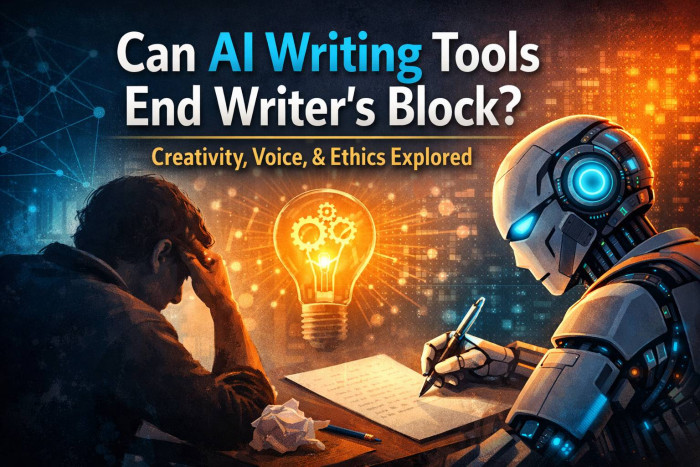
AI writing tools didn’t arrive promising to fix creativity. They arrived offering something much simpler: words where there were none before. And that single change has forced writers to rethink what writer’s block actually is—and whether it still holds the same power.
This article explores AI writing not as a magic solution or an existential threat, but as a structural shift in how writing begins, develops, and stalls.
1. Understanding Writer’s Block Before AI Entered the Picture
Writer’s block is often romanticized as a creative curse, but in practice it is more mechanical than mystical. It emerges when thinking and judging collide too early in the writing process.
Most writers know what they want to say at a high level. The difficulty lies in translating that vague intention into a concrete opening sentence without feeling exposed or wrong. The moment writing begins, it becomes visible—and visibility invites criticism, even if that criticism comes from the writer themselves.
Common forces behind writer’s block include:
● Fear of producing something mediocre
● Pressure to sound original or authoritative
● Overplanning before any drafting happens
● Mental fatigue from overconsumption of content
● Perfectionism disguised as preparation
Writer’s block is not a creative failure. It is a timing problem: evaluation arriving before expression.
2. Why the Blank Page Was So Intimidating
The blank page is not neutral. It is psychologically loud.
Before AI, the blank page offered no response, no guidance, and no reassurance. It asked the writer to generate something from nothing while simultaneously imagining how it would be judged. That combination made starting feel disproportionately difficult compared to revising or editing.
What made the blank page especially powerful was:
● Its silence, which amplified self-doubt
● The sense that the first sentence had to be “right”
● The absence of feedback or momentum
● The feeling that mistakes were permanent
For many writers, this environment didn’t encourage creativity—it triggered avoidance.
3. What AI Writing Tools Actually Change
AI writing tools do not remove the difficulty of writing itself. Writing is still an act of decision-making: choosing what matters, what to emphasize, and what to leave out. What AI removes is the initial void—the moment where nothing exists yet and every possible direction feels equally risky.
Instead of staring at silence, the writer is immediately presented with something tangible. It might be a rough paragraph, a loose outline, a list of angles, or even a poorly phrased draft. That “something” does not solve the writing problem, but it changes the emotional entry point. The writer is no longer creating from zero; they are responding, adjusting, and steering.
At a practical level, AI writing systems help by changing when and how thinking happens:
● They generate plausible language by recognizing patterns in existing text, giving writers a starting surface to work with.
● They respond instantly to prompts or instructions, removing the delay that often breaks momentum.
● They offer multiple variations of the same idea, allowing writers to compare, contrast, and choose rather than invent blindly.
● They introduce structure early—headings, flow, sequencing—so writers can focus on meaning instead of format.
Importantly, none of this replaces thinking. The thinking simply shifts later in the process. Instead of overthinking before a single word exists, writers evaluate, refine, and judge once material is already on the page. AI doesn’t make writing effortless—it makes it possible to begin without fear, which is often the real obstacle.
4. Does AI Actually End Writer’s Block?
AI does not eliminate writer’s block in a universal or permanent way. What it does is solve very specific kinds of blockage—mostly the mechanical and psychological barriers that prevent writing from starting at all. Other forms of writer’s block, especially those tied to meaning, identity, or emotion, remain largely untouched.
When writer’s block is caused by hesitation rather than confusion, AI is often extremely effective. Many writers struggle not because they lack ideas, but because turning those ideas into an initial form feels risky. AI lowers that risk by providing a draftable surface almost immediately.
AI tends to work best when the block comes from:
● Difficulty starting, where the writer knows roughly what they want to say but cannot form the first sentence.
● Structural uncertainty, such as not knowing how to organize an argument, article, or chapter.
● Sentence-level hesitation, where ideas exist but phrasing feels clumsy or stalled.
● Mental fatigue or overload, especially after long periods of writing or research.
● Fear of the empty page, where silence itself creates pressure.
In these situations, AI acts like a ramp. It doesn’t carry the writer forward on its own, but it makes the first step easier and less intimidating.
AI is far less effective when the block stems from:
● Emotional resistance, such as fear of exposing personal feelings or experiences.
● Lack of purpose or direction, where the writer does not yet know what they want to say or why it matters.
● Identity-driven writing, where voice, worldview, or personal stance is central to the work.
● Deep originality concerns, especially when the writer fears repeating ideas that already exist.
● Personal or experiential truth, where authenticity depends on lived experience rather than formulation.
In these cases, AI can generate text, but it cannot resolve the underlying conflict. It may even increase discomfort by producing content that feels technically sound but emotionally hollow.

5. How Different Writers Experience AI Writing
AI writing affects writers differently depending on experience, goals, and context.
For beginners
AI often feels empowering. It shows what a paragraph looks like, how ideas connect, and how structure works. It reduces fear and encourages experimentation.
But it can also:
● Delay skill development
● Encourage over-reliance
● Flatten early voice formation
For experienced writers
AI becomes a tool, not a crutch. Professionals often use it selectively—for outlines, reframing, or overcoming fatigue—while retaining editorial control.
For creative writers
Reactions are mixed. Some use AI for prompts or ideation. Others find it disrupts their internal rhythm or introduces unwanted sameness.
The tool is the same. The outcome is not.
6. Voice, Originality, and the Fear of Sameness
One of the most persistent concerns about AI writing is that it sounds the same. This perception isn’t accidental. AI systems are trained on massive amounts of existing text, which pushes them toward language that is statistically common, widely acceptable, and low-risk. As a result, AI tends to favor clarity over character and balance over sharpness.
Human writers still hold a clear advantage in areas where writing depends on perspective rather than polish. These include:
● Strong opinion, where conviction and bias are intentional rather than errors.
● Lived experience, which adds depth that cannot be inferred from patterns alone.
● Cultural nuance, especially when meaning depends on context, timing, or shared memory.
● Emotional specificity, where small, personal details carry weight.
● Risk and imperfection, which often make writing feel real instead of optimized.
AI can imitate how something sounds, but it cannot originate why it sounds that way. Style can be copied. Perspective has to be lived.
7. Is Using AI Writing Unethical?
Using AI to assist with drafting, brainstorming, or restructuring is not inherently deceptive. The ethical line is crossed only when AI-generated content is presented in a way that violates expectations or misleads the reader. In other words, the concern is not assistance, but misrepresentation.
Whether AI writing is ethical depends on several contextual factors:
● Transparency when required
In environments like education, journalism, or regulated professions, disclosure may be expected or mandatory. Failing to disclose AI involvement in these settings can undermine trust or violate policy.
● Purpose of the writing
Using AI to speed up routine communication or explore ideas is different from using it to falsely claim original authorship, expertise, or lived experience.
● Institutional rules
Schools, workplaces, and publications often set their own guidelines. Ethical use means respecting those boundaries rather than assuming universal acceptance.
● Audience trust
Readers form expectations about how content is created. Ethical writing respects those expectations instead of exploiting them.
AI itself does not carry intent. It does not choose to deceive or be honest. That responsibility lies entirely with the human using it. The tool is neutral—but how it is represented is not.
8. AI Writing in Education
Education is where tensions are sharpest.
On one hand, AI challenges traditional assessment. On the other, it opens new ways to teach thinking rather than typing.
Potential risks include:
● Skill atrophy
● Shortcut culture
● Assessment confusion
Potential benefits include:
● Stronger revision skills
● Support for non-native writers
● Focus on reasoning over mechanics
The challenge is adaptation, not prohibition.
9. When AI Writing Simply Doesn’t Work
Despite its strengths, there are clear situations where AI writing provides limited or even misleading value. These are not failures of technology so much as mismatches between what AI is designed to do and what certain kinds of writing require.
AI is least effective in forms of writing that depend on personal presence, lived reality, or original insight rather than linguistic structure. In these cases, AI can produce fluent sentences, but fluency alone is not enough.
This limitation becomes especially visible in areas such as:
● Deeply personal essays, where the power of the writing comes from individual memory, vulnerability, and subjective experience—elements AI cannot access or feel.
● Trauma-related writing, which requires emotional sensitivity, ethical care, and lived understanding. AI may sound composed, but it cannot grasp the weight or consequences of the subject.
● Original theory building, where new frameworks or ideas emerge from prolonged human reasoning rather than recombination of existing patterns.
● Cultural or historical authority, which depends on context, responsibility, and often personal or community credibility that cannot be synthesized from data alone.
● Writing grounded in lived experience, where authenticity is inseparable from having actually been there.
In all of these cases, AI may generate text that appears coherent or polished, but it lacks the grounding that gives writing its truth. What is missing is not language—it is ownership, responsibility, and human presence.
10. Final Answer: Is This the End of Writer’s Block?
No, but it is the end of the blank page as an absolute barrier.
AI writing doesn’t eliminate doubt, fear, or judgment. It reduces the cost of beginning. It turns silence into something workable.
Writer’s block was never about missing words.
It was about fear arriving too early.
AI doesn’t remove fear.
It helps writers step around it.
And for many, that is enough to finally start.