


Table of Content
- Two Different Philosophies Behind the Dashboard
- What Scheduling Actually Feels Like
- Analytics: Clean Insights vs Deep Control
- Feature Snapshot at a Glance
- Team Collaboration in Real Work Environments
- Engagement and Social Inbox Experience
- AI and Automation Capabilities
- Pricing and Value Perception
- What Real Users Often Say
- Scalability and Long-Term Growth
- When to Choose Buffer
- When to Choose Hootsuite
- Final Perspective
Choosing between Buffer and Hootsuite is less about which tool is bigger and more about how you actually manage social media day to day. Both platforms help schedule posts, track performance, and manage multiple accounts. But they approach the problem very differently.
Instead of breaking this down into a basic features list, let’s walk through how these tools behave in real situations and where each one fits best.
Two Different Philosophies Behind the Dashboard
Buffer was built around simplicity. It began as a straightforward post scheduler and gradually expanded into analytics, engagement tools, and light AI features. The interface is intentionally clean. When you log in, you immediately see your publishing queue and calendar. There is very little clutter.

Hootsuite, on the other hand, was designed as a social command center. It evolved into a more enterprise focused system that includes campaign tagging, team permissions, listening streams, custom reporting dashboards, and workflow automation. When you open Hootsuite, you are entering a control panel, not just a scheduler.

This difference in design philosophy affects everything from learning curve to scalability.
What Scheduling Actually Feels Like
With Buffer, scheduling feels linear and calm. You connect your social accounts, set preferred posting times, and then start filling the queue. The tool automatically distributes your posts based on your predefined schedule. The calendar view is visual and easy to adjust.
Buffer works best for people who batch create content weekly or monthly. If you are a creator planning Instagram posts or a small business managing LinkedIn updates, the workflow is quick and intuitive. You spend more time writing content and less time figuring out the tool.
Hootsuite scheduling is more structured. It allows bulk uploads, campaign tagging, approval chains, and AutoSchedule timing recommendations. Agencies and marketing departments often appreciate this because posts can move through internal review before publishing.
However, that structure comes with complexity. For beginners, it may feel overwhelming at first. For large teams, it feels necessary.
Analytics: Clean Insights vs Deep Control
Analytics is where the separation becomes more obvious.
Buffer focuses on clarity. Its reports highlight engagement rate, reach, impressions, audience growth, and link clicks in a visually simple format. You can quickly see what performed well and adjust your strategy. For small businesses, this is often enough.
Hootsuite goes further into customizable analytics. You can build reports across platforms, track ROI, monitor campaign performance, and export branded reports for clients or executives. It also includes social listening metrics and competitive insights on higher tier plans.
If you run a marketing agency presenting monthly reports to clients, Hootsuite’s reporting flexibility can be a strong advantage. If you just need to know which posts drive clicks and engagement, Buffer keeps things straightforward.
Feature Snapshot at a Glance
| Area | Buffer | Hootsuite |
| Core Strength | Ease of use | Enterprise scale management |
| Free Plan | Available with limits | No traditional free plan |
| Reporting Depth | Moderate | Advanced and customizable |
| Social Inbox | Unified inbox | Advanced inbox with assignments |
| Team Workflows | Basic approvals | Multi level approvals |
| Learning Curve | Low | Medium to high |
| Ideal Users | Creators, small businesses | Agencies, enterprises |
Team Collaboration in Real Work Environments
Buffer supports small team collaboration well. You can assign roles, approve posts, and manage a shared calendar. It works smoothly for startups or businesses with one marketing manager and a few contributors.
Hootsuite is built for structured teams. You can create approval hierarchies, assign tasks to team members, track productivity, and maintain brand compliance standards. Agencies managing multiple clients benefit from this structured environment.
If you are managing 3 to 5 accounts with a small internal team, Buffer is often enough. If you are overseeing 30 client profiles with layered approvals, Hootsuite becomes more suitable.
Engagement and Social Inbox Experience
Buffer offers a unified inbox where you can reply to comments and messages across connected platforms. The interface is simple and suitable for moderate engagement levels.
Hootsuite provides more advanced engagement features. You can assign messages to team members, monitor keywords, track brand mentions, and analyze sentiment. This becomes useful for larger brands that must respond quickly and manage reputation at scale.
For creators or small brands, Buffer’s inbox works comfortably. For companies that treat social media as a customer service channel, Hootsuite offers more control.
AI and Automation Capabilities
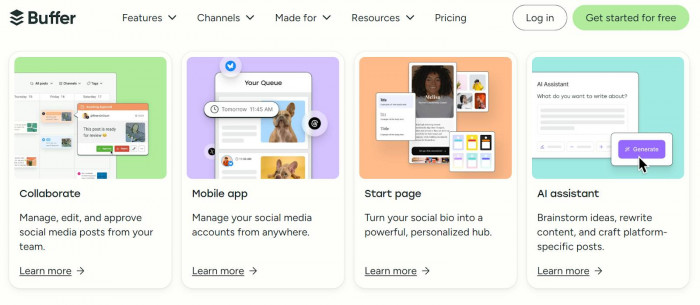
Buffer integrates AI primarily for content assistance. It can help generate captions, suggest improvements, and optimize copy tone. The automation features are designed to speed up content creation rather than deeply automate marketing systems.
Hootsuite integrates AI across content suggestions, analytics enhancements, and timing optimization. Combined with its automation workflows, it supports campaign tracking and team coordination more extensively.
Neither tool replaces advanced marketing automation platforms, but Hootsuite leans more toward operational automation while Buffer focuses on creative efficiency.
Pricing and Value Perception
Buffer typically offers:
1. A limited free plan
2. Affordable entry level paid tiers
3. Transparent pricing structure

This makes it attractive to freelancers and small teams who need predictable costs.
Hootsuite generally positions itself higher in the pricing spectrum. It does not emphasize a traditional free plan and instead targets professional users with more complex needs. Its cost reflects its enterprise features.

For small businesses, Buffer often delivers better value for money. For agencies billing clients and requiring advanced reporting, Hootsuite’s higher cost may be justified.
What Real Users Often Say
On review platforms like G2 and Capterra, Buffer is frequently praised for ease of use and clean interface. Users commonly highlight how quickly they can get started without training.
Hootsuite users often appreciate the breadth of features and reporting depth but sometimes mention the learning curve and pricing as challenges.
The pattern is consistent: simplicity vs power.
Scalability and Long-Term Growth
Buffer scales comfortably for:
1. Individual creators
2. Affiliate marketers
3. Bloggers
4. Small ecommerce stores
5. Early stage startups
However, as team size and account volume grow significantly, some organizations migrate to more complex systems.
Hootsuite is built to handle:
1. Large marketing departments
2. Agencies with dozens of clients
3. Enterprise reporting requirements
4. Structured approval chains
If you anticipate rapid growth with complex collaboration needs, Hootsuite may future proof your setup.
When to Choose Buffer
Choose Buffer if:
1. You are new to social media management tools
2. You want a fast setup with minimal training
3. You manage a small number of accounts
4. You prioritize ease of use over advanced reporting
5. Budget is a strong consideration
Buffer is especially strong for content creators, affiliate marketers, and small businesses that need reliability without operational complexity.
When to Choose Hootsuite

Choose Hootsuite if:
1. You manage multiple brands or clients
2. You need detailed customizable reports
3. Your team requires structured approval workflows
4. Social listening and monitoring are critical
5. You operate at agency or enterprise scale
Hootsuite becomes more valuable as organizational complexity increases.
Final Perspective
The real decision is not about which tool has more features. It is about how much operational structure you need.
Buffer simplifies social media management and removes friction. Hootsuite centralizes and controls it at scale.
If your goal is clarity and speed, Buffer is often enough.
If your goal is oversight, reporting depth, and multi team coordination, Hootsuite is built for that environment.
The better choice depends entirely on the size of your team, the complexity of your campaigns, and how much structure your workflow demands.