


Table of Content
- A Quick Comparison That Actually Matters
- When You Need Structure, Not Just Variations
- When Ads Are Just One Part of Content
- When Video Starts to Matter More Than Static Ads
- When Speed Becomes the Only Priority
- When Automation Goes Beyond Creative Generation
- When You Move Into Enterprise Territory
- Looking at Capabilities More Closely
- The Real Difference Between These Tools
- What This Says About AI Ad Tools Right Now
There is a point where AdCreative.ai starts to feel both impressive and slightly limiting at the same time.
On the surface, it does exactly what most marketers want. You input a product, some text, maybe a few assets, and it generates dozens of ad creatives. It even scores them, which gives the feeling that performance is being predicted rather than guessed.
For quick campaigns and testing variations, this works well. It reduces the time it takes to go from idea to execution. Agencies running multiple campaigns can produce volume without burning design resources.
But after using it for a while, a few gaps start to stand out.
The creatives often feel templated once you look at enough of them. The scoring system gives direction, but not always real strategic insight. And when it comes to video, storytelling, or deeper brand identity, it starts to feel shallow.
That is usually when you stop asking how many creatives it can generate and start asking how useful those creatives actually are.
This is where alternatives begin to make more sense, not as replacements, but as different approaches to the same problem.
A Quick Comparison That Actually Matters
| Tool | Creative Automation | Ad Testing Capability | Best For |
| AdCreative.ai | High | Moderate | Fast creative generation |
| Creatopy | High | Strong | Brand consistency + scaling |
| Predis.ai | Medium | Moderate | Social-first campaigns |
| Creatify | Medium | Low to Moderate | Video ad generation |
| QuickAds.ai | High | Moderate | Fast ad variations |
| Abyssale | Very High | Strong | Automated design workflows |
| Smartly.io | Very High | Very strong | Enterprise campaign scaling |
At a glance, AdCreative.ai sits in the middle. It is strong in volume, but not dominant in depth, automation, or enterprise scaling.
When You Need Structure, Not Just Variations
One of the biggest limitations of AdCreative.ai is that it generates creatives, but does not deeply manage them.
This is where Creatopy starts to feel different.
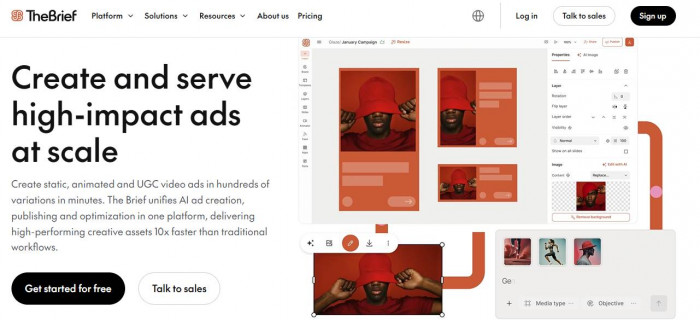
Creatopy is less about generating ads randomly and more about controlling how they are produced at scale. You can build templates, lock brand elements, and generate variations that actually stay consistent. (Creatopy)
Compared to AdCreative.ai, it feels more like a system than a generator.
Where it performs better
● Strong brand control across campaigns
● Better for managing large creative sets
● More structured workflow
Where it is weaker
● Slower to set up initially
● Less “instant” generation feel
Who should use it
● Agencies and brands managing multiple campaigns
When Ads Are Just One Part of Content
AdCreative.ai focuses narrowly on ads. That is its strength, but also its limitation.
Predis.ai expands the idea.
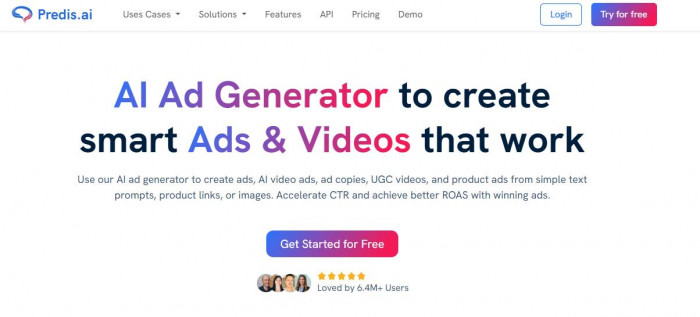
It does not just generate ads. It generates social content, captions, creatives, and even scheduling ideas. This makes it more useful for marketers who think in terms of content ecosystems rather than isolated ads. (Predis.ai)
Compared to AdCreative.ai, it feels less specialized but more flexible.
Where it performs better
● Social media integration
● Content plus ad generation in one workflow
● Better for ongoing content strategies
Where it is weaker
● Ad optimization is not as focused
● Less precision in performance scoring
Who should use it
● Social media marketers and small brands
When Video Starts to Matter More Than Static Ads
This is where AdCreative.ai feels noticeably behind.
Creatify approaches the problem from a different angle. Instead of focusing on static ad variations, it leans into video generation. (Creatify)
You can turn product descriptions into short video ads quickly. This becomes valuable in platforms where motion content performs better than static images. Compared to AdCreative.ai, it sacrifices volume for format diversity.
Where it performs better
● Fast video ad creation
● Better suited for modern ad platforms
● More engaging outputs
Where it is weaker
● Limited control over creative depth
● Not ideal for static ad testing
Who should use it
● Ecommerce brands and performance marketers using video
When Speed Becomes the Only Priority
QuickAds.ai feels like an evolution of what AdCreative.ai tries to do.
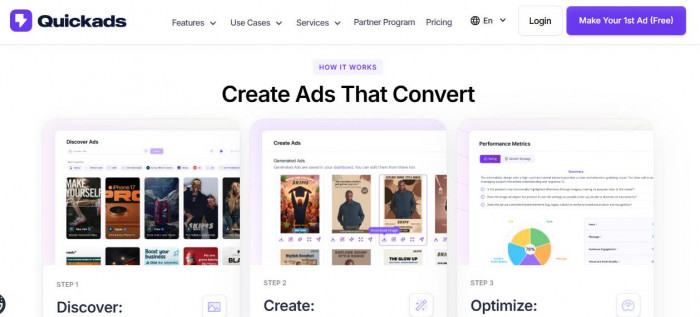
It focuses heavily on generating variations quickly and efficiently, especially for ad testing scenarios. The interface and workflow are built around speed and iteration. (QuickAds.ai)
Compared to AdCreative.ai, it feels slightly more optimized for rapid testing cycles.
Where it performs better
● Faster creative generation
● Better suited for A/B testing workflows
● Lightweight and efficient
Where it is weaker
● Less creative depth
● Limited advanced customization
Who should use it
● Performance marketers running frequent tests
When Automation Goes Beyond Creative Generation
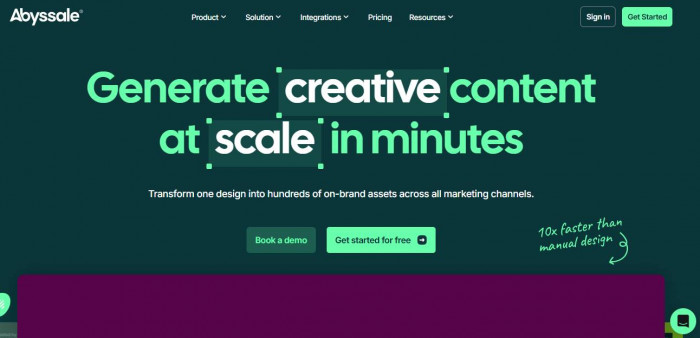
Abyssale is where the conversation shifts from generating ads to automating the entire design process. (Abyssale)
Instead of manually creating or generating creatives each time, you define rules, templates, and variables. The system then produces creatives automatically at scale.
Compared to AdCreative.ai, this is a completely different level of control.
Where it performs better
● Full design automation
● Scalable workflows for large campaigns
● Consistent output across variations
Where it is weaker
● Requires setup and planning
● Less immediate results for beginners
Who should use it
● Agencies and teams handling large-scale campaigns
When You Move Into Enterprise Territory
At a certain point, tools like AdCreative.ai stop being enough.
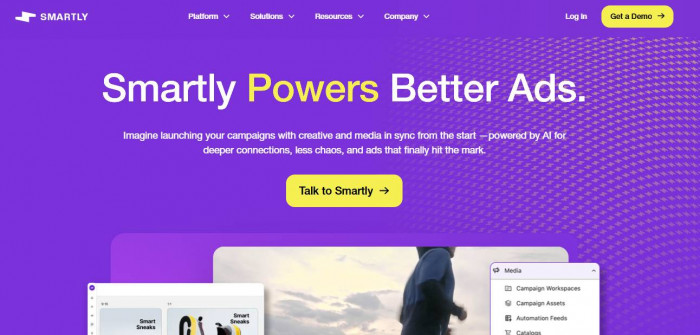
Smartly.io operates in a different category. It combines creative production with media buying, optimization, and analytics. (Smartly.io)
This is not just about generating ads. It is about running entire campaigns.
Compared to AdCreative.ai, it is far more complex, but also far more powerful.
Where it performs better
● Deep integration with ad platforms
● Advanced optimization and scaling
● Real performance-driven workflows
Where it is weaker
● Expensive
● Not suitable for small teams
Who should use it
● Large brands and enterprise marketers
Looking at Capabilities More Closely
| Platform | Static Ads | Video Ads | Scaling Ability | Ease of Use |
| AdCreative.ai | Strong | Limited | Moderate | Very easy |
| Creatopy | Strong | Moderate | High | Medium |
| Predis.ai | Moderate | Moderate | Medium | Easy |
| Creatify | Moderate | Strong | Medium | Easy |
| QuickAds.ai | Strong | Limited | Medium | Very easy |
| Abyssale | Strong | Moderate | Very high | Medium |
| Smartly.io | Strong | Strong | Extremely high | Complex |
This table reveals something important.
AdCreative.ai is optimized for ease and speed. But as soon as you need scaling, automation, or advanced formats, other tools start to take the lead.
The Real Difference Between These Tools
| Tool | Core Focus | What It Actually Optimizes For | How It Differs in Real Use | Best Fit |
| AdCreative.ai | Volume generation | High number of ad variations | Quickly produces multiple creatives but lacks deeper creative control | Fast testing and quick campaigns |
| QuickAds.ai | Speed + volume | Rapid iteration for A/B testing | More optimized for fast testing cycles than creative depth | Performance marketers running frequent tests |
| Creatopy | Structure and control | Brand consistency at scale | Focuses on managing creatives rather than just generating them | Agencies handling multiple campaigns |
| Abyssale | Automation systems | Scalable design workflows | Automates entire creative production instead of manual generation | Teams needing large-scale automation |
| Predis.ai | Flexibility | Content + ad workflow integration | Extends beyond ads into social content and publishing | Social-first brands and creators |
| Creatify | Format evolution | Video-first ad creation | Prioritizes motion content over static variations | Ecommerce brands using video ads |
| Smartly.io | Full campaign control | End-to-end ad performance and scaling | Combines creative, media buying, and optimization in one system | Enterprise-level advertisers |
What This Says About AI Ad Tools Right Now
AI ad generation is still in a transitional phase.
Most tools are very good at producing variations, but not necessarily at producing truly effective creatives. They can generate designs, but they do not fully understand audience psychology, brand nuance, or storytelling.
The scoring systems, including the one in AdCreative.ai, are useful, but they are still approximations.
What we are seeing right now is automation improving faster than creativity.
That gap is where the next wave of tools will likely focus.
Instead of asking how many ads can be generated, the better question will be how intelligently those ads are created.
Until then, choosing the right tool is less about finding the best one and more about understanding what kind of marketing you are actually trying to do.