


Table of Content
A few years ago, an online fashion brand could get by with one photoshoot, a product page, a few Instagram posts, and a sale announcement when inventory moved slowly.
That version of fashion marketing feels almost quaint now.
A single product launch may need a TikTok teaser, Instagram Reels, Pinterest pins, paid ad variations, product photos, try-on visuals, email images, creator briefs, captions, hashtags, and a dozen cropped versions of the same idea. The product has not changed. The amount of content around it has exploded.
This is where many fashion brands quietly get stuck. Not because they lack taste, but because the content pipeline is too heavy. A small team cannot shoot every colorway, write every caption from scratch, test every angle, and still run the business.
So the question in 2026 is not “Should fashion brands use AI?” Most already are, somewhere. We have a better question here: what belongs in the content stack, and what still needs a human eye?
Start with the product truth
Every strong fashion content system starts before the tools. It starts with knowing what must stay accurate.
For fashion, that usually means:
- The garment shape
- The color
- The fabric texture
- The fit
- The styling context
- The brand mood
- The promise being made to the shopper
AI can help create variations, but it should not invent a product that does not exist. If a dress is structured and matte, the content should not turn it into something silky and loose. If a jacket is cropped, the visual should not quietly lengthen it because the model pose looks better that way.
This is the first rule of the stack: use AI to multiply content, not to blur the product.
The visual layer: more than product photos
Fashion is still a visual sale. A caption can explain the garment, but the image does the first round of persuasion.
In the old workflow, brands often had three options: flat lay, model shoot, or user-generated content. Each had tradeoffs. Flat lays were fast but limited. Model shoots looked better but cost more. UGC felt authentic but arrived unpredictably.
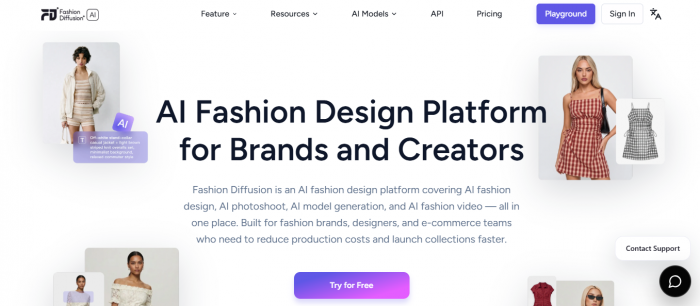
In 2026, AI sits between those options. Brands can now generate try-on images, swap backgrounds, test campaign moods, or create model-style visuals from existing product assets. Tools like Fashion Diffusion AI are useful in this part of the stack because they are built around fashion-specific tasks such as virtual try-ons, AI model generation, sketch-to-render, and fabric restyling.
The practical value is not that every image becomes perfect. It is that teams can test more ideas before spending production money.
- A brand might create:
- A clean product image for the store
- A try-on visual for Instagram
- A street-style version for TikTok
- A neutral background version for paid ads
- A color variation for internal testing
- A flat lay for Pinterest
The short-form video layer
Short-form video is where fashion brands win attention, but it is also where content calendars become exhausting.
A good video stack does not need to be complicated. For most online fashion brands, five repeatable formats are enough:
- New arrival reveal
- “Three ways to style it”
- Before-and-after outfit transition
- Fit or fabric close-up
- Customer question answered visually
AI can help around the edges: turning still images into motion, generating first-draft scripts, cutting hooks shorter, or testing different openings. But the best-performing fashion videos still usually have a human idea at the center.
The mistake is asking AI to “make a viral fashion video.” That prompt produces generic movement and generic copy. A better workflow starts with a real product angle:
“This linen set creases less than expected.”
“This coat looks formal but packs like a travel jacket.”
“This dress solves the wedding guest outfit problem.” Once the angle is clear, AI can help package it.
The caption layer
Captions are no longer just decoration under an image. They help search, explain the product, and give the algorithm more context.
But fashion captions often fall into two bad habits. They either say almost nothing: “Weekend mood.” Or they say too much in a brand voice nobody would use out loud.
A useful caption stack has three versions ready for each product:
- A search-friendly version
- A storytelling version
- A direct selling version
For example, a search-friendly caption might mention “black linen midi dress” in the first line because that is what someone may actually search. A storytelling caption might explain the design decision behind the silhouette. A selling caption might focus on sizing, styling, or when to wear it.
AI can draft these quickly, but a person should cut anything that sounds like filler. Phrases like “elevate your wardrobe,” “effortless elegance,” and “must-have piece” are everywhere because they are easy. They rarely make a shopper understand the product better.
The hashtag and keyword layer
Hashtags are no longer the growth engine they once were. For fashion brands, that is probably good news. It means the job is simpler.
Use hashtags as labels, not magic. A small set of specific tags usually beats a giant block of vague ones.
A simple fashion hashtag structure might look like this:
- One category tag: #womenswear
- One product tag: #linendress
- One style tag: #minimalstyle
- One audience or occasion tag: #summerworkwear
- One branded tag: #[brandname]
The bigger opportunity is often in keywords outside the hashtags: the first line of the caption, alt text where available, product names, Pinterest descriptions, and on-screen text in video.
If the post is about a cropped wool jacket, say that somewhere visible. Do not make the algorithm guess from a mood board.
The profile layer
A fashion brand’s social profile is part of the content stack too. It is the sign above the door.
Many brands use their bio to sound stylish, but not to explain what they sell. That is a missed chance. A good bio should quickly answer:
- What do you sell?
- Who is it for?
- What makes it different?
- Where should the visitor go next?
For a fashion brand, that might be as simple as:
“Tailored everyday pieces for women who travel light. Designed in small batches. New collection live now.”
That is not poetic, but it works. A shopper knows what they are looking at.
The testing layer
The brands that get the most from AI are usually not the ones generating the most content. They are the ones learning fastest.
AI makes it easier to create variations, but those variations need a test plan. Otherwise the team just produces more noise.
Useful things to test:
- Model image vs. flat lay
- Studio background vs. lifestyle background
- Product close-up vs. full outfit
- Benefit-led caption vs. styling-led caption
- Founder voice vs. brand voice
- Short hook vs. direct product name
The test does not need to be scientific enough for a lab. It just needs to be honest enough to stop guessing. Look at saves, shares, profile visits, clicks, comments, and conversion quality. Likes are nice, but they do not tell the whole story.
The human review layer
This is the part too many brands skip.
Before AI-assisted content goes live, someone should check it like an editor, not like a fan of the tool.
Ask:
- Does the product still look accurate?
- Is the color close enough to the real item?
- Would this create the wrong expectation about fit?
- Is the caption making a claim we can prove?
- Does the image match the brand’s taste?
- Does the post sound like us?
- Would a customer feel misled after receiving the item?
That last question matters most. Fashion returns are often caused by expectation gaps. AI should narrow that gap, not widen it.
The stack should make the team calmer
A good content stack does not just create more output. It removes panic.
When the system works, a new product does not start from zero. The team already knows the steps:
- Confirm the product truth.
- Create core product visuals.
- Generate social variations.
- Draft captions for different platforms.
- Add search-friendly keywords.
- Build short-form video angles.
- Publish in batches.
- Measure what moved.
- Feed the learning into the next launch.
That is the real advantage. Not replacing the creative team, but giving them a repeatable way to move from product to content without rebuilding the workflow every week.
The bottom line
Online fashion brands are not short on platforms. They are short on time, clarity, and usable creative assets.
AI helps most when it supports the boring but expensive parts of the job: producing visual variations, adapting content for different channels, drafting first-pass copy, and testing more angles without waiting for another shoot.
But the stack still needs taste. It still needs product accuracy. It still needs someone who knows when an image looks almost right but not true.
That balance is where fashion content is heading in 2026. More AI in the workflow, more human judgment at the final gate, and a much faster path from a product idea to a social post that actually helps someone decide what to wear.