


Table of Content
52% engage less with content they believe was made by a machine SmythOS, 2026 | 78% would rather see ads made by people, even if AI could do it better Canva, 2026 | 73% trust a brand more when it reflects culture authentically Edelman, 2025 |
There's a specific kind of caption that makes thumbs move faster. You know it on sight: “We are pleased to announce our latest offering, designed to elevate your everyday experience.” Nobody talks like that. Nobody wants to read it. And in 2026, your audience can feel it coming from the very first line.
The pressure to post constantly, across more platforms than ever, has nudged brands toward fast, safe, forgettable copy. AI makes that easier still: according to Hootsuite, 2025 was the first year AI-generated articles overtook human-written content online. The tools are genuinely useful. But somewhere in the rush to fill the calendar, a lot of brand writing started to sound like it came from the same beige template.
Here's the encouraging part: sounding human isn't a gift you're born with. It's a set of habits you can copy. This guide breaks down what actually makes a caption feel robotic, what the research says people respond to instead, and a step-by-step playbook you can run on every post, AI-assisted or not.
“Robotic” rarely means badly written
Most of these captions are grammatically flawless. That's part of the problem: they're too clean, too neutral, too obviously engineered to avoid any risk. They announce instead of talk. They describe a product instead of saying something a real person would actually say out loud. And the cost shows up not as criticism, but as silence.
Audiences now actively penalise copy that feels machine-made. Around 52% of consumers say they engage less with content they believe is AI-generated (SmythOS, 2026), and a 2026 Canva report found that 78% would rather see ads made by people, even if AI could technically produce something slicker. Roughly seven in ten say AI-made ads feel like “something's missing.”
It isn't really anti-AI sentiment; it's anti-hollow. A 2026 Gartner survey found 50% of US consumers would prefer to buy from brands that don't use generative AI in their customer-facing content at all. Meanwhile, mentions of “AI slop” in media-monitoring data have jumped ninefold, and 41% of marketing leaders now name low-quality AI output as a genuine challenge (Canva, 2026).
The flip side is the opportunity. In the 2025 Sprout Social Index, consumers ranked authenticity and relatability among the three most important traits in brand content. And being recognisable pays: research widely cited across the industry links consistent brand expression to revenue lifts of up to 33%.
Now layer on how brutal reach already is. By some industry analyses, Instagram's median engagement rate fell from roughly 2.94% in early 2024 to about 0.61% a year later. When attention is that scarce, a caption that reads like a press release isn't neutral. It's a wasted impression. Robotic copy doesn't earn angry replies. It just gets scrolled past. That's the expensive part: you never see the cost, you only see flat numbers.
What people actually respond to
The fix isn't “be more casual” or “sprinkle in some slang.” It's to sound like a person your audience would genuinely want to hear from. Three findings reframe the whole task:
People trust people, not logos. When Sprout asked who audiences most want to see in brand content, the winners were front-line employees (48%), social teams (42%) and real customers (42%). Executives came last, at 15%. The lesson for captions is simple: write from a human vantage point, not a corporate one.
Authentic is not the opposite of on-brand. This trips up teams who assume “authentic” means messy or improvised. As Slate's 2026 trends analysis puts it, authenticity means consistent values, a clear voice and relatable stories, even when the production (or the prose) is simple. You can sound human and unmistakably you.
“Professional” was never meant to be lifeless. Even on LinkedIn, the captions that travel are first-person, specific and honest, not stiff. Stiffness is a choice, and it's usually the wrong one.
The throughline: robotic isn't really a tone problem, it's an empathy problem. Robotic copy is written for the brand: look what we did. Human copy is written for the reader: here's why this matters to you. Point that in the right direction and most of the robot drains out on its own.

Seven habits that keep captions human
None of these require talent, just attention. Run them on every post.
1. Write to one person, not “an audience”
Swap “our customers” for “you,” and picture one real follower as you write, as if you're texting them. Second person is the single fastest way to warm up cold copy.
Before: Our customers love how versatile this is.
After: You'll reach for this on the days you have no idea what to wear.
2. Earn the first line
On every platform, the opening one or two lines decide whether anyone reads the rest. Don't spend them on a label (“New blog post!”) or a windup (“In today's fast-paced world…”). Open with the most surprising, specific or slightly uncomfortable thing you've got: a confession, a sharp claim, a real number, a question with a real answer.
3. Say something only you could say
Generic is the real tell of a robot: copy so safe it could belong to any competitor. Specificity is the cure. Name the exact thing; reference the real moment. The strongest brands lean hard into a point of view: Liquid Death's deadpan, heavy-metal irreverence and Calm's grounded, gentle steadiness are recognisable in a single line precisely because they refuse to be neutral. Find your version of that, and commit.
4. Vary your rhythm, and let it breathe
Machine copy has a metronome quality: every sentence the same medium length, every post the same shape. People don't write like that. Set a punchy three-word sentence against a longer, winding one. Start with “And.” Use a fragment. Read your draft and listen for the monotone. In the AI era this matters more than ever: audiences now read the occasional rough edge as a signal of a real human, so don't sand every sentence into the same smooth pebble.
5. Run the say-it-out-loud test
This one's almost cheating. Read the caption aloud. If you'd never say it to an actual person (“We are excited to leverage synergies across our product suite”), it's robotic, full stop. If it sounds like something you'd say at a dinner table, you're there. Your mouth is a better editor than any tone slider.
6. Treat emojis as seasoning, not the meal
The data is on emojis' side: posts that use them see real lifts: widely cited studies put it around +48% engagement on Instagram and +57% on Facebook, and about 51% of consumers say they're more likely to engage with a post that includes one. But the same research flags a ceiling: 59% of people aged 18 to 34 think brands use too many, and studies find emojis can raise perceived warmth while lowering perceived competence. The move is restraint: one or two that add feeling or rhythm, never a confetti cannon standing in for an actual idea.
7. End with a real invitation
“Comment below” is wallpaper; people have learned to scroll past it. Ask something you actually want the answer to, and make it easy and specific: “Which one could you never give up?” beats “Let us know your thoughts!” This isn't just nice. It's mechanical. Captions that invite a genuine reply pull comments, and comments are what platforms reward, especially as conversation shifts into replies and DMs (Instagram's direct messages have grown more than 20% in recent years, even as feed engagement fell).
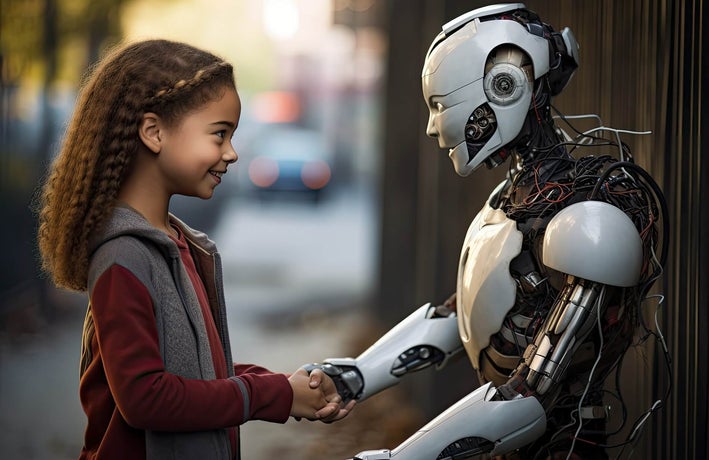
How to use AI without sounding like AI
Let's address the obvious tension. Nearly every brand uses AI now: 97% of marketing leaders report using it in their daily creative work (Canva, 2026). And this guide just spent a whole section on sounding human. Those two things aren't in conflict. The problem was never the tool; it's shipping the first draft the tool hands you.
Use AI the way you'd use a sharp intern: brilliant at speed, angles and rough drafts, but never the final signature on anything carrying your name.
Generate, then translate. Let AI produce three or four directions, then rewrite the best one in your real voice: your phrasing, your humour, your specifics. The draft is the clay, not the sculpture.
Edit reality instead of inventing it. Where you can, build the caption around something that genuinely happened: a customer's exact words, a real behind-the-scenes moment. AI is great at polishing a true story and far worse at faking one convincingly.
Keep a human in the loop. One real person should read every caption before it ships, asking the only question that matters: does this sound like us, or does this sound like everyone?
The brands winning in 2026 aren't the ones avoiding AI, nor the ones drowning in it. They're the ones using it for leverage, and spending the time they save on the human layer machines still can't fake.
The whole playbook, in three rewrites
Same message each time. Two very different results.
ROBOTIC We are pleased to introduce our new spring collection, featuring a range of versatile styles for the modern wardrobe. |
HUMAN Three months of swatches. Two arguments about a single shade of green. And it's finally here: the spring drop is live, and yes, the green won. |
What changed: a real backstory, a specific detail (the green), and rhythm that rises and falls like a person telling a story.
ROBOTIC Don't miss our limited-time offer. Shop now and save big on selected items! |
HUMAN We're not going to pretend this lasts forever. It's three days. You've been eyeing those boots since March. You know what to do. |
What changed: it drops the salesy clichés, speaks to one person, and trusts the reader instead of shouting at them.
ROBOTIC Our team is dedicated to providing exceptional customer service at every touchpoint. |
HUMAN Maria in support stayed online until 11pm last night to help one customer fix an order. Nobody asked her to. That's just kind of how she is. |
What changed: an abstract promise becomes a true, specific story about a real person: exactly the voice audiences trust most.
The voice check
Run every caption through five fast questions. Fail two or more, and rewrite the opening before you publish.
✓ Would I actually say this out loud to a real person? ✓ Does the first line earn the second? ✓ Could a competitor have posted this word-for-word? (If yes, it's too generic.) ✓ Is there one specific, true detail in here? ✓ Am I asking for engagement I'd genuinely want to receive? |
Write the caption you'd actually want to read
Sounding human at scale isn't about one clever turn of phrase on your best day. It's about a repeatable voice: one you've defined clearly enough that anyone on your team, or any AI you hand a draft to, can write inside it. So document how your brand talks: the words you use, the ones you'd never use, how you'd open a caption and how you'd close it. Then protect that voice on every single post.
The bar in 2026 is strangely low and strangely high at once. Low, because most brands still sound like a settings menu read aloud. High, because audiences now notice the difference instantly, and reward the brands that bothered. Write like a person who actually cares about the one reading. That's the whole secret. And it's the one thing the robots still can't do for you.